Tort Law
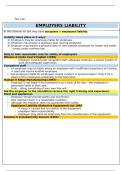
EMPLOYERS LIABILITY
In the scenario for tort they have occupiers + employers liability.
Liability takes place in 3 ways:
1) Employers may be vicariously liable for employee.
2) Employer may breach a statutory duty injuring employee.
3) Employer may breach a personal duty of care towards employee for health and safety
– arises under common law.
Duty to take reasonable care for safety of employees
Wilsons & Clyde Coal V English (1938)
– Employer must provide competent staff, adequate materials, a proper system of
work and adequate supervision.
Competent staff
• An employer may be liable where an employee with insufficient experience or training
is used and injures another employee.
• Are employers liable for employees violent conduct or practical jokes? Only if he is
aware of the employees propensity to this behaviour.
Hudson V Ridge Manufacturing (1957)
• Employer is not liable if the employee is on a frolic of his own – the employee is
personally liable in that case.
• Frolic – doing something of your own free will.
Did the employer in the simulation receive the right training and experience
Plant and appliances
• Employer should provide plants and machinery.
• Also maintain them in a reasonable condition.
• Although the employer does not guarantee their safety.
• Employers Liability (Defective Equipment) Act 1969.
– If injury is caused due to a defect in the equipment
– employer taken responsibility
– Employer may claim an indemnity from the manufacturer of the equipment
Knowles V Liverpool City Council (1993)
, Premises
• Applies to premises where the employees work.
• Latimer V AEC (1953).
– Flood at a factory
– Employers uses sawdust on the floors to prevent slipping
– C slipped anyway
Held: not liable – reasonable safety measures were taken.
• Usually accidents occur at the workplace and the employer is therefore responsible
• This was not the case in Gray V Fire Alarm Fabrication Services Ltd (2007)
– Fire alarm installer
– Died by falling through a skylight
– Estate sued employer successfully
– D sought a contribution from the occupier of the property and the main
contractor for which D worked.
– Held: main contractor took partial responsibility but occupier did not.
Safe System of Work
• Employer must
– Instruct a safe and suitable system of work
– Instruct the employees what to do
– Supply any implements required
– Take care that the system is complied with
– Account for the fact that workmen may be careless for their own safety
COURSEWORK: were risk assessments conducted?
Did the university know/find out about the stairs? What did they do about it?
Was he shown in a safe way etc.
• General cleaning contractors V Christmas (1953) – window cleaner fell from 6
inch wide sill when a sash window shut. Employer was liable
• Do employers have to warn against obvious risks? See Ammah V Kuehne & Nagel
Logistics (2009).
• Eyres V Atkinsons kitchens and bedrooms (2007).
EMPLOYERS LIABILITY
In the scenario for tort they have occupiers + employers liability.
Liability takes place in 3 ways:
1) Employers may be vicariously liable for employee.
2) Employer may breach a statutory duty injuring employee.
3) Employer may breach a personal duty of care towards employee for health and safety
– arises under common law.
Duty to take reasonable care for safety of employees
Wilsons & Clyde Coal V English (1938)
– Employer must provide competent staff, adequate materials, a proper system of
work and adequate supervision.
Competent staff
• An employer may be liable where an employee with insufficient experience or training
is used and injures another employee.
• Are employers liable for employees violent conduct or practical jokes? Only if he is
aware of the employees propensity to this behaviour.
Hudson V Ridge Manufacturing (1957)
• Employer is not liable if the employee is on a frolic of his own – the employee is
personally liable in that case.
• Frolic – doing something of your own free will.
Did the employer in the simulation receive the right training and experience
Plant and appliances
• Employer should provide plants and machinery.
• Also maintain them in a reasonable condition.
• Although the employer does not guarantee their safety.
• Employers Liability (Defective Equipment) Act 1969.
– If injury is caused due to a defect in the equipment
– employer taken responsibility
– Employer may claim an indemnity from the manufacturer of the equipment
Knowles V Liverpool City Council (1993)
, Premises
• Applies to premises where the employees work.
• Latimer V AEC (1953).
– Flood at a factory
– Employers uses sawdust on the floors to prevent slipping
– C slipped anyway
Held: not liable – reasonable safety measures were taken.
• Usually accidents occur at the workplace and the employer is therefore responsible
• This was not the case in Gray V Fire Alarm Fabrication Services Ltd (2007)
– Fire alarm installer
– Died by falling through a skylight
– Estate sued employer successfully
– D sought a contribution from the occupier of the property and the main
contractor for which D worked.
– Held: main contractor took partial responsibility but occupier did not.
Safe System of Work
• Employer must
– Instruct a safe and suitable system of work
– Instruct the employees what to do
– Supply any implements required
– Take care that the system is complied with
– Account for the fact that workmen may be careless for their own safety
COURSEWORK: were risk assessments conducted?
Did the university know/find out about the stairs? What did they do about it?
Was he shown in a safe way etc.
• General cleaning contractors V Christmas (1953) – window cleaner fell from 6
inch wide sill when a sash window shut. Employer was liable
• Do employers have to warn against obvious risks? See Ammah V Kuehne & Nagel
Logistics (2009).
• Eyres V Atkinsons kitchens and bedrooms (2007).