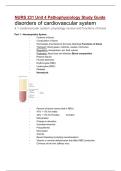
NURS 231 Unit 4 Pathophysiology Study Guide
disorders of cardiovascular system
4.1 cardiovascular system: physiology review and functions of blood
Part 1 - Hematopoietic System
- Funtions of blood
- Composition of blood
- Hemostasis (mechanisms that stop bleeding) Functions of blood
- Transport: blood gases, nutrients, wastes, hormones
- Regulation: temperature, pH, fluid volume
- Protection: blood loss and infection Blood composition
- Plasma (liquid)
- Formed elements
- Erythrocytes (RBC)
- Leukocytes (WBC)
- Platelets
- Hematocrit
- Percent of blood volume that is RBCs
- 47% +- 5% for males
- 42% +- 5% for females - Increase
- Dehydration
- Change in elevation
- Increased exercise
- Polycythemia
- Decreased
- Anemia
- Recent bleeding (including menstrauation)
- Vitamin or mineral deficienceies that affect RBC production
- Cirrhosis of the liver (affects iron)
, 4.2 hematologic disorders
Blood Disorders
- Primary: proble within the blood itself
- Secondary: proble or causative agent is not the blood
- Qualitative: cell abnormalities or plasma factor dysfunction (hemophylia)
- Quantitative: increased or decreased cell production or destruction
(thrombocytopenia)
Anemia: when there is a decrease in O2 carrying capacity resulting in decreased oxygen to
the body’s tissues. It can be from insufficient erythrocytes or decreased hemoglobin -
Etiology:
- Blood loss
- 1. Acute
- 2. Chronic
- Decreased RBCs production - 1. Aplastic anemia
- Pancytopenia from congenital or acquired causes - 2. Anemia of chronic
disease
- Chronic infection, inflammation or cancer causes decrease - Increased
RBC destruction
- 1. Hemolytic Anemia - acquired
- 2. Sickle cell anemia - inherited - 3. Thalassemia - inherited
- Genetic disease with defective hemoglobin synthesis and hemolysis
- Deficiency anemias
- 1. Pernicious anemia
disorders of cardiovascular system
4.1 cardiovascular system: physiology review and functions of blood
Part 1 - Hematopoietic System
- Funtions of blood
- Composition of blood
- Hemostasis (mechanisms that stop bleeding) Functions of blood
- Transport: blood gases, nutrients, wastes, hormones
- Regulation: temperature, pH, fluid volume
- Protection: blood loss and infection Blood composition
- Plasma (liquid)
- Formed elements
- Erythrocytes (RBC)
- Leukocytes (WBC)
- Platelets
- Hematocrit
- Percent of blood volume that is RBCs
- 47% +- 5% for males
- 42% +- 5% for females - Increase
- Dehydration
- Change in elevation
- Increased exercise
- Polycythemia
- Decreased
- Anemia
- Recent bleeding (including menstrauation)
- Vitamin or mineral deficienceies that affect RBC production
- Cirrhosis of the liver (affects iron)
, 4.2 hematologic disorders
Blood Disorders
- Primary: proble within the blood itself
- Secondary: proble or causative agent is not the blood
- Qualitative: cell abnormalities or plasma factor dysfunction (hemophylia)
- Quantitative: increased or decreased cell production or destruction
(thrombocytopenia)
Anemia: when there is a decrease in O2 carrying capacity resulting in decreased oxygen to
the body’s tissues. It can be from insufficient erythrocytes or decreased hemoglobin -
Etiology:
- Blood loss
- 1. Acute
- 2. Chronic
- Decreased RBCs production - 1. Aplastic anemia
- Pancytopenia from congenital or acquired causes - 2. Anemia of chronic
disease
- Chronic infection, inflammation or cancer causes decrease - Increased
RBC destruction
- 1. Hemolytic Anemia - acquired
- 2. Sickle cell anemia - inherited - 3. Thalassemia - inherited
- Genetic disease with defective hemoglobin synthesis and hemolysis
- Deficiency anemias
- 1. Pernicious anemia