Lever Systems
Lever systems help the body to move
A lever is a rigid bar that moves about a fixed point when a force is applied to it.
When a muscle pulls on a bone to move a body part about a joint, it uses the body part as a lever.
This lever makes a part of a lever system that has four different components.
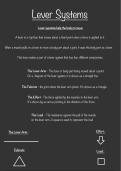
The Lever Arm - The bone or body part being moved about a point.
On a diagram of the lever system, it is shown as a straight line.
The Fulcrum - the joint where the lever arm pivots. It’s shown as a triangle.
The Effort - The force applied by the muscles to the lever arm.
It’s shown by an arrow pointing in the direction of the force.
The Load - The resistance against the pull of the muscle
on the lever arm. A square is used to represent the load
The Lever Arm : Effort :
-
Fulcrum: Load :
, Lever Systems
Levers can be First, Second or Third Class.
First Class Levers
First Class - The load and effort are at the opposite ends of the lever the fulcrum is in the middle
First Class levers are used in elbow extension. E.g a football throw-in
Second Class Levers
Second Class - The fulcrum and effort are at opposite ends of the lever. The load is in the middle
Second-class leavers are used in plantarflexion and dorsiflexion at
the ankle while standing. E.g when you stand on your toes to jump
Third Class Levers
Third Class - The fulcrum and load are at opposite ends of the lever. The effort is in the middle
Third class leavers are used in elbow flexion and in flexion and extension at the shoulder, hip and knee
Lever systems help the body to move
A lever is a rigid bar that moves about a fixed point when a force is applied to it.
When a muscle pulls on a bone to move a body part about a joint, it uses the body part as a lever.
This lever makes a part of a lever system that has four different components.
The Lever Arm - The bone or body part being moved about a point.
On a diagram of the lever system, it is shown as a straight line.
The Fulcrum - the joint where the lever arm pivots. It’s shown as a triangle.
The Effort - The force applied by the muscles to the lever arm.
It’s shown by an arrow pointing in the direction of the force.
The Load - The resistance against the pull of the muscle
on the lever arm. A square is used to represent the load
The Lever Arm : Effort :
-
Fulcrum: Load :
, Lever Systems
Levers can be First, Second or Third Class.
First Class Levers
First Class - The load and effort are at the opposite ends of the lever the fulcrum is in the middle
First Class levers are used in elbow extension. E.g a football throw-in
Second Class Levers
Second Class - The fulcrum and effort are at opposite ends of the lever. The load is in the middle
Second-class leavers are used in plantarflexion and dorsiflexion at
the ankle while standing. E.g when you stand on your toes to jump
Third Class Levers
Third Class - The fulcrum and load are at opposite ends of the lever. The effort is in the middle
Third class leavers are used in elbow flexion and in flexion and extension at the shoulder, hip and knee