Components of Fitness
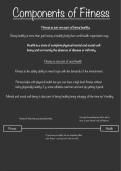
Fitness is just one part of being healthy.
Being healthy is more than just having a healthy body that world health organisation say.
Health is a state of complete physical mental and social well-
being and not merely the absence of disease or infirmity.
Fitness is one part of good health
Fitness is the ability ability to meet/cope with the demands of the environment.
Fitness helps with physical health but you can have a high level fitness without
being physically healthy. E.g. some athletes overtrain and end up getting injured.
Mental and social well-being is also part of being healthy being unhappy all the time isn’t healthy.
You might be unhealthy but still be able to
Keeping fit helps keep you physically healthy
train, so your fitness could still improve
Fitness -
Health
If you have poor health, this can negatively affect
your fitness - e.g if you can’t train as much.
, Components of Fitness
Cardiovascular endurance - getting oxygen to the muscles
Cardiovascular endurance is ability of the heart
and lungs to supply oxygen to the working muscles.
Your heart and lungs work together to keep your muscles supplied with
oxygen. The harder you work your muscles, the more oxygen they need.
So if you have a high level of cardiovascular insurance your body is able to
supply the oxygen your muscles need to exercise for long periods of time.
Most sports require good cardiovascular endurance.
Muscular endurance - how long until you get tired
When you work your muscles they can get tired and start to feel heavy and weak. (fatigued)
Muscular endurance is the ability repeatedly use
muscles over a long time about without getting tired.
Muscular endurance is really important in any physical activity
where you are using the same muscles again and again.
, Components of Fitness
Strength - the force a muscle can exert.
Strength is just how strong your muscles are:
Strength is the amount of force that a muscle or muscle group can apply against a resistance.
It’s very important in sports where you need to lift push or
pull things using a lot of force, like weightlifting and judo.
Strength can be broken down into different types:
Maximal strength is the most amount of force and muscle group can create in a single movement.
Static strength is when the muscle don’t move but still apply for e.g. when holding a handstand.
Explosive strength uses a muscle’s strength in a short, fast burst - it’s similar to power.
Dynamic strength means using your strength to move things repeatedly - like muscular endurance .
Speed - how quickly
Speed is a measure of how quickly you can do something.
Speed is the rate at which someone is able to move
or cover a distance in a given amount of time.
This might be a measure of how quickly you can cover a distance
it could also be how quickly you can carry out a movement.
To work out speed you just divide the distance covered by the time taken to do it.
, Components of Fitness
Power - Speed and Strength together.
Power is a combination of speed and strength
Power = Strength x Speed
Most sports need power for some things it’s important for throwing, hitting, sprinting and jumping
Coordination and balance also help to make the most of power -
an uncoordinated or off-balance action will not be as powerful.
Agility - Control over your body’s movement
Agility is important in any activity where you’ve got to change direction all the time like football or hockey.
Jumping and intercept in a pass in netball or basketball involves a high level of agility.
Agility is the ability to change body position or direction quickly and with control.
Fitness is just one part of being healthy.
Being healthy is more than just having a healthy body that world health organisation say.
Health is a state of complete physical mental and social well-
being and not merely the absence of disease or infirmity.
Fitness is one part of good health
Fitness is the ability ability to meet/cope with the demands of the environment.
Fitness helps with physical health but you can have a high level fitness without
being physically healthy. E.g. some athletes overtrain and end up getting injured.
Mental and social well-being is also part of being healthy being unhappy all the time isn’t healthy.
You might be unhealthy but still be able to
Keeping fit helps keep you physically healthy
train, so your fitness could still improve
Fitness -
Health
If you have poor health, this can negatively affect
your fitness - e.g if you can’t train as much.
, Components of Fitness
Cardiovascular endurance - getting oxygen to the muscles
Cardiovascular endurance is ability of the heart
and lungs to supply oxygen to the working muscles.
Your heart and lungs work together to keep your muscles supplied with
oxygen. The harder you work your muscles, the more oxygen they need.
So if you have a high level of cardiovascular insurance your body is able to
supply the oxygen your muscles need to exercise for long periods of time.
Most sports require good cardiovascular endurance.
Muscular endurance - how long until you get tired
When you work your muscles they can get tired and start to feel heavy and weak. (fatigued)
Muscular endurance is the ability repeatedly use
muscles over a long time about without getting tired.
Muscular endurance is really important in any physical activity
where you are using the same muscles again and again.
, Components of Fitness
Strength - the force a muscle can exert.
Strength is just how strong your muscles are:
Strength is the amount of force that a muscle or muscle group can apply against a resistance.
It’s very important in sports where you need to lift push or
pull things using a lot of force, like weightlifting and judo.
Strength can be broken down into different types:
Maximal strength is the most amount of force and muscle group can create in a single movement.
Static strength is when the muscle don’t move but still apply for e.g. when holding a handstand.
Explosive strength uses a muscle’s strength in a short, fast burst - it’s similar to power.
Dynamic strength means using your strength to move things repeatedly - like muscular endurance .
Speed - how quickly
Speed is a measure of how quickly you can do something.
Speed is the rate at which someone is able to move
or cover a distance in a given amount of time.
This might be a measure of how quickly you can cover a distance
it could also be how quickly you can carry out a movement.
To work out speed you just divide the distance covered by the time taken to do it.
, Components of Fitness
Power - Speed and Strength together.
Power is a combination of speed and strength
Power = Strength x Speed
Most sports need power for some things it’s important for throwing, hitting, sprinting and jumping
Coordination and balance also help to make the most of power -
an uncoordinated or off-balance action will not be as powerful.
Agility - Control over your body’s movement
Agility is important in any activity where you’ve got to change direction all the time like football or hockey.
Jumping and intercept in a pass in netball or basketball involves a high level of agility.
Agility is the ability to change body position or direction quickly and with control.