PATHO 370 Midterm Review Latest Update
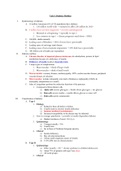
Chapter 2 Homeostasis and Adaptive Responses to Stressors Homeostasis- state of equilibrium Allostasis- Ability to successfully adapt to changes Stress: a state manifested by a specific syndrome of the body developed in response to any stimuli that made an intense demand on it. Influenced by genetics, socioeconomic status, prior susceptibilities, pre-existing health status, allostatic state and ability to manage stress General Adaptation Syndrome (GAS): Involves 3 STAGES: • Alarm stage: stimulation of the SNS, resulting in release of catecholamines & cortisol • Resistance stage: body selects the most effective and economic channels of defense; cortisol levels present in first stage drop b/c they are no longer needed • Exhaustion stage: resources are depleted & signs of “wear & tear” or systemic damage appear Acute versus Chronic Stress: • Acute stress: associated with the ANS, the fight or flight response; persons with preexisting heart disease can have complications with acute stress response that can lead to arrhythmias; in healthy individuals acute stress response can redirect attention from behaviors that promote health and interrupt compliance with medication regiments & exercise programs • Chronic stress: it has been linked to health disorders including diseases of the cardiovascular, gastrointestinal, immune, & neurological systems; sympathetic activity & cortisol are elevated Physiological stress & psychosocial stress: • Physiological stress: stress-induced changes in body functions; detected by body’s normal regulatory sensors; the body alters function to restore normal balance; when normal balance is restored, negative feedback stops the reaction • Psychosocial stress: Directly affects central nervous system; turns on the stress responses, even when the body’s internal sensors have not detected an imbalance Adaptation & Coping Mechanisms: Adaptation: the ability to respond to challenges of physical or psychological homeostasis & to return to a balanced state. • Influenced by previous learning, physiologic reserve, time, genetic endowment, age, health status & nutrition, sleep-wake cycles, & psychosocial factors. Coping Mechanisms: • Guided Imagery: scene visualization • Music therapy: listening to music to ease anxiety or stress • Massage therapy: manipulation of soft tissues to promote relaxation & relief of muscle tension • Biofeedback: technique
Written for
- Institution
- West Coast University
- Module
- PATHO 370 Midterm Review Latest Update (PATHO370MIDTERMREVIEWLATESTUPDATE)
Document information
- Uploaded on
- February 10, 2021
- Number of pages
- 121
- Written in
- 2020/2021
- Type
- Exam (elaborations)
- Contains
- Questions & answers
Subjects
-
chapter 2 homeostasis and adaptive responses to stressors homeostasis state of equilibrium allostasis ability to successfully adapt to changes stress a state manifested by a specific syndrome o