PPG end-term summary
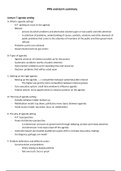
Lecture 7 agenda setting
A: What is agenda setting?
- K+T: getting an issue on the agenda
- Bikland:
- process by which problems and alternative solutions gain or lose public and elite attention
- A collection of problems, understanding of causes, symbols, solutions and other elements of
public problems that come to the attention of members of the public and their government
officials
- Problems as the core element
- Governmental and non gov actors
B: Types of agendas
- Agenda universe: all matters possible up for discussions
- Systematic: problems worthy of public attention
- Instrumental: problems up for spending time and resources
- Decision: problems that will be acted upon
C: Getting on the right agenda
- Moving up the agenda ----> competition between potential public interest
- The higher you get the more competition between interest groups
- Core executive system: small time window to influence agenda
- Federal system: more opportunities to advance position on the agenda
D: The how of agenda setting
- Outside initiative model: bottom up
- Mobilisation model: top down, politicians move topics between agendas
- Inside access model: top down, focus on stakeholders
E: The why of agenda setting
- K+T 3 perspectives
- Power distribution perspective
- 1st dimension: pressure on government through lobbying, protest and media attention
- 2nd dimension: how topics kept off the agenda
- Institution based: punctuated equilibrium (quick shift in normally slow policy making)
- Contingency: garbage can model
F: Problem definitions and different actors
- Constructivism and problems
- Policy making as deeply political
- Not one truth, fact or proof
, - Multivisions of reality
- Language and symbolic meanings are ambiguous
- Stone: politics + policy = strategic context of problems and solutions
G: Problem definition
- Cognitive dimension
- Problem def: problem formulation and preferred solution
- Naming: giving a problem a name
- Proposition of fact: causal, predictive, historical, severity, incidence, novelty, proximity claims
- Numerical estimates: incidence, growth, range (Stone)
- Examples
- Moral dimension
- Shaming
- Enables status quo or desire change
- Propositions of value (Stone ch9)
- What is good, bad and immoral
- Lead justifications for solutions with support for action
Lecture 8: Policy design
A: Policy design
- K+T decision making
- Policy formulation and policy adoption
- 2 parts:
- What is policy design?
- Who designs it
- Policy instruments are important aspects
- What and who designs policy?
- Sidney: identifying and crafting policy alternatives to address a problem
- Narrowing down solutions in preparation for a final decision
- Elements: tax evasion as an example
- Goals: formulate a goal
- Targeted groups: tax evaders who are they?
- Agents: actors that bring policy into practice
- Implementation structure: organisational forms
- Policy instruments: the means they use
- Rationales: argument to why it makes sense
- Assumptions: what do i assume e.g. cost
- Policy design and institutions
- Actors are influenced by:
- Dominant political ideas
, - Agenda setting process
- What affected groups have to say
- The setting
- Parliament
- Executive
- Ministry
- European commission
- United nations
- Who is involved
- K+T: policy design confined to executive, parliaments and state bureaucracy
- Civil servants influenced by
- Experts
- International organisations
- Interest groups
- Party ideology
- NGOs and SMOs
- K+T: the role of veto players
- They can reject policies that have been developed
B: Policy instruments and policy design
- The role of policy instruments
- Policy design not only refining goals and coming up with solutions
- Also: finding means to achieve solutions
- Means: policy instruments
- Rules and regulation: stone 13
- Financial measures: stone 12
- Communication: stone 14
- Choice of instruments: when do instruments fit?
- Complicating factor: behavioural change
- It’s difficult to achieve in a collective
- Consider impediments:
- there’s always things people would otherwise not have done
- Stop doing something
- Or things they may have done otherwise
- Wanting people to do something
Lecture 7 agenda setting
A: What is agenda setting?
- K+T: getting an issue on the agenda
- Bikland:
- process by which problems and alternative solutions gain or lose public and elite attention
- A collection of problems, understanding of causes, symbols, solutions and other elements of
public problems that come to the attention of members of the public and their government
officials
- Problems as the core element
- Governmental and non gov actors
B: Types of agendas
- Agenda universe: all matters possible up for discussions
- Systematic: problems worthy of public attention
- Instrumental: problems up for spending time and resources
- Decision: problems that will be acted upon
C: Getting on the right agenda
- Moving up the agenda ----> competition between potential public interest
- The higher you get the more competition between interest groups
- Core executive system: small time window to influence agenda
- Federal system: more opportunities to advance position on the agenda
D: The how of agenda setting
- Outside initiative model: bottom up
- Mobilisation model: top down, politicians move topics between agendas
- Inside access model: top down, focus on stakeholders
E: The why of agenda setting
- K+T 3 perspectives
- Power distribution perspective
- 1st dimension: pressure on government through lobbying, protest and media attention
- 2nd dimension: how topics kept off the agenda
- Institution based: punctuated equilibrium (quick shift in normally slow policy making)
- Contingency: garbage can model
F: Problem definitions and different actors
- Constructivism and problems
- Policy making as deeply political
- Not one truth, fact or proof
, - Multivisions of reality
- Language and symbolic meanings are ambiguous
- Stone: politics + policy = strategic context of problems and solutions
G: Problem definition
- Cognitive dimension
- Problem def: problem formulation and preferred solution
- Naming: giving a problem a name
- Proposition of fact: causal, predictive, historical, severity, incidence, novelty, proximity claims
- Numerical estimates: incidence, growth, range (Stone)
- Examples
- Moral dimension
- Shaming
- Enables status quo or desire change
- Propositions of value (Stone ch9)
- What is good, bad and immoral
- Lead justifications for solutions with support for action
Lecture 8: Policy design
A: Policy design
- K+T decision making
- Policy formulation and policy adoption
- 2 parts:
- What is policy design?
- Who designs it
- Policy instruments are important aspects
- What and who designs policy?
- Sidney: identifying and crafting policy alternatives to address a problem
- Narrowing down solutions in preparation for a final decision
- Elements: tax evasion as an example
- Goals: formulate a goal
- Targeted groups: tax evaders who are they?
- Agents: actors that bring policy into practice
- Implementation structure: organisational forms
- Policy instruments: the means they use
- Rationales: argument to why it makes sense
- Assumptions: what do i assume e.g. cost
- Policy design and institutions
- Actors are influenced by:
- Dominant political ideas
, - Agenda setting process
- What affected groups have to say
- The setting
- Parliament
- Executive
- Ministry
- European commission
- United nations
- Who is involved
- K+T: policy design confined to executive, parliaments and state bureaucracy
- Civil servants influenced by
- Experts
- International organisations
- Interest groups
- Party ideology
- NGOs and SMOs
- K+T: the role of veto players
- They can reject policies that have been developed
B: Policy instruments and policy design
- The role of policy instruments
- Policy design not only refining goals and coming up with solutions
- Also: finding means to achieve solutions
- Means: policy instruments
- Rules and regulation: stone 13
- Financial measures: stone 12
- Communication: stone 14
- Choice of instruments: when do instruments fit?
- Complicating factor: behavioural change
- It’s difficult to achieve in a collective
- Consider impediments:
- there’s always things people would otherwise not have done
- Stop doing something
- Or things they may have done otherwise
- Wanting people to do something