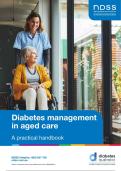
Diabetes management
in aged care
A practical handbook
NDSS Helpline 1800 637 700
ndss.com.au
Version 4, November 2024. First published June 2016. NDSSA4B017
, This handbook has been written for all care staff, from carers to registered nurses.
Its aim is to help care staff understand the basics of diabetes management without
overwhelming them with complex information about advanced clinical care.
Diabetes Australia believes that the information
contained in this training resource was accurate
and reliable at the time of publication. The websites
quoted in the resource were accessible at the
time of publication. Diabetes Australia takes no
responsibility for the accuracy or future availability
of these sites.
Diabetes Australia takes no responsibility for any
adverse consequences that arise as a result of
using the content of the resources for clinical
purposes. Trainees and other health professionals
need to consider the individual circumstances
and needs of people with diabetes when they are
applying the skills outlined in this resource in their
clinical practice information.
,Introduction
Around one quarter of all people living in The following package of resources supporting
residential aged care facilities (RACFs) have the DMAC handbook have been developed as a
diabetes. These people may have lived with direct result of working with aged care facilities
the condition for many years and may be and responding to their needs.
living with co-morbidities and diabetes-
related complications. As a result, care is » Diabetes management in aged care: Fast
often complex. facts for care workers contains a summary of
key information found in the DMAC handbook.
Diabetes management in aged care: a practical
handbook (DMAC) aims to increase knowledge » Diabetes quality review tool: management
and understanding of diabetes in older people of residents who have diabetes is a tool
for staff who support those living with diabetes designed to assist managers in aged care
in RACFs. assess the quality of the management and care
of residents with diabetes against evidence-
The DMAC has been available for a number of based practice. The tool covers admission and
years, with the last revision in 2020.This latest screening, diabetes care plan, hypoglycaemia,
version includes important updates, along with hyperglycaemia/sick day management,
a range of linked resources, which will assist complications screening and prevention, facility
management and staff to support residents and staff considerations (training/equipment).
with diabetes.
» Six Minute Intensive Training (SMIT)
The standard of care provided to residents in resources on a range of topics:
aged care settings was highlighted in the 2021 hypoglycaemia, hyperglycaemia, insulin,
Royal Commission into Aged Care Quality sick day management, glucose-lowering
and Safety. medicines, monitoring and healthy eating.
These are designed to provide key
Residents in aged care are more likely to be information which can be delivered to staff
frail with reduced life expectancy. A significant in six minutes and reinforced in a busy
proportion of these residents may have cognitive environment. They can be used in a variety
impairment or dementia, with reduced capacity of settings including at handover, team
to communicate how they are feeling. The ability meetings or as a quick refresher.
of staff to recognise and respond in a timely
manner for those residents with diabetes has an » Sick day management quick guide. Every
enormous impact on residents’ quality of life. resident with diabetes should have an
individualised sick day management plan. This
Ensuring quality of life and resident safety, quick guide gives an overview of key steps to
coupled with regular reviews, are key factors in take when a resident is sick.
diabetes management in an aged care setting
and have implications for all care needs. In » McKellar guidelines for managing older
particular, information regarding management people with diabetes in residential and
in the residential setting around blood glucose other care settings (2014) provides detailed
monitoring and healthy eating have been updated information regarding diabetes management in
to reflect this focus. Regular resident review the aged care sector.
is crucial to ensuring care delivered enables
residents to have the best quality of life. All the resources can be found at ndss.com.
au/health-professionals/working-with-older-
people-with-diabetes.
Diabetes management in aged care Page 1 of 108
Version 4, November 2024. First published June 2016. NDSSA4B017
, Acknowledgements
We would like to thank all those who contributed
to this and earlier editions of this handbook,
including:
» The many aged care sector staff who
generously gave their time and expertise in the
development and revision of this handbook.
» Australian Diabetes Educators Association
(ADEA)
– Rachel Freeman
– Fleur Kelly
– ADEA Clinical Practice Committee
» National Diabetes Australia Dietitians (NDAD)
– Laura Scott
» NDSS Older People Living with Diabetes
Program Expert Reference Group (ERG)
– Associate Professor Georgia Soldatos
(Chair, 2021)
– Dr Melanie Burkhardt (Chair, 2016)
– Judy Broad
– Sue Draycott
– Professor Trish Dunning
– Stuart Fellows
– Ngaire Hobbins
– Michelle Hogan
– Associate Professor Gary Kilov
– Darren Mathewson
– Naomi Moore
– Trish Roderick
– Juanita Westbury
– Caroline Wells
This handbook contains “Fast
facts” that have been developed
for assistants in nursing and care
workers. It also has “More details”
sections for nurses or care staff
wanting to learn more about a topic.
Page 2 of 108
Diabetes management in aged care
Version 4, November 2024. First published June 2016. NDSSA4B017
in aged care
A practical handbook
NDSS Helpline 1800 637 700
ndss.com.au
Version 4, November 2024. First published June 2016. NDSSA4B017
, This handbook has been written for all care staff, from carers to registered nurses.
Its aim is to help care staff understand the basics of diabetes management without
overwhelming them with complex information about advanced clinical care.
Diabetes Australia believes that the information
contained in this training resource was accurate
and reliable at the time of publication. The websites
quoted in the resource were accessible at the
time of publication. Diabetes Australia takes no
responsibility for the accuracy or future availability
of these sites.
Diabetes Australia takes no responsibility for any
adverse consequences that arise as a result of
using the content of the resources for clinical
purposes. Trainees and other health professionals
need to consider the individual circumstances
and needs of people with diabetes when they are
applying the skills outlined in this resource in their
clinical practice information.
,Introduction
Around one quarter of all people living in The following package of resources supporting
residential aged care facilities (RACFs) have the DMAC handbook have been developed as a
diabetes. These people may have lived with direct result of working with aged care facilities
the condition for many years and may be and responding to their needs.
living with co-morbidities and diabetes-
related complications. As a result, care is » Diabetes management in aged care: Fast
often complex. facts for care workers contains a summary of
key information found in the DMAC handbook.
Diabetes management in aged care: a practical
handbook (DMAC) aims to increase knowledge » Diabetes quality review tool: management
and understanding of diabetes in older people of residents who have diabetes is a tool
for staff who support those living with diabetes designed to assist managers in aged care
in RACFs. assess the quality of the management and care
of residents with diabetes against evidence-
The DMAC has been available for a number of based practice. The tool covers admission and
years, with the last revision in 2020.This latest screening, diabetes care plan, hypoglycaemia,
version includes important updates, along with hyperglycaemia/sick day management,
a range of linked resources, which will assist complications screening and prevention, facility
management and staff to support residents and staff considerations (training/equipment).
with diabetes.
» Six Minute Intensive Training (SMIT)
The standard of care provided to residents in resources on a range of topics:
aged care settings was highlighted in the 2021 hypoglycaemia, hyperglycaemia, insulin,
Royal Commission into Aged Care Quality sick day management, glucose-lowering
and Safety. medicines, monitoring and healthy eating.
These are designed to provide key
Residents in aged care are more likely to be information which can be delivered to staff
frail with reduced life expectancy. A significant in six minutes and reinforced in a busy
proportion of these residents may have cognitive environment. They can be used in a variety
impairment or dementia, with reduced capacity of settings including at handover, team
to communicate how they are feeling. The ability meetings or as a quick refresher.
of staff to recognise and respond in a timely
manner for those residents with diabetes has an » Sick day management quick guide. Every
enormous impact on residents’ quality of life. resident with diabetes should have an
individualised sick day management plan. This
Ensuring quality of life and resident safety, quick guide gives an overview of key steps to
coupled with regular reviews, are key factors in take when a resident is sick.
diabetes management in an aged care setting
and have implications for all care needs. In » McKellar guidelines for managing older
particular, information regarding management people with diabetes in residential and
in the residential setting around blood glucose other care settings (2014) provides detailed
monitoring and healthy eating have been updated information regarding diabetes management in
to reflect this focus. Regular resident review the aged care sector.
is crucial to ensuring care delivered enables
residents to have the best quality of life. All the resources can be found at ndss.com.
au/health-professionals/working-with-older-
people-with-diabetes.
Diabetes management in aged care Page 1 of 108
Version 4, November 2024. First published June 2016. NDSSA4B017
, Acknowledgements
We would like to thank all those who contributed
to this and earlier editions of this handbook,
including:
» The many aged care sector staff who
generously gave their time and expertise in the
development and revision of this handbook.
» Australian Diabetes Educators Association
(ADEA)
– Rachel Freeman
– Fleur Kelly
– ADEA Clinical Practice Committee
» National Diabetes Australia Dietitians (NDAD)
– Laura Scott
» NDSS Older People Living with Diabetes
Program Expert Reference Group (ERG)
– Associate Professor Georgia Soldatos
(Chair, 2021)
– Dr Melanie Burkhardt (Chair, 2016)
– Judy Broad
– Sue Draycott
– Professor Trish Dunning
– Stuart Fellows
– Ngaire Hobbins
– Michelle Hogan
– Associate Professor Gary Kilov
– Darren Mathewson
– Naomi Moore
– Trish Roderick
– Juanita Westbury
– Caroline Wells
This handbook contains “Fast
facts” that have been developed
for assistants in nursing and care
workers. It also has “More details”
sections for nurses or care staff
wanting to learn more about a topic.
Page 2 of 108
Diabetes management in aged care
Version 4, November 2024. First published June 2016. NDSSA4B017