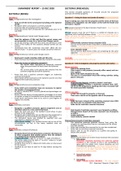
AN INSPECTOR CALLS BOOKLET │ GCSE ENG LIT
An Inspector Calls Booklet
Character Analysis 2 - 20 Act Summaries Continued
Arthur Birling Act 3
Sybil Birling Past Paper Questions 60 - 74
The Inspector (Goole)
Sheila Birling
Eva Smith / Daisy Renton
Gerald Croft
Eric Birling
Edna
Context 20 - 30
The Victorian Influence / J.B. Priestley’s Upbringing
The World Wars / The Great Depression
The Class System / The Industrial Revolution
Politics
Targeting Grade 8/9
Sigmund Freud and The Psychoanalytical Theory
Karl Marx and The Marxist Perspective
Simone de Beauvoir and The Feminist Perspective
Ouspensky and Dunne’s Theory of Time
Themes 30 - 56
Capitalism Vs Socialism
Generations – Young Vs Old
Gender
Social Class
Social Responsibility
Act Summaries 56 - 60
Act 1 J. B. Priestley
Act 2 Written – 1945 -
Set – 1912 -
1
, AN INSPECTOR CALLS BOOKLET │ GCSE ENG LIT
Character Analysis
Arthur Birling
Arthur Birling’s character is firmly entrenched within 1912 ante-belllum (before war) English
Social Elite
Mr Birling holds a dominant position within a static society
o His Patriarchal role as owner of Birling and Co only employs young women at
extortionately low wages
o His marriage to Mrs Birling, reflects Mr Bieling’s control over his household; she,
despite being his ‘social superior’, is dominated by Mr Birling, and is often ordered to
sit in the ‘drawing room’, while men talk
o His indifference to Sheila’s concerns regarding Gerlad’s alleged affair – it risks the
economic relationship between the Croft Business and his own
Mr Birling is portrayed as the living embodiment of the capitalist ideology, and is
concerned for his reputation
His obsession with his status and reputation blinds him to the suffering of others
o His lack of empathy for his family lead them to be entwined in a controversy
His position as a wealthy influential businessman gives him a sense of power and control
over others
o He uses this power to further his own interests throughout the play
His physical appearance is a reflection of capitalism; he wears formal clothes, and is ‘heavy
looking’ (symbolises greed) and frequently displays his ‘portentous’ attitude (tries hard to
impress)
Birling’s clearly pompous perspective is evidenced through his immediate reclamation of
the spotlight after Sheila’s engagement – ‘it is one of the happiest nights of my life’, and
toasts to ‘lower costs, higher prices’
o Mr Birling values Sheila on her capacity to further the family company and therefore
objectifies her like a bargaining chip – ‘she’ll make you happy (Gerlad)’
o It’s clear that Mr Birling values the prospect of increased profit over his daughter’s
joy in engagement
His business is of greater importance than his own family – this foreshadows Mr Birling’s
indifference to Eva Smith’s suicide, which is initiated through his refusal to grant her higher
pay
o He attempts to bribe the inspector to prevent losing wealth and social status through
a criminal record, epitomising the individualistic nature of capitalism – ‘Look,
Inspector – I’d give thousands – yes, thousands –‘
He is a ‘hard headed practical man of business’
o Priestly has deliberately used the language of the Labour Party manifesto, to turn it
not a drama his audience can relate too
o An allusion to the language of Sir Stanley Baldwin
Arguably, Mr Birling is insecure in his own social position
Despite his success in the world of business, his tendency to be ‘provincial in speech’
reveals his lower class origins
2
, AN INSPECTOR CALLS BOOKLET │ GCSE ENG LIT
o This insecurity causes Mr Birling to constantly remind people of his status in society,
through bringing up former roles as ‘Lord Mayor’ and suggesting ‘there’s a very good
chance of knighthood’ to convince Gerlad of his great social status
This relative uncouthness (Mr Birling’s mannerisms, etiquette and pronunciation are not
aligned to the middle-class norms) is preyed upon by Mrs Birling, who is his natural ‘social
superior’
o Mrs Birling was, contrastingly, brought up within a wealthy household and thus her
social etiquette has been refined; she is embarrassed by her husband
o Priestly introduces this insecurity immediately in the play; thus, this insecurity
becomes synonymous with the character of Mr Birling
o Insecurity in middle-class social position reveals the far-reaching nature of the
suffering caused by large differences in wealth and clear social divisions; It’s not
simply the lower-classes who suffer, although their hardship is to a greater extent
The Birling’s wealth seems unnatural as Mr Birling isn’t from a traditionally wealthy
background, linking into the idea of him attacking the ‘Nouveau riche’
It is important to consider how has lack of knowledge about money and wealth affects Mr
Birling, as he lacks the reputation of a well-known family name
Priestly’s opening descriptions of the Birling household through stage directions as
‘substantial and heavily comfortable but not cosy or homelike’ immediately indicates the
great wealth of the Birlings - yet the lack of feeling like home reinforces the cosmetic nature
of the comfort in their own wealth; Mr Birling’s lower-class roots means his higher-class
lifestyle can never seem ‘homelike’
Birling compensates for his ‘provincial’ speech and unrefined etiquette, through his
‘substantial’ house as a clear indicator of his high social status.
o This desire to ensure his status as belonging to the upper echelons of society is
derived from his initial social inferiority, before he started his business
Mr Birling’s character is condemned by higher-class men and those from respected families
due to his lack of an aristocratic background
Priestly uses the character of Mr Birling, not only as a method to critique capitalism, but to
reveal the cycle of oppression caused by social divisions and classism – Mr Birling attains
validation of his superiority in an almost sadistic manner, through denying pay rises and
maintaining poor working conditions and hours – he is exercising complete control over
these lower-class women
o The excessively self-centred nature of Mr Birling is driven by his determination to
uphold an appearance of affluence – Priestly focuses on the insecurities of Mr Birling
and the middle-class, and this is necessary to establish a connection with the
middle-class contemporary audience, through exploiting the genuine insecurities
they faced
Arthur Birling has a variety of relationships with other characters
Marriage to Mrs Birling – married for her social status rather than love.
o Their marriage acted as a transaction – Mr Birling’s financial stability in exchange for
Sybil’s reputable family.
o The lack of love and intimacy in their relationship is demonstrated through Mrs
Birling ‘reproachfully’ responding to Mr Birling
3
, AN INSPECTOR CALLS BOOKLET │ GCSE ENG LIT
o Mrs Birling noticeably feels unfulfilled by her husband – she says to Sheila that she’ll
just ‘have to get used to, just as I did’, highlighting her unhappiness caused by this
capitalist system, where status and wealth are paramount.
Father-son relationship with Eric, lacks a sense of familial connection
o Eric opposes his fathers individualistic capitalist ideology.
o The division represents the divide between the older and younger generation – Eric
is more aligned to the idea of socialism
o Mr Birling attempts to lecture Eric and influence him with capitalist and individualistic
notions – ‘a man has to make his own way – he has to look after himself’
Mr Birling is the antithesis (or foil) of the Inspector
o Mr Birling represents Capitalism, whilst The Inspector represents Socialism
o The concept of rugged individualism and ‘a man has to look after himself’ proposed
by Mr Birling is contrasted by The Inspector’s notion of social responsibility and that
‘we are all members of one body’
The Inspector plays on Mr Birling’s appearance of a reputable family – ‘you
seem like a nice, well-behaved family’, while emphasising the superficiality of
their appearance with the verb ‘seem’
o Mr Birling attempts to intimidate the Inspector and retain some authority by
referencing his irrelevant roles as ‘I was an alderman for years – and lord mayor two
years ago’
o The Inspectors indifference to his attempts to intimidate him lead to Mr Birling
asserting his authority over his children – ‘you’ve had enough of that port, Eric’ and
‘you keep quite Eric’ – Mr Birling’s insecurity in his own authority leads to oppression,
also reflected onto the lower-classes in the workplace as he resists his workers’
strike for a pay rise
He has an uncertain relationship with Gerald
o Gerald is above him in the social hierarchy, and the croft family are more reputable
and wealthier than the Burling’s – creating a noticeable tension between the two
Characters, which causes Mr Birking to increase his ostentatious tendencies
o Mr Birling buys the same port as Gerald’s father – an attempt to present himself as
socially equal
o Mrs Croft disapproves of Gerald’s marriage to Sheila, therefore Mr Birling attempts to
compensate for his lower social status by suggesting that there’s a ‘very good
chance of knighthood’.
o The self-promotion of Mr Birling reveals the real motive behind marriage, as rather
than praise Sheila as a great potential partner, he promotes himself in an attempt to
unite the Croft and Birling families, and thereby increase his ranking on the social
hierarchy
o The profound effect of the class system is revealed by Mr Birling’s great respect for
Gerlad, despite Mr Birling being considerably older.
Priestly demonstrates that respect is merely gained through status
Sybil Birling
Her name ‘Sybil’ derives from the ancient Greek prophetesses: ‘Sibyls’ – female seers from
the ancient world whose prophecies it was thought foretold the coming of Christ
4
An Inspector Calls Booklet
Character Analysis 2 - 20 Act Summaries Continued
Arthur Birling Act 3
Sybil Birling Past Paper Questions 60 - 74
The Inspector (Goole)
Sheila Birling
Eva Smith / Daisy Renton
Gerald Croft
Eric Birling
Edna
Context 20 - 30
The Victorian Influence / J.B. Priestley’s Upbringing
The World Wars / The Great Depression
The Class System / The Industrial Revolution
Politics
Targeting Grade 8/9
Sigmund Freud and The Psychoanalytical Theory
Karl Marx and The Marxist Perspective
Simone de Beauvoir and The Feminist Perspective
Ouspensky and Dunne’s Theory of Time
Themes 30 - 56
Capitalism Vs Socialism
Generations – Young Vs Old
Gender
Social Class
Social Responsibility
Act Summaries 56 - 60
Act 1 J. B. Priestley
Act 2 Written – 1945 -
Set – 1912 -
1
, AN INSPECTOR CALLS BOOKLET │ GCSE ENG LIT
Character Analysis
Arthur Birling
Arthur Birling’s character is firmly entrenched within 1912 ante-belllum (before war) English
Social Elite
Mr Birling holds a dominant position within a static society
o His Patriarchal role as owner of Birling and Co only employs young women at
extortionately low wages
o His marriage to Mrs Birling, reflects Mr Bieling’s control over his household; she,
despite being his ‘social superior’, is dominated by Mr Birling, and is often ordered to
sit in the ‘drawing room’, while men talk
o His indifference to Sheila’s concerns regarding Gerlad’s alleged affair – it risks the
economic relationship between the Croft Business and his own
Mr Birling is portrayed as the living embodiment of the capitalist ideology, and is
concerned for his reputation
His obsession with his status and reputation blinds him to the suffering of others
o His lack of empathy for his family lead them to be entwined in a controversy
His position as a wealthy influential businessman gives him a sense of power and control
over others
o He uses this power to further his own interests throughout the play
His physical appearance is a reflection of capitalism; he wears formal clothes, and is ‘heavy
looking’ (symbolises greed) and frequently displays his ‘portentous’ attitude (tries hard to
impress)
Birling’s clearly pompous perspective is evidenced through his immediate reclamation of
the spotlight after Sheila’s engagement – ‘it is one of the happiest nights of my life’, and
toasts to ‘lower costs, higher prices’
o Mr Birling values Sheila on her capacity to further the family company and therefore
objectifies her like a bargaining chip – ‘she’ll make you happy (Gerlad)’
o It’s clear that Mr Birling values the prospect of increased profit over his daughter’s
joy in engagement
His business is of greater importance than his own family – this foreshadows Mr Birling’s
indifference to Eva Smith’s suicide, which is initiated through his refusal to grant her higher
pay
o He attempts to bribe the inspector to prevent losing wealth and social status through
a criminal record, epitomising the individualistic nature of capitalism – ‘Look,
Inspector – I’d give thousands – yes, thousands –‘
He is a ‘hard headed practical man of business’
o Priestly has deliberately used the language of the Labour Party manifesto, to turn it
not a drama his audience can relate too
o An allusion to the language of Sir Stanley Baldwin
Arguably, Mr Birling is insecure in his own social position
Despite his success in the world of business, his tendency to be ‘provincial in speech’
reveals his lower class origins
2
, AN INSPECTOR CALLS BOOKLET │ GCSE ENG LIT
o This insecurity causes Mr Birling to constantly remind people of his status in society,
through bringing up former roles as ‘Lord Mayor’ and suggesting ‘there’s a very good
chance of knighthood’ to convince Gerlad of his great social status
This relative uncouthness (Mr Birling’s mannerisms, etiquette and pronunciation are not
aligned to the middle-class norms) is preyed upon by Mrs Birling, who is his natural ‘social
superior’
o Mrs Birling was, contrastingly, brought up within a wealthy household and thus her
social etiquette has been refined; she is embarrassed by her husband
o Priestly introduces this insecurity immediately in the play; thus, this insecurity
becomes synonymous with the character of Mr Birling
o Insecurity in middle-class social position reveals the far-reaching nature of the
suffering caused by large differences in wealth and clear social divisions; It’s not
simply the lower-classes who suffer, although their hardship is to a greater extent
The Birling’s wealth seems unnatural as Mr Birling isn’t from a traditionally wealthy
background, linking into the idea of him attacking the ‘Nouveau riche’
It is important to consider how has lack of knowledge about money and wealth affects Mr
Birling, as he lacks the reputation of a well-known family name
Priestly’s opening descriptions of the Birling household through stage directions as
‘substantial and heavily comfortable but not cosy or homelike’ immediately indicates the
great wealth of the Birlings - yet the lack of feeling like home reinforces the cosmetic nature
of the comfort in their own wealth; Mr Birling’s lower-class roots means his higher-class
lifestyle can never seem ‘homelike’
Birling compensates for his ‘provincial’ speech and unrefined etiquette, through his
‘substantial’ house as a clear indicator of his high social status.
o This desire to ensure his status as belonging to the upper echelons of society is
derived from his initial social inferiority, before he started his business
Mr Birling’s character is condemned by higher-class men and those from respected families
due to his lack of an aristocratic background
Priestly uses the character of Mr Birling, not only as a method to critique capitalism, but to
reveal the cycle of oppression caused by social divisions and classism – Mr Birling attains
validation of his superiority in an almost sadistic manner, through denying pay rises and
maintaining poor working conditions and hours – he is exercising complete control over
these lower-class women
o The excessively self-centred nature of Mr Birling is driven by his determination to
uphold an appearance of affluence – Priestly focuses on the insecurities of Mr Birling
and the middle-class, and this is necessary to establish a connection with the
middle-class contemporary audience, through exploiting the genuine insecurities
they faced
Arthur Birling has a variety of relationships with other characters
Marriage to Mrs Birling – married for her social status rather than love.
o Their marriage acted as a transaction – Mr Birling’s financial stability in exchange for
Sybil’s reputable family.
o The lack of love and intimacy in their relationship is demonstrated through Mrs
Birling ‘reproachfully’ responding to Mr Birling
3
, AN INSPECTOR CALLS BOOKLET │ GCSE ENG LIT
o Mrs Birling noticeably feels unfulfilled by her husband – she says to Sheila that she’ll
just ‘have to get used to, just as I did’, highlighting her unhappiness caused by this
capitalist system, where status and wealth are paramount.
Father-son relationship with Eric, lacks a sense of familial connection
o Eric opposes his fathers individualistic capitalist ideology.
o The division represents the divide between the older and younger generation – Eric
is more aligned to the idea of socialism
o Mr Birling attempts to lecture Eric and influence him with capitalist and individualistic
notions – ‘a man has to make his own way – he has to look after himself’
Mr Birling is the antithesis (or foil) of the Inspector
o Mr Birling represents Capitalism, whilst The Inspector represents Socialism
o The concept of rugged individualism and ‘a man has to look after himself’ proposed
by Mr Birling is contrasted by The Inspector’s notion of social responsibility and that
‘we are all members of one body’
The Inspector plays on Mr Birling’s appearance of a reputable family – ‘you
seem like a nice, well-behaved family’, while emphasising the superficiality of
their appearance with the verb ‘seem’
o Mr Birling attempts to intimidate the Inspector and retain some authority by
referencing his irrelevant roles as ‘I was an alderman for years – and lord mayor two
years ago’
o The Inspectors indifference to his attempts to intimidate him lead to Mr Birling
asserting his authority over his children – ‘you’ve had enough of that port, Eric’ and
‘you keep quite Eric’ – Mr Birling’s insecurity in his own authority leads to oppression,
also reflected onto the lower-classes in the workplace as he resists his workers’
strike for a pay rise
He has an uncertain relationship with Gerald
o Gerald is above him in the social hierarchy, and the croft family are more reputable
and wealthier than the Burling’s – creating a noticeable tension between the two
Characters, which causes Mr Birking to increase his ostentatious tendencies
o Mr Birling buys the same port as Gerald’s father – an attempt to present himself as
socially equal
o Mrs Croft disapproves of Gerald’s marriage to Sheila, therefore Mr Birling attempts to
compensate for his lower social status by suggesting that there’s a ‘very good
chance of knighthood’.
o The self-promotion of Mr Birling reveals the real motive behind marriage, as rather
than praise Sheila as a great potential partner, he promotes himself in an attempt to
unite the Croft and Birling families, and thereby increase his ranking on the social
hierarchy
o The profound effect of the class system is revealed by Mr Birling’s great respect for
Gerlad, despite Mr Birling being considerably older.
Priestly demonstrates that respect is merely gained through status
Sybil Birling
Her name ‘Sybil’ derives from the ancient Greek prophetesses: ‘Sibyls’ – female seers from
the ancient world whose prophecies it was thought foretold the coming of Christ
4