Unit 3 Section B Criminological Psychology
E xplanations for Crime and Anti-Social Behaviour
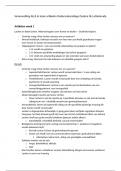
SOCIAL LEARNING FROM THE MEDIA
SLT Key terms:
• Nurture-environment approach
• Imitation
• Role models
• Attention → Retention (behaviour stays in your memory) → Reproduction (when appropriate)
• Physical ability to reproduce the behaviour
• Motivation (reward) → positive reinforcement (operant)
• Vicarious reinforcement (Bandura)
Bandura’s Study - IMPORTANT
! Male child copies aggressive male role model a lot and more aggressively than female do, whilst
female child copies aggressive female role model, however, not as much as the male role model
→ Gender is tricky when it comes to identifying with a role mode
AO1 AO3
Bandura’s Bobo doll study + It is a controlled lab experiment → highly
internally valid, BUT hard to generalise to
adults, because children are naive and
irrational
Tannis MacBeth Williams - natural experiment, - Might have been lots of factors that could
after 2 yrs of watching TV ptts were 2x have caused aggressive behaviour over 2
aggressive than control group years → EVs were not controlled → less valid,
BUT external validity is high
Most of the evidence is correlational, e.g. - Does violent TV cause criminal behaviour or
Comstock & Paik - meta-analysis of the other way round? → no causation
correlational studies which concluded a established
positive correlation
Flood-Page et al found that children from lower - This shows that there is a third unmeasured
socio-economic class were more likely to be variable such as social class that might cause
delinquent a criminal behaviour → there is only a
relationship between media and crime
Raine’s study on prisoners (Biological unit): - Alternative explanation, which shows that it
there was low activity in PFC and di erent might be not only nurture but also a nature
activity in amygdala issue
Freud suggests that watching violent media is - Challenges the idea that we learn and adopt
cathartic → it acts as a safety valve to release these behaviours from the media
negative emotions in order to prevent oneself
from committing an actual crime
Repeat reo enders - Does not support because they experience
negative consequences and still choose to
commit crime again
1
ff ff
, Unit 3 Section B Criminological Psychology
Practical applications + If we assume that it does cause aggressive
behaviour we can reduce criminal acts shown
on the media
SELF-FULFILLING PROPHECY
Step 1
Expectations / perceptions about the aggressor being violent based on stereotype
Step 2
People show their fear by avoiding / walking away
Step 3
The aggressor internalises the label → starts to believe he is very violent
Step 4
Changes his behaviour towards people on the street → e.g. threaten
Prophecy is ful lled
AO1 AO3
Rosenthal & Jacobson ( eld experiment) - + It does show that people’s expectations can
education in uence one’s behaviour, BUT it cannot be
generalised to crime
Johada, Ashanti Tribe of West Africa: males + It is related to criminal behaviour, BUT this
were given labels depending on what day of relationship is very weak as there could have
the week they were born → Wed had higher been loads of other factors → it is impossible
arrest rate than Mon to study in a controlled lab setting with regards
to crime
Madon et al: sfp within the family home - + Supports theory BUT maybe is not fully
child’s alcohol use turned into a future drinking related to violent behaviour as not all alcohol
behaviour → positive correlation + negative addicts turn into criminals
label is stronger
2
fl fi fi
, Unit 3 Section B Criminological Psychology
It is a descriptive theory - It does not explain how exactly we learn the
criminal behaviour → there are alternative
explanations such as SLT and Biology
Implies that it has to do with society + Practical implications: we can change
society’s labels e.g. through media campaigns
→ decrease criminality
ANTI-SOCIAL PERSONALITY DISORDER (ASPD)
* It is a mental illness that is characterised by a reckless disregard for social norms, impulsive
behaviour, an inability to experience guilt, and a low tolerance for frustration. Individuals with
ASPD exhibit an in ated sense of self-worth and possess a super cial charm, traits that often
aid their attempts to exploit and violate the rights of others.
* The Diagnostic and Statistical Manual of Mental Disorders, Fourth Edition (DSM–IV) classi es
ASPD as a “Cluster B” or “erratic” illness, comparable in symptoms to borderline, narcissistic,
and histrionic personality disorders.18 The DSM-IV restricts the diagnosis of ASPD to individuals
who are at least 18 years of age but who have experienced antisocial tendencies before age 15.
* Criminal behaviour is frequently associated with ASPD.
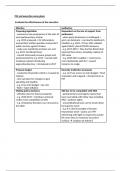
Explanation Evidence Evaluation
PFC - • Raine et al: 11% decrease of PFC grey matter volume - Shows link
personality, in ASPD individuals compared to healthy controls; between ASPD
decision- • Pietrini et al: PET study: reduced activity of the and PFC, but no
making, orbitofrontal PFC during antisocial behaviours was link to criminality
focus and reported → It was suggested that ASPD o enders are - Although brain
attention predisposed to antisocial behaviours because of scans used to
cortical abnormalities that down-regulate the PFC. determine
• Amen et al: decreased PFC activity was shown in damaged areas are
antisocial criminals when compared to healthy objective, the
controls. research is still
• Gregory: ASPD + psychopaths o enders had problems correlational → no
with PFC whilst ASPD o enders did not → there are causation
di erent types of ASPD, not all of them are criminals
Amygdala - • Luo et al: found increased amygdala activity in ASPD
responsible subjects
for mediating • Blair and Blair et al: disruption in amygdala activity is
memory and responsible for disruptions in social behaviour and
emotional morality in violent o enders and psychopaths
drives + • Raine et al: higher levels of CSP, a marker of limbic
responsible maldevelopment, in ASPD su erers → abnormalities in
for the amygdala (and the limbic system in general) a ect
associating the development of ASPD.
harmful
actions with
a victim’s fear
response.
Treatment for ASPD might be CBT (Cognitive Behavioural Therapy), BUT it is extremely hard to
get them going there because:
There is no problem → no therapy is needed
Forced to have a therapy → lie about their improvements and get away with it regardless
3
ff
flff ff ff ff ff ff fi fi
E xplanations for Crime and Anti-Social Behaviour
SOCIAL LEARNING FROM THE MEDIA
SLT Key terms:
• Nurture-environment approach
• Imitation
• Role models
• Attention → Retention (behaviour stays in your memory) → Reproduction (when appropriate)
• Physical ability to reproduce the behaviour
• Motivation (reward) → positive reinforcement (operant)
• Vicarious reinforcement (Bandura)
Bandura’s Study - IMPORTANT
! Male child copies aggressive male role model a lot and more aggressively than female do, whilst
female child copies aggressive female role model, however, not as much as the male role model
→ Gender is tricky when it comes to identifying with a role mode
AO1 AO3
Bandura’s Bobo doll study + It is a controlled lab experiment → highly
internally valid, BUT hard to generalise to
adults, because children are naive and
irrational
Tannis MacBeth Williams - natural experiment, - Might have been lots of factors that could
after 2 yrs of watching TV ptts were 2x have caused aggressive behaviour over 2
aggressive than control group years → EVs were not controlled → less valid,
BUT external validity is high
Most of the evidence is correlational, e.g. - Does violent TV cause criminal behaviour or
Comstock & Paik - meta-analysis of the other way round? → no causation
correlational studies which concluded a established
positive correlation
Flood-Page et al found that children from lower - This shows that there is a third unmeasured
socio-economic class were more likely to be variable such as social class that might cause
delinquent a criminal behaviour → there is only a
relationship between media and crime
Raine’s study on prisoners (Biological unit): - Alternative explanation, which shows that it
there was low activity in PFC and di erent might be not only nurture but also a nature
activity in amygdala issue
Freud suggests that watching violent media is - Challenges the idea that we learn and adopt
cathartic → it acts as a safety valve to release these behaviours from the media
negative emotions in order to prevent oneself
from committing an actual crime
Repeat reo enders - Does not support because they experience
negative consequences and still choose to
commit crime again
1
ff ff
, Unit 3 Section B Criminological Psychology
Practical applications + If we assume that it does cause aggressive
behaviour we can reduce criminal acts shown
on the media
SELF-FULFILLING PROPHECY
Step 1
Expectations / perceptions about the aggressor being violent based on stereotype
Step 2
People show their fear by avoiding / walking away
Step 3
The aggressor internalises the label → starts to believe he is very violent
Step 4
Changes his behaviour towards people on the street → e.g. threaten
Prophecy is ful lled
AO1 AO3
Rosenthal & Jacobson ( eld experiment) - + It does show that people’s expectations can
education in uence one’s behaviour, BUT it cannot be
generalised to crime
Johada, Ashanti Tribe of West Africa: males + It is related to criminal behaviour, BUT this
were given labels depending on what day of relationship is very weak as there could have
the week they were born → Wed had higher been loads of other factors → it is impossible
arrest rate than Mon to study in a controlled lab setting with regards
to crime
Madon et al: sfp within the family home - + Supports theory BUT maybe is not fully
child’s alcohol use turned into a future drinking related to violent behaviour as not all alcohol
behaviour → positive correlation + negative addicts turn into criminals
label is stronger
2
fl fi fi
, Unit 3 Section B Criminological Psychology
It is a descriptive theory - It does not explain how exactly we learn the
criminal behaviour → there are alternative
explanations such as SLT and Biology
Implies that it has to do with society + Practical implications: we can change
society’s labels e.g. through media campaigns
→ decrease criminality
ANTI-SOCIAL PERSONALITY DISORDER (ASPD)
* It is a mental illness that is characterised by a reckless disregard for social norms, impulsive
behaviour, an inability to experience guilt, and a low tolerance for frustration. Individuals with
ASPD exhibit an in ated sense of self-worth and possess a super cial charm, traits that often
aid their attempts to exploit and violate the rights of others.
* The Diagnostic and Statistical Manual of Mental Disorders, Fourth Edition (DSM–IV) classi es
ASPD as a “Cluster B” or “erratic” illness, comparable in symptoms to borderline, narcissistic,
and histrionic personality disorders.18 The DSM-IV restricts the diagnosis of ASPD to individuals
who are at least 18 years of age but who have experienced antisocial tendencies before age 15.
* Criminal behaviour is frequently associated with ASPD.
Explanation Evidence Evaluation
PFC - • Raine et al: 11% decrease of PFC grey matter volume - Shows link
personality, in ASPD individuals compared to healthy controls; between ASPD
decision- • Pietrini et al: PET study: reduced activity of the and PFC, but no
making, orbitofrontal PFC during antisocial behaviours was link to criminality
focus and reported → It was suggested that ASPD o enders are - Although brain
attention predisposed to antisocial behaviours because of scans used to
cortical abnormalities that down-regulate the PFC. determine
• Amen et al: decreased PFC activity was shown in damaged areas are
antisocial criminals when compared to healthy objective, the
controls. research is still
• Gregory: ASPD + psychopaths o enders had problems correlational → no
with PFC whilst ASPD o enders did not → there are causation
di erent types of ASPD, not all of them are criminals
Amygdala - • Luo et al: found increased amygdala activity in ASPD
responsible subjects
for mediating • Blair and Blair et al: disruption in amygdala activity is
memory and responsible for disruptions in social behaviour and
emotional morality in violent o enders and psychopaths
drives + • Raine et al: higher levels of CSP, a marker of limbic
responsible maldevelopment, in ASPD su erers → abnormalities in
for the amygdala (and the limbic system in general) a ect
associating the development of ASPD.
harmful
actions with
a victim’s fear
response.
Treatment for ASPD might be CBT (Cognitive Behavioural Therapy), BUT it is extremely hard to
get them going there because:
There is no problem → no therapy is needed
Forced to have a therapy → lie about their improvements and get away with it regardless
3
ff
flff ff ff ff ff ff fi fi