

Unit 3 Section A Developmental Psychology
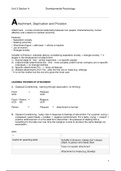
A ttachment, Deprivation and Privation
Attachment - a close emotional relationship between two people, characterised by mutual
a ection and a desire to maintain proximity.
Features:
• Separation anxiety
• Seeking proximity
• Attachment gure = safe base → allows to explore
• Joy at reunion
• Stranger anxiety
Scha er & Emerson: collected data by considering separation anxiety + stranger anxiety → 4
stages in the development of attachment:
1) Asocial stage (0 - 6w) - similar responses + no speci c people
2) Indiscriminate attachments (6w - 6m) - more sociable, prefer human company yet no speci c
individuals + no stranger distress
3) Speci c attachments (7m…) - show all features
4) Multiple attachments (10/11m) - after the rst one is made (e.g. siblings)
* It is not the mother but the one who gives the most care.
LEARNING THEORIES OF ATTACHMENT
A. Classical Conditioning - learning through association, no thinking
Food → Pleasure
UCS UCR
Food + Person → Pleasure
UCS NS UCR
Person → Pleasure → Attachment is formed
B. Operant Conditioning - baby cries in response to feelings of discomfort. For a parent: crying =
unpleasant, parent feeds + cuddles → negative reinforcement. For a baby: crying → reward →
positive reinforcement. It is the relief from discomfort / the pleasure of feeding that is
rewarding for the baby but over time the caregiver comes to produce the same feelings via
association.
AO3:
+ -
Useful for parenting skills Scha er & Emerson: babies don't always
attach to person who feeds them
Does not explain attachment
Attachment is innate (e.g. Bowlby)
1
ff fffi fi fi fi fi
, Unit 3 Section A Developmental Psychology
Lorenz’s gees: gees follow the rst moving object they see during a 12-17 hr critical period after
hatching (imprinting) → suggests that attachment is innate + preprogrammed genetically.
Harlow’s monkeys
1) Infant monkey reared in isolation
- Engaged in bizarre behaviour (e.g. clutching their own bodies)
- Aggression towards other monkeys when placed together
- Unable to communicate/socialise + being bullied
- Indulged in self-mutilation, tearing hair out, scratching, biting themselves
Conclusion: Privation (never forming an attachment bond) is permanently damaging
2) Infant monkeys reared with surrogate mothers
- More time spent with cloth mother (wired if only hungry)
- Refuge with the cloth mother if frightened (= safe base)
- Explore more when with cloth mother
- Compared to those reared with normal mothers: more timid, no interaction, were easily bullied,
di culty with mating, females = inadequate mothers themselves (only if more than 90 days →
less than 90 days e ects could be reversed if placed in a normal environment)
Conclusions: early maternal deprivation → emotional damage but its impact could be reversed if
an attachment was made before the end of critical period.
O’CONNOR’S IDEAS ABOUT ATTACHMENT: SLT
• SLT emphasises on the role of imitation - children see parents & other siblings in a loving way →
imitates their behaviour
• Hay & Vespo: attachments develop because parents teach their children to love them through:
- Modelling: copying the a ectionate behaviour that they see
- Direct instructions: parents teach their children to be a ectionate
- Social facilitations: parents watch their children + encourage appropriate behaviours
AO3:
+ -
Harlow’s monkeys: those who grew up without Durkin: SLT cannot explain why attachments
parents were bad at parenting BUT still got are so emotionally intense
better over time with no instruction
Useful → parents can learn how to be a better Lorenz: innate
role model
2
ffi ff ff fi ff
, Unit 3 Section A Developmental Psychology
O’CONNOR’S STUDY ON SLT INTERVENTIONS IN PARENTING
AO1 AO3
All pre- and post treatment parent-child + did not know if it was experimental / control
interaction data were collected by 2 trained group → reduced researcher bias, which
developmental researchers blind to makes the study more valid
intervention status
Home-visits: 3 tasks videotaped, e.g. in one 10 - arti cial environment → demand
min task parent + child were instructed to characteristics from parents
construct LEGO (only verbal instruction was
allowed)
Sample: randomised controlled trial (randomly + very likely to be representative sample, as it
assigns ptts into groups); 672 children + 174 was chosen randomly → generalisable to the
parents; strati ed sampling (2:1 high risk, 1:2 target population (e.g. children and parents)
low risk)
DV = likert scale (level & intensity of parent - Might be inaccurate measure of attachment
child interaction quality), role play (The → everything was interpreted subjectively →
Manchester Attachment Story Task) decreases validity of the study
Results:
• Parents from treatment group became more sensitive in their responses to the children
• Showed more positive responses to the children
• NO e ect on the attachment narrative of the children
Conclusions:
• SLT interventions can improve attachment behaviour of parents which may have an e ect on
the quality of the relationship between a parent + a child.
BOWLBY’S THEORY OF ATTACHMENT (BASED ON DARWIN, FREUD)
The evolutionary approach
• Infants are born with a drive to become attached to a caregiver because attachment is adaptive
and good for reproduction + survival, because:
1) The infant is more likely to be well cared for when young + defenceless
2) Attachments form the basis for later social relationships → provide a template for how to have
relationships with other people and this promotes survival + reproduction (The Continuity
Hypothesis)
• Infants have innate social releasers (e.g. smiling/crying) → elicit caregiving
• Attachments form because infants and caregivers interact
• Monotropy - one special attachment to primary caregiver who responds to infants’ social
releasers and interacts the most.
• This leads to an internal working model - attachment with primary caregiver is important for
emotional and social development as it has emotional intensity → develops an internal working
model of relationships based on this rst attachment (=schema). The infant internalises this
model - primary caregiver’s behaviour will be expected from others.
• Attachment is a biological process, which takes place during a critical period of development
( rst 2.5 years) or not at all.
3
fi
fiff fi fi ff
A ttachment, Deprivation and Privation
Attachment - a close emotional relationship between two people, characterised by mutual
a ection and a desire to maintain proximity.
Features:
• Separation anxiety
• Seeking proximity
• Attachment gure = safe base → allows to explore
• Joy at reunion
• Stranger anxiety
Scha er & Emerson: collected data by considering separation anxiety + stranger anxiety → 4
stages in the development of attachment:
1) Asocial stage (0 - 6w) - similar responses + no speci c people
2) Indiscriminate attachments (6w - 6m) - more sociable, prefer human company yet no speci c
individuals + no stranger distress
3) Speci c attachments (7m…) - show all features
4) Multiple attachments (10/11m) - after the rst one is made (e.g. siblings)
* It is not the mother but the one who gives the most care.
LEARNING THEORIES OF ATTACHMENT
A. Classical Conditioning - learning through association, no thinking
Food → Pleasure
UCS UCR
Food + Person → Pleasure
UCS NS UCR
Person → Pleasure → Attachment is formed
B. Operant Conditioning - baby cries in response to feelings of discomfort. For a parent: crying =
unpleasant, parent feeds + cuddles → negative reinforcement. For a baby: crying → reward →
positive reinforcement. It is the relief from discomfort / the pleasure of feeding that is
rewarding for the baby but over time the caregiver comes to produce the same feelings via
association.
AO3:
+ -
Useful for parenting skills Scha er & Emerson: babies don't always
attach to person who feeds them
Does not explain attachment
Attachment is innate (e.g. Bowlby)
1
ff fffi fi fi fi fi
, Unit 3 Section A Developmental Psychology
Lorenz’s gees: gees follow the rst moving object they see during a 12-17 hr critical period after
hatching (imprinting) → suggests that attachment is innate + preprogrammed genetically.
Harlow’s monkeys
1) Infant monkey reared in isolation
- Engaged in bizarre behaviour (e.g. clutching their own bodies)
- Aggression towards other monkeys when placed together
- Unable to communicate/socialise + being bullied
- Indulged in self-mutilation, tearing hair out, scratching, biting themselves
Conclusion: Privation (never forming an attachment bond) is permanently damaging
2) Infant monkeys reared with surrogate mothers
- More time spent with cloth mother (wired if only hungry)
- Refuge with the cloth mother if frightened (= safe base)
- Explore more when with cloth mother
- Compared to those reared with normal mothers: more timid, no interaction, were easily bullied,
di culty with mating, females = inadequate mothers themselves (only if more than 90 days →
less than 90 days e ects could be reversed if placed in a normal environment)
Conclusions: early maternal deprivation → emotional damage but its impact could be reversed if
an attachment was made before the end of critical period.
O’CONNOR’S IDEAS ABOUT ATTACHMENT: SLT
• SLT emphasises on the role of imitation - children see parents & other siblings in a loving way →
imitates their behaviour
• Hay & Vespo: attachments develop because parents teach their children to love them through:
- Modelling: copying the a ectionate behaviour that they see
- Direct instructions: parents teach their children to be a ectionate
- Social facilitations: parents watch their children + encourage appropriate behaviours
AO3:
+ -
Harlow’s monkeys: those who grew up without Durkin: SLT cannot explain why attachments
parents were bad at parenting BUT still got are so emotionally intense
better over time with no instruction
Useful → parents can learn how to be a better Lorenz: innate
role model
2
ffi ff ff fi ff
, Unit 3 Section A Developmental Psychology
O’CONNOR’S STUDY ON SLT INTERVENTIONS IN PARENTING
AO1 AO3
All pre- and post treatment parent-child + did not know if it was experimental / control
interaction data were collected by 2 trained group → reduced researcher bias, which
developmental researchers blind to makes the study more valid
intervention status
Home-visits: 3 tasks videotaped, e.g. in one 10 - arti cial environment → demand
min task parent + child were instructed to characteristics from parents
construct LEGO (only verbal instruction was
allowed)
Sample: randomised controlled trial (randomly + very likely to be representative sample, as it
assigns ptts into groups); 672 children + 174 was chosen randomly → generalisable to the
parents; strati ed sampling (2:1 high risk, 1:2 target population (e.g. children and parents)
low risk)
DV = likert scale (level & intensity of parent - Might be inaccurate measure of attachment
child interaction quality), role play (The → everything was interpreted subjectively →
Manchester Attachment Story Task) decreases validity of the study
Results:
• Parents from treatment group became more sensitive in their responses to the children
• Showed more positive responses to the children
• NO e ect on the attachment narrative of the children
Conclusions:
• SLT interventions can improve attachment behaviour of parents which may have an e ect on
the quality of the relationship between a parent + a child.
BOWLBY’S THEORY OF ATTACHMENT (BASED ON DARWIN, FREUD)
The evolutionary approach
• Infants are born with a drive to become attached to a caregiver because attachment is adaptive
and good for reproduction + survival, because:
1) The infant is more likely to be well cared for when young + defenceless
2) Attachments form the basis for later social relationships → provide a template for how to have
relationships with other people and this promotes survival + reproduction (The Continuity
Hypothesis)
• Infants have innate social releasers (e.g. smiling/crying) → elicit caregiving
• Attachments form because infants and caregivers interact
• Monotropy - one special attachment to primary caregiver who responds to infants’ social
releasers and interacts the most.
• This leads to an internal working model - attachment with primary caregiver is important for
emotional and social development as it has emotional intensity → develops an internal working
model of relationships based on this rst attachment (=schema). The infant internalises this
model - primary caregiver’s behaviour will be expected from others.
• Attachment is a biological process, which takes place during a critical period of development
( rst 2.5 years) or not at all.
3
fi
fiff fi fi ff


