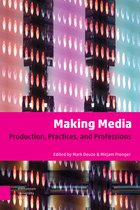
Chapter 1 Making Media: Production, Practices, and Professions
Media production: issues at play within, across, and around the institutions
and forces that create our media, our information, and our culture: management
and economics, media policy, markets, consumers.
Media practices: the various ways in which media professionals make media:
innovation, working conditions, affective labour.
Media professions: more or less demarcated fields of work that make up
professional life in the media industries: journalism, advertising, marketing
communications.
Media production
Shift from consumer electronics to information technology as most powerful
force shaping how media content gets produced, distributed and experienced.
Internet, platforms and connected devices.
Media users and producers are co-dependent on their products and platforms
for formatting, distributing, accessing, and sharing media content because
intermediaries have disrupted the ways in which legacy media operate.
Automation, data, and algorithm play important role.
All elements of the production cycle of making media are computerized and
digitalized new professional roles emerge, job cuts, doing more work with
fewer workers.
Media practices
Technology diminishes costs of production. A new media logic arises: replace
analogue with digital. Digital is always on permanent publication presence.
New technologies work that is more flexible.
Just-time-production = the process of acceleration (whilst cost-cutting): the
production of goods to meet customer demand exactly in time, quality, and
quantity. Continuous deadlines have become the norm.
Media practices disjoined you do not have to be in the same country to work
on the same product.
Media professionals are expected to have cross-media proficiencies and multi-
skills.
Media professions
The boundaries between formerly distinct peer-based communities of practice
are blurring. Freelancing, part-times becomes the norm across the industry. The
media industry in reality is the enormous amount of emotional labour that is
required to ‘stay in’ the industry, the ability to handle rejection, stress.
Principal component: something that all practitioners who make media
professionally experience in one way or another.
Collapse: there is an ongoing convergence of different domains, sectors, and
disciplines within and across media industries.
, Hybridity: blurring of the distinction between professions and practices.
Combining command of one profession with knowledge of a host of others.
Affordance: Media makers face challenges to use multiple media channels,
formats, and interfaces to tell a story. More people can participate.
Power: power moves away from the professional content creators to the media
users and the media owners. Consequence: underpaid, undervalued. However,
more ways to organize themselves (social media, local communities).
Flexibility: Numerical flexibility = the creative use of workforce numbers to
manage a media organization. Functional flexibility = the division of the media
workforce in a multi-skilled core of employees and a periphery of freelance
professional. The core is diminished, and does not offer guarantees in job
security. Temporal flexibility: the lack of dependable, well-organized working
schedules. Flexibility brings presentism: a form of limiting concern for one’s
work and career prospects by focusing on the present.
Precarity: coming to terms with having little or no control over what happens
next in your professional career. Find a way to cross-subsidize the work: doing
what you have to do in order to do what you want to do finding other jobs
aside of your professional job.
Entrepreneurship: an individual solution to systematic problems, clearly
visible within media industries.
Agency: content, connectivity, creativity, and commerce.
Affect: work that elicits an affective investment from its practitioners exceeding
conscious deliberation, and that is intended to elicit a similarly pre-cognitive
response in people. Engagement is a key aspect of making media: not just
getting people to notice your product or service, but get engaged. Labour is
affective and immaterial: a category of work where people turn the whole self
into work. Negative emotions usually not tolerated. Extreme emotions is part of
making the work meaningful.
Chapter 2 Media Industries: A Decade in Review
Creative labour and media work
Scholars revisited Karl Marx ideas about exploitation, necessary labour time.
Impact of digitalization, globalization, conglomeration and deregulation on
creative workers.
Nowadays, more bottom-up methods such as interviews, observation, archival
research and discourse analysis to examine the nature of creative work past and
present. Network executives, talent scouts, market researchers, and brand
managers are a kind of labour and this value is underlined.
Digital distribution
Scholars increasingly mindful of how distribution itself functions as the locus for
a great deal of cultural and political power. How new markets have been
formed, the dimensions of digital distribution.
Platforms and algorithmic culture
Media production: issues at play within, across, and around the institutions
and forces that create our media, our information, and our culture: management
and economics, media policy, markets, consumers.
Media practices: the various ways in which media professionals make media:
innovation, working conditions, affective labour.
Media professions: more or less demarcated fields of work that make up
professional life in the media industries: journalism, advertising, marketing
communications.
Media production
Shift from consumer electronics to information technology as most powerful
force shaping how media content gets produced, distributed and experienced.
Internet, platforms and connected devices.
Media users and producers are co-dependent on their products and platforms
for formatting, distributing, accessing, and sharing media content because
intermediaries have disrupted the ways in which legacy media operate.
Automation, data, and algorithm play important role.
All elements of the production cycle of making media are computerized and
digitalized new professional roles emerge, job cuts, doing more work with
fewer workers.
Media practices
Technology diminishes costs of production. A new media logic arises: replace
analogue with digital. Digital is always on permanent publication presence.
New technologies work that is more flexible.
Just-time-production = the process of acceleration (whilst cost-cutting): the
production of goods to meet customer demand exactly in time, quality, and
quantity. Continuous deadlines have become the norm.
Media practices disjoined you do not have to be in the same country to work
on the same product.
Media professionals are expected to have cross-media proficiencies and multi-
skills.
Media professions
The boundaries between formerly distinct peer-based communities of practice
are blurring. Freelancing, part-times becomes the norm across the industry. The
media industry in reality is the enormous amount of emotional labour that is
required to ‘stay in’ the industry, the ability to handle rejection, stress.
Principal component: something that all practitioners who make media
professionally experience in one way or another.
Collapse: there is an ongoing convergence of different domains, sectors, and
disciplines within and across media industries.
, Hybridity: blurring of the distinction between professions and practices.
Combining command of one profession with knowledge of a host of others.
Affordance: Media makers face challenges to use multiple media channels,
formats, and interfaces to tell a story. More people can participate.
Power: power moves away from the professional content creators to the media
users and the media owners. Consequence: underpaid, undervalued. However,
more ways to organize themselves (social media, local communities).
Flexibility: Numerical flexibility = the creative use of workforce numbers to
manage a media organization. Functional flexibility = the division of the media
workforce in a multi-skilled core of employees and a periphery of freelance
professional. The core is diminished, and does not offer guarantees in job
security. Temporal flexibility: the lack of dependable, well-organized working
schedules. Flexibility brings presentism: a form of limiting concern for one’s
work and career prospects by focusing on the present.
Precarity: coming to terms with having little or no control over what happens
next in your professional career. Find a way to cross-subsidize the work: doing
what you have to do in order to do what you want to do finding other jobs
aside of your professional job.
Entrepreneurship: an individual solution to systematic problems, clearly
visible within media industries.
Agency: content, connectivity, creativity, and commerce.
Affect: work that elicits an affective investment from its practitioners exceeding
conscious deliberation, and that is intended to elicit a similarly pre-cognitive
response in people. Engagement is a key aspect of making media: not just
getting people to notice your product or service, but get engaged. Labour is
affective and immaterial: a category of work where people turn the whole self
into work. Negative emotions usually not tolerated. Extreme emotions is part of
making the work meaningful.
Chapter 2 Media Industries: A Decade in Review
Creative labour and media work
Scholars revisited Karl Marx ideas about exploitation, necessary labour time.
Impact of digitalization, globalization, conglomeration and deregulation on
creative workers.
Nowadays, more bottom-up methods such as interviews, observation, archival
research and discourse analysis to examine the nature of creative work past and
present. Network executives, talent scouts, market researchers, and brand
managers are a kind of labour and this value is underlined.
Digital distribution
Scholars increasingly mindful of how distribution itself functions as the locus for
a great deal of cultural and political power. How new markets have been
formed, the dimensions of digital distribution.
Platforms and algorithmic culture