Plasma Membrane
5.1 The structure and function of membranes
5.1 The Structure and Function of Membranes
- The Plasma membrane separates the internal cell contents 5.2 Factors affecting membrane structure
with the environment and controls what enters and leaves 5.3 Diffusion
the cell.
- Membranes also separate different areas within the cell 5.4 Active Transport
(organelles) from each other and the cytosol. 5.5 Osmosis
- Some organelles are divided up further by internal
membranes e.g. chloroplasts and mitochondria.
- Formation of separate membrane-bound areas in a cell is called compartmentalisation.
- This is crucial for cell metabolism as is allows the specific conditions required for reactions.
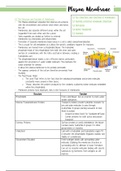
- Membranes are formed from a phospholipid bilayer. The hydrophilic
phosphate heads of the phospholipids form both the inner and outer
surface of a membrane, with the fatty acid tails in between, creating a
hydrophobic core.
- The phospholipid bilayer makes a very effective barrier, particularly
against the movement of water-soluble molecules. This maintains the
water potential for osmosis.
- It allows the plasma membrane to be partially permeable
- The aqueous contents of the cell are therefore prevented from
escaping.
- The Fluid Mosaic Model
o The word ‘fluid’ refers to the fact that the individual phospholipids and protein molecules
constantly move around in their layers,
o ‘Mosaic’ describes the pattern produced by the randomly scattered protein molecules embedded
within the phospholipids.
- Membrane proteins have important roles in the functions of membranes:
Structure Function
Phospholipids Form a lipid bilayer. Act as a barrier to most water-
soluble substances.
Intrinsic/Transmembrane Proteins Transport proteins provide hydrophilic channels for
ions and polar molecules to pass through.
Hydrophobic R-groups pointing outwards to keep
them in position.
- Channel proteins (pore) for facilitated diffusion
- Carrier proteins for both active and passive
transport
Extrinsic Proteins Surface proteins or partly embedded in the bilayer.
Contain mainly hydrophilic R-groups. For either
glycoproteins or enzymes.
Cholesterol Lipid with a hydrophilic and hydrophobic region. Fit
in between the phospholipids. Regulates stability and
fluidity of a membrane.
Glycoprotein/Glycolipid Form hydrogen bonds with surrounding water
molecules stabilising the membrane structure or
surrounding cells for adhesion in tissue formation.
Can act as receptor molecules binding with specific
substances e.g. hormones. Form antigens as cell
markers.
5.1 The structure and function of membranes
5.1 The Structure and Function of Membranes
- The Plasma membrane separates the internal cell contents 5.2 Factors affecting membrane structure
with the environment and controls what enters and leaves 5.3 Diffusion
the cell.
- Membranes also separate different areas within the cell 5.4 Active Transport
(organelles) from each other and the cytosol. 5.5 Osmosis
- Some organelles are divided up further by internal
membranes e.g. chloroplasts and mitochondria.
- Formation of separate membrane-bound areas in a cell is called compartmentalisation.
- This is crucial for cell metabolism as is allows the specific conditions required for reactions.
- Membranes are formed from a phospholipid bilayer. The hydrophilic
phosphate heads of the phospholipids form both the inner and outer
surface of a membrane, with the fatty acid tails in between, creating a
hydrophobic core.
- The phospholipid bilayer makes a very effective barrier, particularly
against the movement of water-soluble molecules. This maintains the
water potential for osmosis.
- It allows the plasma membrane to be partially permeable
- The aqueous contents of the cell are therefore prevented from
escaping.
- The Fluid Mosaic Model
o The word ‘fluid’ refers to the fact that the individual phospholipids and protein molecules
constantly move around in their layers,
o ‘Mosaic’ describes the pattern produced by the randomly scattered protein molecules embedded
within the phospholipids.
- Membrane proteins have important roles in the functions of membranes:
Structure Function
Phospholipids Form a lipid bilayer. Act as a barrier to most water-
soluble substances.
Intrinsic/Transmembrane Proteins Transport proteins provide hydrophilic channels for
ions and polar molecules to pass through.
Hydrophobic R-groups pointing outwards to keep
them in position.
- Channel proteins (pore) for facilitated diffusion
- Carrier proteins for both active and passive
transport
Extrinsic Proteins Surface proteins or partly embedded in the bilayer.
Contain mainly hydrophilic R-groups. For either
glycoproteins or enzymes.
Cholesterol Lipid with a hydrophilic and hydrophobic region. Fit
in between the phospholipids. Regulates stability and
fluidity of a membrane.
Glycoprotein/Glycolipid Form hydrogen bonds with surrounding water
molecules stabilising the membrane structure or
surrounding cells for adhesion in tissue formation.
Can act as receptor molecules binding with specific
substances e.g. hormones. Form antigens as cell
markers.