Science Exam Notes
Physics: A
3
magnitude Direction
~ L
displacement ·
. distance
Speed → 20m/s N
N
Mechanics Unit - 3 6
.
~
B
Km m
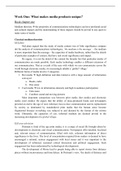
Vectors: a quantity that has both magnitude + direction [ E.g. weight,velocity,displacement,acceleration ] h s
j
Scalars: a quantity that only has magnitude [ E.g. mass, time,speed,distance ]
X 36 .
Magnitude:size,which can be measured
Bearing:an angle measured clockwise from north
Resultant: a single vector that will have the same effect as the original vectors acting together
Displacement: a measurement of the change in position of an object - the straight line distance pointing from the st rting point Q
to the end point,with the direction
Distance: a measurement of how far an object has moved (ΔX)
Velocity: the rate of change of position
Vector Quantity Unit Scalar Quantity Unit Frame of Reference:reference in which the position or motion of an
Velocity m.s⁻¹ Speed m/s object is compared to
Displacement m Distance m =>
Average Speed:distance traveled divided by the total time taken Vau =&
Ax
Acceleration m.s - 2
Time s AverageVelocity:displacement divided by the total time taken V =
F
Force N Energy J ConstantVelocity:when both magnitude and direction don't change over time
Charge C and the object is traveling at the same velocity throughout
Di
1cm = 10m N a) 30m at 45
Ax
b)15.8m at 20 south of east X
c)22m at south 30 east Head to Tail vector
Som
· W E d)28m at 330 4cm
Use pythag to solve for x
-
S Resultant Vector = single vector that has the same effect as a number
1800
of vectors acting together
U D
Sound, Light and Waves fX ST
Pulse: a single disturbance that transfers energy in a medium
Pulselength:the distance from st rt to finish of a pulse
a
Transverse Pulse: the vibration of pArticles is perpendicular to the direction of movement
Longitudinal Pulse: the vibration of pArticles is parallel to the direction of movement
(A) Amplitude: the maximum displacement from position of rest (m)
(λ) Wavelength: the distance between 2 points in phase (m)
(T) Period: the time taken for a complete wave to pass a point (s)
(f) Frequency: the number of complete waves to pass a point in one second (Hz) pulse length
, fixed end free end
Pulses
Pulse moving towards the surface → incident pulse
·
Pulse moving away from the surface → reflected pulse
When a pulse moves from a thin to thick medium:
energy is lost → amplitude decreases
thick medium = fixed end → pulse is reflected inverted
When a pulse moves from a thick to thin medium:
a portion of the pulse speeds up → amplitude increases
thin medium = free end → pulse is reflected with no inversion
Superstition of Pulses
When 2 pulses meet eachother while traveling in the same medium, the resultant amplitude at any point is the algebraic sum of the
amplitudes of the individual pulses at that point.
ConstructiveInterference
When a crest meets a crest, a bigger wave (higher amplitude) is formed. The
crests will then continue in their original directions with their original amplitudes.
&
Destructive Interference
When a crest meets a trough, a smaller wave (lower amplitude) is formed. The
waves will then continue in their original directions with their original amplitudes.
When there is continuous interference by coherent waves (waves of the same frequency and amplitude vibrating at the same time)
there are:
areas with maximum disturbance → constructive
areas with zero disturbance → destructive (nodallines)
Waves
A series of consecutive pulses which transfer energy through a medium
Transverse Pulse: the disturbances are perpendicular to the direction of movement
Longitudinal Pulse: the disturbances are parallel to the direction of movement
Points in Phase: points on a wave with the same displacement from the equilibrium moving in the same direction
Period and Frequency of a Wave
Inverse of eachother → f= 1/T + T= 1/f
The higher the frequency, the shorter the wavelength
Number of waves = number of crest -1
, Sound
Sound waves are longitudinal waves that originate from the vibration of an object.
:
-
The vibrations can only be transmitted through matter (not a vacuum).
The quality of sound refers to the loudness and pitch of a note:
Pressure
The greater the amplitude, the louder the note
time
The higher the frequency the higher the pitch
Ultrasound
A
Waves are considered to be ultrasonic if they have a frequency
above 20 khz (20 000Hz)
This means that they have extremely small wavelengths
They can be used to detect objects by transmitting a signal
and detecting the reflected waves.
Pica = 10
- 12
m = 10
O
Nano = 10
-
9
Km = 10
3
EM Spectrum:
Micro = 10
6
Mega = 10
-
6
Electromagnetic Waves Mili = 10
Can travel through a vacuum
Travel at the speed of light = c = (3 x 10 m/s)
.
The shorter the wavelength and the higher the frequency, the greater
the energy → the greater the penetrating ability of the wave.
10 10 10 10
3. 00
10
. . .
10
-
1
0.5 x 10
Electricity & Magnetism
Magnetic Fields
A magnetic field is a region where a magnetic object will experience a force.
• Magnetic field lines run from North to South
• They are continuous
• They never cross
• They are closest together where the field is stronger ①
·
• Magnetic field lines are vector quantities
When two fields superimpose:
• Field lines in the same direction result in a stronger field
&
• Field lines in opposite directions result in a weaker field
Magnetic Domains
The electrons in matter are all surrounded by their = domains unaligned
own magnetic field. The material thus consists of
regions called domains (which are tiny magnetic Coil Off
fields). If these domains are not all aligned in the
same direction, the material will not be magnetic.
However, if they align in the same direction, there = domains aligned
will be an overall polarity.
Coil On
Physics: A
3
magnitude Direction
~ L
displacement ·
. distance
Speed → 20m/s N
N
Mechanics Unit - 3 6
.
~
B
Km m
Vectors: a quantity that has both magnitude + direction [ E.g. weight,velocity,displacement,acceleration ] h s
j
Scalars: a quantity that only has magnitude [ E.g. mass, time,speed,distance ]
X 36 .
Magnitude:size,which can be measured
Bearing:an angle measured clockwise from north
Resultant: a single vector that will have the same effect as the original vectors acting together
Displacement: a measurement of the change in position of an object - the straight line distance pointing from the st rting point Q
to the end point,with the direction
Distance: a measurement of how far an object has moved (ΔX)
Velocity: the rate of change of position
Vector Quantity Unit Scalar Quantity Unit Frame of Reference:reference in which the position or motion of an
Velocity m.s⁻¹ Speed m/s object is compared to
Displacement m Distance m =>
Average Speed:distance traveled divided by the total time taken Vau =&
Ax
Acceleration m.s - 2
Time s AverageVelocity:displacement divided by the total time taken V =
F
Force N Energy J ConstantVelocity:when both magnitude and direction don't change over time
Charge C and the object is traveling at the same velocity throughout
Di
1cm = 10m N a) 30m at 45
Ax
b)15.8m at 20 south of east X
c)22m at south 30 east Head to Tail vector
Som
· W E d)28m at 330 4cm
Use pythag to solve for x
-
S Resultant Vector = single vector that has the same effect as a number
1800
of vectors acting together
U D
Sound, Light and Waves fX ST
Pulse: a single disturbance that transfers energy in a medium
Pulselength:the distance from st rt to finish of a pulse
a
Transverse Pulse: the vibration of pArticles is perpendicular to the direction of movement
Longitudinal Pulse: the vibration of pArticles is parallel to the direction of movement
(A) Amplitude: the maximum displacement from position of rest (m)
(λ) Wavelength: the distance between 2 points in phase (m)
(T) Period: the time taken for a complete wave to pass a point (s)
(f) Frequency: the number of complete waves to pass a point in one second (Hz) pulse length
, fixed end free end
Pulses
Pulse moving towards the surface → incident pulse
·
Pulse moving away from the surface → reflected pulse
When a pulse moves from a thin to thick medium:
energy is lost → amplitude decreases
thick medium = fixed end → pulse is reflected inverted
When a pulse moves from a thick to thin medium:
a portion of the pulse speeds up → amplitude increases
thin medium = free end → pulse is reflected with no inversion
Superstition of Pulses
When 2 pulses meet eachother while traveling in the same medium, the resultant amplitude at any point is the algebraic sum of the
amplitudes of the individual pulses at that point.
ConstructiveInterference
When a crest meets a crest, a bigger wave (higher amplitude) is formed. The
crests will then continue in their original directions with their original amplitudes.
&
Destructive Interference
When a crest meets a trough, a smaller wave (lower amplitude) is formed. The
waves will then continue in their original directions with their original amplitudes.
When there is continuous interference by coherent waves (waves of the same frequency and amplitude vibrating at the same time)
there are:
areas with maximum disturbance → constructive
areas with zero disturbance → destructive (nodallines)
Waves
A series of consecutive pulses which transfer energy through a medium
Transverse Pulse: the disturbances are perpendicular to the direction of movement
Longitudinal Pulse: the disturbances are parallel to the direction of movement
Points in Phase: points on a wave with the same displacement from the equilibrium moving in the same direction
Period and Frequency of a Wave
Inverse of eachother → f= 1/T + T= 1/f
The higher the frequency, the shorter the wavelength
Number of waves = number of crest -1
, Sound
Sound waves are longitudinal waves that originate from the vibration of an object.
:
-
The vibrations can only be transmitted through matter (not a vacuum).
The quality of sound refers to the loudness and pitch of a note:
Pressure
The greater the amplitude, the louder the note
time
The higher the frequency the higher the pitch
Ultrasound
A
Waves are considered to be ultrasonic if they have a frequency
above 20 khz (20 000Hz)
This means that they have extremely small wavelengths
They can be used to detect objects by transmitting a signal
and detecting the reflected waves.
Pica = 10
- 12
m = 10
O
Nano = 10
-
9
Km = 10
3
EM Spectrum:
Micro = 10
6
Mega = 10
-
6
Electromagnetic Waves Mili = 10
Can travel through a vacuum
Travel at the speed of light = c = (3 x 10 m/s)
.
The shorter the wavelength and the higher the frequency, the greater
the energy → the greater the penetrating ability of the wave.
10 10 10 10
3. 00
10
. . .
10
-
1
0.5 x 10
Electricity & Magnetism
Magnetic Fields
A magnetic field is a region where a magnetic object will experience a force.
• Magnetic field lines run from North to South
• They are continuous
• They never cross
• They are closest together where the field is stronger ①
·
• Magnetic field lines are vector quantities
When two fields superimpose:
• Field lines in the same direction result in a stronger field
&
• Field lines in opposite directions result in a weaker field
Magnetic Domains
The electrons in matter are all surrounded by their = domains unaligned
own magnetic field. The material thus consists of
regions called domains (which are tiny magnetic Coil Off
fields). If these domains are not all aligned in the
same direction, the material will not be magnetic.
However, if they align in the same direction, there = domains aligned
will be an overall polarity.
Coil On