Preview cart 2018/8/7 20(24
CHAPTER1 S
1. Explain the three economic questions that all economies face because of the basic economic problem.
Explanation
The term 'scarcity' describes that at any point of time there is finite amount of resources available to satisfy infinite wants. Wants include needs and desires to
obtain and use various goods and services that provide satisfaction. Resources are typically called factors of production (land, labour, capital and
entrepreneur) are all the inputs used in the production of those goods and services that we want.
Scarcity occurs among poor as well as rich people. It applies to all because there will never be enough of everything that people want at zero price. Because
of scarcity of productive resources, output itself is limited and society is not able to produce and consume all the goods and services it wants. Thus, choices
have to be made. These choices involve the allocation of scarce resources among alternative uses to achieve given ends. No matter what the economic
system, the problem of scarcity must be addressed and in doing so every economic system faces opportunity cost in decision making.
Owing to scarcity, all societies, following any economic system, must address the basic questions of what, how and for whom to produce to finalise their
choices.
1. What to produce? Given that resources are not enough to produce all commodities people want to consume. Society has to decide what mix of
commodities to produce and in what quantities. For example, whether to construct new roads or hospitals, produce cars or tanks, and in what quantities
each of the commodities should be produced.
2. How to produce? The nation also has to decide what methods of production to adopt in order to produce maximum possible quantities from scarce
resources of all commodities that it chooses to produce. In other words, what combination of resources are going to be used and in what quantities those
resources should be used? For example, whether to use relatively greater amount of capital compared to labour (capital intensive) or use relatively larger
quantity of labour compared to capital (labour intensive).
3. How to distribute? This question focuses upon the distribution of the economy's output. Since resources are scarce and so are commodities therefore not
everything can be produced for everyone. On a broad level the nation needs to decide whether everyone is going to have an equal share of what is
produced or some will have more than others. In a market economy the decisive factor is individuals' incomes. For instance, those with higher incomes
obtain a larger share from the nation's output.
Finally, the term scarcity indicates the excess of human wants over what can actually be produced to fulfill these wants.
2. How might opportunity cost help to explain the pattern of international trade?
Explanation
Opportunity cost is the sacrifice of the next best outcome in taking a decision. For a nation, the opportunity cost is the amount of other products, which must
be sacrificed to produce a unit of another product. The concept of opportunity cost provides basis for explanation of international trade.
According to the principle of comparative advantage total output will be the greatest when each good is produced by that nation which has the lowest
domestic opportunity cost for that good. To illustrate this principle we assume that there are only two countries involved in trade, say Pakistan and Iran and
each can produce just two products textile and steel. Also, opportunity costs are constant for each product and the exchange rate operating for international
transaction must be between the respective domestic opportunity cost ratios. We also assume that transport costs are zero and there are no restrictions on
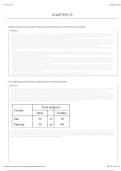
free trade. Following table summarises production possibilities of these two countries of two products:
If it is assumed that all resources are fully employed it is only possible to produce one more unit of a commodity if resources are reallocated from the
production of the other commodity. In case of Iran, production of one more unit of textiles requires 2 units of steel to be sacrificed, thus giving an opportunity
cost ratio of 1 : 2. In terms of Pakistan the production of one more unit of textiles requires 5 units of steel to be sacrificed, the opportunity cost ratio therefore
being 1 : 5. The opportunity cost ratios are summerised in the following table.
https://lms.coursemo.com/#/questionbank/card/preview 1 22
,Preview cart 2018/8/7 20(24
The opportunity cost of producing textiles is higher in Pakistan (5 units of steel), than in Iran (2 units of steel), whereas for steel it is higher in Iran than Pakistan.
The difference between opportunity cost ratios means that there are benefits to be obtained from specialization and trade, with Pakistan specializing in steel
and Iran in textile production. Pakistan can obtain one unit of textiles by scarifying less than 5 units of steel which is lower than the domestic opportunity cost.
Similarly, Iran will be able to obtain more than 2 units of steel for each unit of textiles. Hence, after specialization both countries would be able to consume
more than what they can produce themselves.
In conclusion a country therefore, has a comparative advantage in the production of the commodities whose opportunity cost is lower. There is no advantage
and therefore, no gain to be made from trade if the opportunity costs are identical.
3. Explain, with the help of a production possibility diagram, how the opportunity cost of producing different combinations of goods can be
measured.
Explanation
A production possibility curve (PPC) shows all possible combinations of two goods that a country can produce within a specified time period with the
given state of technology when all its resources are fully and efficiently employed. The idea of production possibilities is usually shown graphically as given
below:
In the graph above each point on the PPC represents maximum output of capital goods and consumer goods. The country must achieve full employment and
productive efficiency in order to operate at any point on the PPC. However, if the economy were at point G; there would be unemployed resources and by
bringing those resources into use the economy could move to any point on the PPC. Points outside the frontier such as H are unattainable with the current
supplies of resources and technology.
Primarily the negative slope of the PPC can be viewed in terms of scarcity of resources and opportunity cost. Opportunity cost is often referred to as the real
cost measured in terms of the next most desired alternative sacrificed. Construction of a new sports complex, for instance, might involve sacrificing the
construction of a number of houses from the same resources. In this case we say that the opportunity cost of constructing a sports complex is the housing
which is sacrificed.
To be precise a PPC shows that obtaining more of one type of output requires having less of the other On the graph above as we move down from point A
along the PPC we can measure the opportunity cost because more units of consumer goods needs resources to be taken from the production of capital
goods, i.e. there is an alternative forgone. Thus at point A the opportunity cost of 30 million units of consumer goods involves 25 million units of capital goods
sacrificed. A movement from A to B involving the production of 5 million units of capital goods requires a reduction of 2 million units in the production of
consumer goods with an opportunity cost of 0.4 i.e. one unit of capital has been gained at the expense of 0.4 units of consumer goods. Similarly in moving
from B to C an extra 5 million units of capital goods production will mvolve a reduction in consumer goods production of 3 million units, with a
resulting opportunity cost of 0.6. Finally a movement from E to F, again with an extra 5 million units of capital produc-tion, will require forgoing 15 million units
of consumer goods with an opportunity cost of 3.0 The opportunity cost decreases as we move down the negatively sloping concave PPC.
However, the movement from point G to any point on the PPC within the shaded area will involve zero opportunity cost This is because the economy can
increase its output of both goods simultaneously by sirrply usmg the unemployed resources. Nevertheless, the concept of opportunity cost cannot be applied
to point H or any other point outside PPC. This is because the available resources do not allow the economy to obtain those quantities of either goods.
Thus opportunity cost of different combination of goods can be measured on a PPC.
https://lms.coursemo.com/#/questionbank/card/preview 2 22
,Preview cart 2018/8/7 20(24
4. Discuss whether the combination of improved technology and globalisation will result in solving the basic economic problem.
Explanation
The term 'scarcity' describes that at any point of time there is finite amount of resources available to satisfy infinite wants. Owing to scarcity all societies have
to make choices and the process of making choices involve sacrifice measured as opportunity cost. It is important to distinguish scarcity from poverty.
Scarcity occurs among poor as well as rich people. It applies to all because there will never be enough of everything that people want at zero price. Even the
richest person on earth will still have unfulfilled wants.
Improvement in technology entails progress in knowledge about techniques of production. Such progress may allow more output to be obtained from the
same amount of resources. While globalization is the process by which the whole world becomes a single market. This means that goods and services, capital
and labour are traded on a worldwide basis. Another way of describing globalisation is to describe it as a process of making the world economy more
interdependent. The expansion of trade in goods and services, the huge increase in flows of financial capital across national boundaries and the significant
increase in multinational economic activity means that most of the world's economies are increasingly dependent on each other for their economic
health. Globalization no longer necessarily requires a business to own a physical presence in terms of either owning production plants or land in other
countries, or even exports and imports. For instance, economic activity can be shifted abroad by the processes of licensing and franchising which only needs
information and finance to cross borders.
The process of globalization has been aided largely by the phenomenal technological progress particularly in the area of transportation and communication.
Technological progress has reduced massively the cost of transmitting and communicating information - sometimes known as "the death of distance" - this is
an enormous factor behind the growth of trade in knowledge products using internet technology. Advances in transport technology have lowered the costs,
increased the speed and reliability of transporting goods and people - extending the geographical reach of firms by making new and growing markets
accessible on a cost-effective basis. As a result, there has been a significant increase in the number of firms that locate, source and sell internationally,
reflecting the new opportunities presented by the ICT revolution.
For consumers and capitalists, the rapid expansion of international trade and foreign investment is normally considered a good thing. The ease with which
goods, capital and technical knowledge can be moved around the world has increasingly enabled the division of labour on a global scale, as firms allocate
their operations in line with countries' comparative advantage. It means that the nations concentrate on producing what they can do best rather than relying on
self sufficiency. It also results in nations producing surplus beyond their needs. Surplus products can then be exchanged and traded with the potential for
gains in welfare for all parties.
Economic theory suggests that increased competition from overseas leads to improvements in efficiency and gains in economic welfare. Vigorous trade makes
for more choice for consumers, greater spending, rising living standards and a growth in international travel.
However concern has been expressed in some quarters that economic activity and employment in some economies drain away to the others. Inevitably some
jobs are lost as firms switch their production to countries with lower unit labour costs. But the theory of international trade and most past experiences suggest
that all nations in the globalization process will gain in the long run - as trade is an important determinant of long run growth and rising living standards. Critics
of globalisation in some developed countries point to the risks of increasing income equalities and greater job insecurity together with the threat of structural
unemployment in industries where demand for labour falls.
While no one will dispute the fact that technological progress coupled with globalization will increase the world output from the available resources and as a
result much more than ever will be available to consume which is likely to improve standard of living for majority if not for all. Yet the world, at any point in time,
will never be able to produce enough to satisfy all wants of all the people living in the world.
5. Explain the contributions of enterprise and division of labour to an economy.
Explanation
Enterprise is a distinct type of human resource. Entrepreneurship is associated with the founding of new businesses, or taking the initiative in combining the
resources of land, capital, and labor to produce a good or service. The entrepreneur is the driving force behind production and the agent who combines the
other resources in what is hoped will be a successful business venture. As an innovator he is the one who attempts to introduce, on a commercial basis, new
products, new productive techniques, or even new forms of business organization. The entrepreneur risks not only time, effort, and business reputation but his
or her invested funds and those of associates.
The role of entrepreneur is of prime importance in a free market economy. It is the entrepreneur who decides what to produce, how to produce and where to
produce. Without the entrepreneur, land, labour and capital are just masses of resources of no economic importance. It is the entrepreneur who organizes
them for production and devices technical combinations of inputs to make the most efficient use of scarce resources.
Large production units allow the process of production to be broken down into a series of tasks. This is called division of labour. Adam Smith, in his book,
showed how the production of pins would benefit from the application of the division of labour in a factory. He suggested that pin making could be divided into
18 distinct operations and that each employee undertook only one of the operations, production would rise to 5000 pins per employee per day. This was
compared to his estimate that each employee would be able to produce only a few dozen each day if they produce pins individually.
Division of labour allows people to specialize in doing a job at which they can become both ·proficient and efficient. This improvement in efficiency results in
higher productivity, mass output, reduction in per unit cost and prosperity in general.
6. Explain why the successful operation of the division of labour depends upon the use of money.
Explanation
Division of labour involves the process of production to be broken up into many separate tasks each performed by one person or by a small group of
people specializing in performing those particular tasks.
Division of labour allows each person to do what he or she can do well while leaving everything else to be done by others. As a result a person who
concentrates on one activity becomes better at it than could a jack-of-alltrades. This brings a variety of skills among workers and makes it easier and less
costly for firms to train them. Also it allows firms to benefit from specialist machinery and gain from economizing in the use of tools.
Thus division of labour allows businesses to produce standardized goods on a large scale. The result is higher output, lower per unit cost and improved
quality. A higher output at lower costs means economic progress as more wants and needs might be satisfied with a given amount of scarce resources.
However in order to fully benefit from division of labour the resulting higher output must be traded with the potential for gains in welfare for all parties. It,
therefore, follows that successful operation of division of labour requires an efficient medium of exchange. Since money avoids the use of barter and the need
for a double coincidence of wants therefore, makes trade more efficient. Acting as a unit of account and a medium of exchange it also simplifies the trading
process. The store of value and standard of deferred payment functions encourage saving and investment and hence foster efficiency and economic progress.
We define money as anything which is generally acceptable in purchasing goods or settling debts. It need not consist of coins and notes. There are examples
in the history when Oxen, salt, cotton cloth and cigarettes have been used as money.
https://lms.coursemo.com/#/questionbank/card/preview 3 22
, Preview cart 2018/8/7 20(24
Money stimulates trade by making it easier to exchange through its functions. Firstly, as a medium of exchange money allows society to escape the
complication of double coincidence that requires the need for both sides to want the good the other has to trade. It is cumbersome costly and difficult, if not
impossible. Besides this large and bulky goods may be difficult to divide to facilitate exchanges. It therefore reduces trade volumes and restrains the use of
specialization and division of labour. On the contrary money is denominated in different values thus making it easier to buy and sell goods of different values.
As a unit of account money provides a scale to measure the relative worth of a wide variety of commodities, making possible the operation of a price system
and automatically providing the basis for keeping accounts, calculating profit and loss etc. In a barter system it is difficult to establish agreed units of account
as people's opinion of the value of certain items differ greatly making it even more difficult to trade.
Money also functions as a standard of deferred payments, the unit in which, given stability in its value, loans are made and future contracts fixed. Without
money, there would be no common basis to allow for dealing in debts. By providing a standard for repayment, money makes borrowing and lending much
easier and therefore makes it possible to borrow and make large scale investments where division of labour can be applied.
Thus it can be concluded that money, by facilitating trade, has contributed a great deal to the successful operation of division of labour.
7. Palm Oil Production
Palm oil is used in the production of many goods, including cooking oil, margarine, ice cream, soap, shampoo and more recently fuel for
vehicles. It competes with other vegetable oils, made from soyabeans, rapeseed, sunflowers and groundnuts. While palm oil production takes up
6% of the land used for vegetable oil plants across the world, :t produces 38% of the total output of vegetable oil globally and accounts for 60%
of world exports of vegetable oil.
Palm oil is produced from the flesh of the palm fruit and, at the same time, palm kernel oil is produced from the kernel or seed. After the
extraction of the oils the waste is turned into palm kernel cake that is then sold for animal feed.
In Malaysia the palm oil industry employs 570000 people of which 405000 are engaged in cultivation. Malaysia and Indonesia are the world's
two most important palm oil producers and details of their production are given in Table 1.
Table 1: Palm oil production in Malaysia and Indonesia, 1995 and 2008
Malaysia Indonesia
1995 Production (’000 tonnes) 7811 4480
1995 Area cultivated (’000
2540 2025
hectares)
2008 Production (’000 tonnes) 17734 18090
2008 Area cultivated (’000
4488 7008
hectares)
The increase in the cultivation of palm oil has been criticised on environmental grounds. There have been accusations of deforestation, reduction
of biodiversity, harm to wildlife and increasing emissions of greenhouse gases. One response has been an organisation of growers,
processors, and food companies to encourage the production of sustainable palm oil that limits the harm to the environment.
a. Give two reasons why palm oil is an important product for the economy of Malaysia.
b. Analyse, with the aid of diagrams, the impact of an increase in demand for palm oil on the markets for palm oil and palm kernel cake.
c. i. How can Table 1 be used to provide one measure of productivity in palm oil production?
ii. Use Table 1 to compare the productivity of palm oil production in Indonesia in 1995 and 2008.
d. What additional information would give a better understanding of changes in productivity in palm oil production in Indonesia?
e. Discuss any two policies that governments might use to prevent harm to the environment from palm oil production.
Explanation
a. 1. Palm oil industry employs 570,000 people.
2. Industry earns foreign exchange from palm oil export.
b.
Increased demand for palm oil shifts the market equilibrium point from 'e' to e1. It, therefore, results in an increase in market equilibrium price from P to P1
and quantity from Q to Q1.Palm kernel cake is in joint supply i.e. produced as a byproduct of palm oil. So an increase in production and quantity supplied
of palm oil simultaneously increases the supply of palm kernel from S to S1 and hence results in a fall in equilibrium price from P to P1 and a rise in quantity
from q to q1.
c. i. Information in the table can be used to measure output per hector of land used in production of palm oil.
Productivity per hector =(Total output of palm oil)/(Area cultivated)
ii. 1995:(4480/2025)=2.2
2008:(18090/7008)=2.6
Productivity per hector of land increased in Indonesia between 1995 and 2008.
d. Palm oil production involves many other inputs combined with land, therefore, a change in the quality and/or quantities of those complementary inputs
https://lms.coursemo.com/#/questionbank/card/preview 4 22
CHAPTER1 S
1. Explain the three economic questions that all economies face because of the basic economic problem.
Explanation
The term 'scarcity' describes that at any point of time there is finite amount of resources available to satisfy infinite wants. Wants include needs and desires to
obtain and use various goods and services that provide satisfaction. Resources are typically called factors of production (land, labour, capital and
entrepreneur) are all the inputs used in the production of those goods and services that we want.
Scarcity occurs among poor as well as rich people. It applies to all because there will never be enough of everything that people want at zero price. Because
of scarcity of productive resources, output itself is limited and society is not able to produce and consume all the goods and services it wants. Thus, choices
have to be made. These choices involve the allocation of scarce resources among alternative uses to achieve given ends. No matter what the economic
system, the problem of scarcity must be addressed and in doing so every economic system faces opportunity cost in decision making.
Owing to scarcity, all societies, following any economic system, must address the basic questions of what, how and for whom to produce to finalise their
choices.
1. What to produce? Given that resources are not enough to produce all commodities people want to consume. Society has to decide what mix of
commodities to produce and in what quantities. For example, whether to construct new roads or hospitals, produce cars or tanks, and in what quantities
each of the commodities should be produced.
2. How to produce? The nation also has to decide what methods of production to adopt in order to produce maximum possible quantities from scarce
resources of all commodities that it chooses to produce. In other words, what combination of resources are going to be used and in what quantities those
resources should be used? For example, whether to use relatively greater amount of capital compared to labour (capital intensive) or use relatively larger
quantity of labour compared to capital (labour intensive).
3. How to distribute? This question focuses upon the distribution of the economy's output. Since resources are scarce and so are commodities therefore not
everything can be produced for everyone. On a broad level the nation needs to decide whether everyone is going to have an equal share of what is
produced or some will have more than others. In a market economy the decisive factor is individuals' incomes. For instance, those with higher incomes
obtain a larger share from the nation's output.
Finally, the term scarcity indicates the excess of human wants over what can actually be produced to fulfill these wants.
2. How might opportunity cost help to explain the pattern of international trade?
Explanation
Opportunity cost is the sacrifice of the next best outcome in taking a decision. For a nation, the opportunity cost is the amount of other products, which must
be sacrificed to produce a unit of another product. The concept of opportunity cost provides basis for explanation of international trade.
According to the principle of comparative advantage total output will be the greatest when each good is produced by that nation which has the lowest
domestic opportunity cost for that good. To illustrate this principle we assume that there are only two countries involved in trade, say Pakistan and Iran and
each can produce just two products textile and steel. Also, opportunity costs are constant for each product and the exchange rate operating for international
transaction must be between the respective domestic opportunity cost ratios. We also assume that transport costs are zero and there are no restrictions on
free trade. Following table summarises production possibilities of these two countries of two products:
If it is assumed that all resources are fully employed it is only possible to produce one more unit of a commodity if resources are reallocated from the
production of the other commodity. In case of Iran, production of one more unit of textiles requires 2 units of steel to be sacrificed, thus giving an opportunity
cost ratio of 1 : 2. In terms of Pakistan the production of one more unit of textiles requires 5 units of steel to be sacrificed, the opportunity cost ratio therefore
being 1 : 5. The opportunity cost ratios are summerised in the following table.
https://lms.coursemo.com/#/questionbank/card/preview 1 22
,Preview cart 2018/8/7 20(24
The opportunity cost of producing textiles is higher in Pakistan (5 units of steel), than in Iran (2 units of steel), whereas for steel it is higher in Iran than Pakistan.
The difference between opportunity cost ratios means that there are benefits to be obtained from specialization and trade, with Pakistan specializing in steel
and Iran in textile production. Pakistan can obtain one unit of textiles by scarifying less than 5 units of steel which is lower than the domestic opportunity cost.
Similarly, Iran will be able to obtain more than 2 units of steel for each unit of textiles. Hence, after specialization both countries would be able to consume
more than what they can produce themselves.
In conclusion a country therefore, has a comparative advantage in the production of the commodities whose opportunity cost is lower. There is no advantage
and therefore, no gain to be made from trade if the opportunity costs are identical.
3. Explain, with the help of a production possibility diagram, how the opportunity cost of producing different combinations of goods can be
measured.
Explanation
A production possibility curve (PPC) shows all possible combinations of two goods that a country can produce within a specified time period with the
given state of technology when all its resources are fully and efficiently employed. The idea of production possibilities is usually shown graphically as given
below:
In the graph above each point on the PPC represents maximum output of capital goods and consumer goods. The country must achieve full employment and
productive efficiency in order to operate at any point on the PPC. However, if the economy were at point G; there would be unemployed resources and by
bringing those resources into use the economy could move to any point on the PPC. Points outside the frontier such as H are unattainable with the current
supplies of resources and technology.
Primarily the negative slope of the PPC can be viewed in terms of scarcity of resources and opportunity cost. Opportunity cost is often referred to as the real
cost measured in terms of the next most desired alternative sacrificed. Construction of a new sports complex, for instance, might involve sacrificing the
construction of a number of houses from the same resources. In this case we say that the opportunity cost of constructing a sports complex is the housing
which is sacrificed.
To be precise a PPC shows that obtaining more of one type of output requires having less of the other On the graph above as we move down from point A
along the PPC we can measure the opportunity cost because more units of consumer goods needs resources to be taken from the production of capital
goods, i.e. there is an alternative forgone. Thus at point A the opportunity cost of 30 million units of consumer goods involves 25 million units of capital goods
sacrificed. A movement from A to B involving the production of 5 million units of capital goods requires a reduction of 2 million units in the production of
consumer goods with an opportunity cost of 0.4 i.e. one unit of capital has been gained at the expense of 0.4 units of consumer goods. Similarly in moving
from B to C an extra 5 million units of capital goods production will mvolve a reduction in consumer goods production of 3 million units, with a
resulting opportunity cost of 0.6. Finally a movement from E to F, again with an extra 5 million units of capital produc-tion, will require forgoing 15 million units
of consumer goods with an opportunity cost of 3.0 The opportunity cost decreases as we move down the negatively sloping concave PPC.
However, the movement from point G to any point on the PPC within the shaded area will involve zero opportunity cost This is because the economy can
increase its output of both goods simultaneously by sirrply usmg the unemployed resources. Nevertheless, the concept of opportunity cost cannot be applied
to point H or any other point outside PPC. This is because the available resources do not allow the economy to obtain those quantities of either goods.
Thus opportunity cost of different combination of goods can be measured on a PPC.
https://lms.coursemo.com/#/questionbank/card/preview 2 22
,Preview cart 2018/8/7 20(24
4. Discuss whether the combination of improved technology and globalisation will result in solving the basic economic problem.
Explanation
The term 'scarcity' describes that at any point of time there is finite amount of resources available to satisfy infinite wants. Owing to scarcity all societies have
to make choices and the process of making choices involve sacrifice measured as opportunity cost. It is important to distinguish scarcity from poverty.
Scarcity occurs among poor as well as rich people. It applies to all because there will never be enough of everything that people want at zero price. Even the
richest person on earth will still have unfulfilled wants.
Improvement in technology entails progress in knowledge about techniques of production. Such progress may allow more output to be obtained from the
same amount of resources. While globalization is the process by which the whole world becomes a single market. This means that goods and services, capital
and labour are traded on a worldwide basis. Another way of describing globalisation is to describe it as a process of making the world economy more
interdependent. The expansion of trade in goods and services, the huge increase in flows of financial capital across national boundaries and the significant
increase in multinational economic activity means that most of the world's economies are increasingly dependent on each other for their economic
health. Globalization no longer necessarily requires a business to own a physical presence in terms of either owning production plants or land in other
countries, or even exports and imports. For instance, economic activity can be shifted abroad by the processes of licensing and franchising which only needs
information and finance to cross borders.
The process of globalization has been aided largely by the phenomenal technological progress particularly in the area of transportation and communication.
Technological progress has reduced massively the cost of transmitting and communicating information - sometimes known as "the death of distance" - this is
an enormous factor behind the growth of trade in knowledge products using internet technology. Advances in transport technology have lowered the costs,
increased the speed and reliability of transporting goods and people - extending the geographical reach of firms by making new and growing markets
accessible on a cost-effective basis. As a result, there has been a significant increase in the number of firms that locate, source and sell internationally,
reflecting the new opportunities presented by the ICT revolution.
For consumers and capitalists, the rapid expansion of international trade and foreign investment is normally considered a good thing. The ease with which
goods, capital and technical knowledge can be moved around the world has increasingly enabled the division of labour on a global scale, as firms allocate
their operations in line with countries' comparative advantage. It means that the nations concentrate on producing what they can do best rather than relying on
self sufficiency. It also results in nations producing surplus beyond their needs. Surplus products can then be exchanged and traded with the potential for
gains in welfare for all parties.
Economic theory suggests that increased competition from overseas leads to improvements in efficiency and gains in economic welfare. Vigorous trade makes
for more choice for consumers, greater spending, rising living standards and a growth in international travel.
However concern has been expressed in some quarters that economic activity and employment in some economies drain away to the others. Inevitably some
jobs are lost as firms switch their production to countries with lower unit labour costs. But the theory of international trade and most past experiences suggest
that all nations in the globalization process will gain in the long run - as trade is an important determinant of long run growth and rising living standards. Critics
of globalisation in some developed countries point to the risks of increasing income equalities and greater job insecurity together with the threat of structural
unemployment in industries where demand for labour falls.
While no one will dispute the fact that technological progress coupled with globalization will increase the world output from the available resources and as a
result much more than ever will be available to consume which is likely to improve standard of living for majority if not for all. Yet the world, at any point in time,
will never be able to produce enough to satisfy all wants of all the people living in the world.
5. Explain the contributions of enterprise and division of labour to an economy.
Explanation
Enterprise is a distinct type of human resource. Entrepreneurship is associated with the founding of new businesses, or taking the initiative in combining the
resources of land, capital, and labor to produce a good or service. The entrepreneur is the driving force behind production and the agent who combines the
other resources in what is hoped will be a successful business venture. As an innovator he is the one who attempts to introduce, on a commercial basis, new
products, new productive techniques, or even new forms of business organization. The entrepreneur risks not only time, effort, and business reputation but his
or her invested funds and those of associates.
The role of entrepreneur is of prime importance in a free market economy. It is the entrepreneur who decides what to produce, how to produce and where to
produce. Without the entrepreneur, land, labour and capital are just masses of resources of no economic importance. It is the entrepreneur who organizes
them for production and devices technical combinations of inputs to make the most efficient use of scarce resources.
Large production units allow the process of production to be broken down into a series of tasks. This is called division of labour. Adam Smith, in his book,
showed how the production of pins would benefit from the application of the division of labour in a factory. He suggested that pin making could be divided into
18 distinct operations and that each employee undertook only one of the operations, production would rise to 5000 pins per employee per day. This was
compared to his estimate that each employee would be able to produce only a few dozen each day if they produce pins individually.
Division of labour allows people to specialize in doing a job at which they can become both ·proficient and efficient. This improvement in efficiency results in
higher productivity, mass output, reduction in per unit cost and prosperity in general.
6. Explain why the successful operation of the division of labour depends upon the use of money.
Explanation
Division of labour involves the process of production to be broken up into many separate tasks each performed by one person or by a small group of
people specializing in performing those particular tasks.
Division of labour allows each person to do what he or she can do well while leaving everything else to be done by others. As a result a person who
concentrates on one activity becomes better at it than could a jack-of-alltrades. This brings a variety of skills among workers and makes it easier and less
costly for firms to train them. Also it allows firms to benefit from specialist machinery and gain from economizing in the use of tools.
Thus division of labour allows businesses to produce standardized goods on a large scale. The result is higher output, lower per unit cost and improved
quality. A higher output at lower costs means economic progress as more wants and needs might be satisfied with a given amount of scarce resources.
However in order to fully benefit from division of labour the resulting higher output must be traded with the potential for gains in welfare for all parties. It,
therefore, follows that successful operation of division of labour requires an efficient medium of exchange. Since money avoids the use of barter and the need
for a double coincidence of wants therefore, makes trade more efficient. Acting as a unit of account and a medium of exchange it also simplifies the trading
process. The store of value and standard of deferred payment functions encourage saving and investment and hence foster efficiency and economic progress.
We define money as anything which is generally acceptable in purchasing goods or settling debts. It need not consist of coins and notes. There are examples
in the history when Oxen, salt, cotton cloth and cigarettes have been used as money.
https://lms.coursemo.com/#/questionbank/card/preview 3 22
, Preview cart 2018/8/7 20(24
Money stimulates trade by making it easier to exchange through its functions. Firstly, as a medium of exchange money allows society to escape the
complication of double coincidence that requires the need for both sides to want the good the other has to trade. It is cumbersome costly and difficult, if not
impossible. Besides this large and bulky goods may be difficult to divide to facilitate exchanges. It therefore reduces trade volumes and restrains the use of
specialization and division of labour. On the contrary money is denominated in different values thus making it easier to buy and sell goods of different values.
As a unit of account money provides a scale to measure the relative worth of a wide variety of commodities, making possible the operation of a price system
and automatically providing the basis for keeping accounts, calculating profit and loss etc. In a barter system it is difficult to establish agreed units of account
as people's opinion of the value of certain items differ greatly making it even more difficult to trade.
Money also functions as a standard of deferred payments, the unit in which, given stability in its value, loans are made and future contracts fixed. Without
money, there would be no common basis to allow for dealing in debts. By providing a standard for repayment, money makes borrowing and lending much
easier and therefore makes it possible to borrow and make large scale investments where division of labour can be applied.
Thus it can be concluded that money, by facilitating trade, has contributed a great deal to the successful operation of division of labour.
7. Palm Oil Production
Palm oil is used in the production of many goods, including cooking oil, margarine, ice cream, soap, shampoo and more recently fuel for
vehicles. It competes with other vegetable oils, made from soyabeans, rapeseed, sunflowers and groundnuts. While palm oil production takes up
6% of the land used for vegetable oil plants across the world, :t produces 38% of the total output of vegetable oil globally and accounts for 60%
of world exports of vegetable oil.
Palm oil is produced from the flesh of the palm fruit and, at the same time, palm kernel oil is produced from the kernel or seed. After the
extraction of the oils the waste is turned into palm kernel cake that is then sold for animal feed.
In Malaysia the palm oil industry employs 570000 people of which 405000 are engaged in cultivation. Malaysia and Indonesia are the world's
two most important palm oil producers and details of their production are given in Table 1.
Table 1: Palm oil production in Malaysia and Indonesia, 1995 and 2008
Malaysia Indonesia
1995 Production (’000 tonnes) 7811 4480
1995 Area cultivated (’000
2540 2025
hectares)
2008 Production (’000 tonnes) 17734 18090
2008 Area cultivated (’000
4488 7008
hectares)
The increase in the cultivation of palm oil has been criticised on environmental grounds. There have been accusations of deforestation, reduction
of biodiversity, harm to wildlife and increasing emissions of greenhouse gases. One response has been an organisation of growers,
processors, and food companies to encourage the production of sustainable palm oil that limits the harm to the environment.
a. Give two reasons why palm oil is an important product for the economy of Malaysia.
b. Analyse, with the aid of diagrams, the impact of an increase in demand for palm oil on the markets for palm oil and palm kernel cake.
c. i. How can Table 1 be used to provide one measure of productivity in palm oil production?
ii. Use Table 1 to compare the productivity of palm oil production in Indonesia in 1995 and 2008.
d. What additional information would give a better understanding of changes in productivity in palm oil production in Indonesia?
e. Discuss any two policies that governments might use to prevent harm to the environment from palm oil production.
Explanation
a. 1. Palm oil industry employs 570,000 people.
2. Industry earns foreign exchange from palm oil export.
b.
Increased demand for palm oil shifts the market equilibrium point from 'e' to e1. It, therefore, results in an increase in market equilibrium price from P to P1
and quantity from Q to Q1.Palm kernel cake is in joint supply i.e. produced as a byproduct of palm oil. So an increase in production and quantity supplied
of palm oil simultaneously increases the supply of palm kernel from S to S1 and hence results in a fall in equilibrium price from P to P1 and a rise in quantity
from q to q1.
c. i. Information in the table can be used to measure output per hector of land used in production of palm oil.
Productivity per hector =(Total output of palm oil)/(Area cultivated)
ii. 1995:(4480/2025)=2.2
2008:(18090/7008)=2.6
Productivity per hector of land increased in Indonesia between 1995 and 2008.
d. Palm oil production involves many other inputs combined with land, therefore, a change in the quality and/or quantities of those complementary inputs
https://lms.coursemo.com/#/questionbank/card/preview 4 22