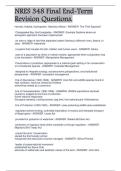
NRES 348 Final End-Term
Revision Questions.
Harvest, Habitat, Hydropower, Hatchery effects - ANSWER The "Fish Squeeze"
Chesapeake Bay, the Everglades - ANSWER Example Systems where an
ecosystem approach has been implemented
an area or ridge of land that separates waters flowing to different rivers, basins, or
seas - ANSWER watershed
a system that includes the fish, habitat, and human users - ANSWER fishery
acts on a population by direct or indirect means; appropriate when a population has
to be harvested - ANSWER Manipulative Management
Preventative or protective; appropriate in a national park setting or for conservation
of a threatened species - ANSWER Custodial Management
designed to integrate ecology, socioeconomic perspectives, and institutional
perspectives - ANSWER ecosystem management
Era of Abundance (1600-1849) - ANSWER most fish and wildlife species found in
high numbers, resource viewed as limitless
everything viewed as a commons
Era of Overexploitation (1850-1899) - ANSWER Wildlife populations declined
Hunted or trapped to the brink of extinction
Some reactive responses:
first game wardens, hunting license, bag limit, first national park (Yellowstone)
Era of Protection (1900-1925) - ANSWER Laws protecting wildlife were established
regulated market hunting, controlled importation of exotics and interstate transport
of illegal game - ANSWER Lacey Act
provided for protection of waterfowl - ANSWER Weeks-McClean Act
protection of migratory birds either complete or through regulation - ANSWER
Migratory Bird Treaty Act
coined the term "conservation
started the first forestry school
recognized that resources must be managed - ANSWER Gifford Pinchot
leader of preservationist movement
established the Sierra Club
advocate of wilderness and aesthetic values of the land - ANSWER John Muir
, NRES 348 Final End-Term
Revision Questions.
Era of Game Management (1930-1965) - ANSWER first research and management
programs developed in North America
Era of Environmental Management (1965-Present) - ANSWER significant growth in
environmental regulation
Endangered Species Act
EPA established in 1970
concern over global change has generated increased recognition of environmental
issues
importance of interspecific interactions - ANSWER Community Ecology
recognition of importance of intraspecific competition - ANSWER Darwin
consumption of a shared resource - ANSWER Indirect Competition
When organisms prevent access to or harm other organisms while seeking a
resource - ANSWER Direct competition
estimate how many animals can be harvested, use populations as indicators of
environmental health, understand how populations are affected by environmental
changes - ANSWER Why is the understanding of populations important to the study
and management of wildlife and fisheries?
semelparity - ANSWER the occurrence of a single act of reproduction during an
organism's lifetime
iteroparity - ANSWER repeated production of offspring at intervals throughout the
organism's lifetime
Food availability, spread of disease, rates of predation - ANSWER Density
Dependent factors
Weather, climate, catastrophes - ANSWER Density Independent factors
Inversity - ANSWER negative relationship between population density and natality
or recruitment
when one source of mortality replaces another and the total rate of mortality does
not change - ANSWER compensatory mortality
removal of one individual through harvesting results in the survival of another
individual that would have died because of density-dependent factors; "doomed
surplus" - ANSWER Completely compensatory mortality
Revision Questions.
Harvest, Habitat, Hydropower, Hatchery effects - ANSWER The "Fish Squeeze"
Chesapeake Bay, the Everglades - ANSWER Example Systems where an
ecosystem approach has been implemented
an area or ridge of land that separates waters flowing to different rivers, basins, or
seas - ANSWER watershed
a system that includes the fish, habitat, and human users - ANSWER fishery
acts on a population by direct or indirect means; appropriate when a population has
to be harvested - ANSWER Manipulative Management
Preventative or protective; appropriate in a national park setting or for conservation
of a threatened species - ANSWER Custodial Management
designed to integrate ecology, socioeconomic perspectives, and institutional
perspectives - ANSWER ecosystem management
Era of Abundance (1600-1849) - ANSWER most fish and wildlife species found in
high numbers, resource viewed as limitless
everything viewed as a commons
Era of Overexploitation (1850-1899) - ANSWER Wildlife populations declined
Hunted or trapped to the brink of extinction
Some reactive responses:
first game wardens, hunting license, bag limit, first national park (Yellowstone)
Era of Protection (1900-1925) - ANSWER Laws protecting wildlife were established
regulated market hunting, controlled importation of exotics and interstate transport
of illegal game - ANSWER Lacey Act
provided for protection of waterfowl - ANSWER Weeks-McClean Act
protection of migratory birds either complete or through regulation - ANSWER
Migratory Bird Treaty Act
coined the term "conservation
started the first forestry school
recognized that resources must be managed - ANSWER Gifford Pinchot
leader of preservationist movement
established the Sierra Club
advocate of wilderness and aesthetic values of the land - ANSWER John Muir
, NRES 348 Final End-Term
Revision Questions.
Era of Game Management (1930-1965) - ANSWER first research and management
programs developed in North America
Era of Environmental Management (1965-Present) - ANSWER significant growth in
environmental regulation
Endangered Species Act
EPA established in 1970
concern over global change has generated increased recognition of environmental
issues
importance of interspecific interactions - ANSWER Community Ecology
recognition of importance of intraspecific competition - ANSWER Darwin
consumption of a shared resource - ANSWER Indirect Competition
When organisms prevent access to or harm other organisms while seeking a
resource - ANSWER Direct competition
estimate how many animals can be harvested, use populations as indicators of
environmental health, understand how populations are affected by environmental
changes - ANSWER Why is the understanding of populations important to the study
and management of wildlife and fisheries?
semelparity - ANSWER the occurrence of a single act of reproduction during an
organism's lifetime
iteroparity - ANSWER repeated production of offspring at intervals throughout the
organism's lifetime
Food availability, spread of disease, rates of predation - ANSWER Density
Dependent factors
Weather, climate, catastrophes - ANSWER Density Independent factors
Inversity - ANSWER negative relationship between population density and natality
or recruitment
when one source of mortality replaces another and the total rate of mortality does
not change - ANSWER compensatory mortality
removal of one individual through harvesting results in the survival of another
individual that would have died because of density-dependent factors; "doomed
surplus" - ANSWER Completely compensatory mortality