1|Page
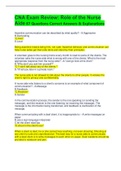
Pediatrics NSG 3600 Exam 1 & NSG 3600 Exam 3
Newest – 350 Prep Questions and Correct answers/
NSG 3600 Pediatrics Exam 1 & 3 Galen College
Graded A+
Describe nursing interventions used to break the chain of
infection - ...ANSWER...✓✓ The 6 points in the chain of
infection: the infectious agent, reservoir, portal of exit,
mode of transmission, portal of entry, and susceptible
host.
Nurses can break the chain by washing hands, staying up
to date on vaccines, covering coughs and sneezes, using
necessary PPE, and practicing asepsis.
Identify situations in which hand hygiene is indicated. -
...ANSWER...✓✓ Moment 1 - Before touching a patient
Moment 2 - Before a clean or aseptic procedure
Moment 3 - After a body fluid exposure risk
Moment 4 - After touching a patient
Moment 5 - After touching patient surroundings
,2|Page
Describe strategies for implementing CDC guidelines for
standard and transmission-based precautions when
caring for patients. - ...ANSWER...✓✓ • Transmission-
based precautions: CDC precautions used in patients
known or suspected to be infected with pathogens that
can be transmitted by airborne, droplet, or contact routes;
used in addition to standard precautions
• The 2007 guidelines include a directive to don personal
protective equipment (PPE) when entering the room of a
patient on contact or droplet precautions. These
categories recognize that a disease may have multiple
routes of transmission.
• The three types of transmission-based precautions
(airborne, droplet, or contact) may be used alone or in
combination, but always in addition to standard
precautions.
Differentiate recommended techniques for medical and
surgical asepsis. - ...ANSWER...✓✓ • Asepsis is the
absence of infection (microbes). We are responsible for
always working towards asepsis
• Medical asepsis- clean technique.
• Surgical asepsis- sterile technique
,3|Page
Define and describe the purpose of the five types of
nursing assessments. Initial Assessment- -
...ANSWER...✓✓ • Initial (Comprehensive) Assessment-
performed shortly after the patient is admitted to a health
care agency or service.
o The purpose of this assessment is to establish a
complete database for problem identification and care
planning. The nurse collects data concerning all aspects
of the patient's health, establishing priorities for ongoing
focused assessments and creating a reference baseline
for future comparison.
Define and describe the purpose of the five types of
nursing assessments. Focused Assessment- -
...ANSWER...✓✓ nurse gathers data about a specific
problem that has already been identified.
o Questions include: what are your signs and symptoms?
When did they start? Were you doing anything different
than usual when they started? What makes them better?
Worse? Are you taking anything for your symptoms?
o This is where we use OPQRSTU (onset, palliative
factors, quality of signs/symptoms, region, severity,
timing, understanding)
, 4|Page
Define and describe the purpose of the five types of
nursing assessments. Follow-Up Assessment- -
...ANSWER...✓✓ one that is conducted at regular intervals
during care of the patient. Focuses on identified health
problems to monitor positive or negative changes and
evaluate the effectiveness of interventions.
Define and describe the purpose of the five types of
nursing assessments. Emergency Assessment -
...ANSWER...✓✓ performed when a physiologic or
psychological crisis presents to identify life-threatening
problems.
Define and describe the purpose of the five types of
nursing assessments.Time-Lapsed Assessment -
...ANSWER...✓✓ - scheduled to compare a patient's
current status to the baseline data obtained earlier.
o Patients in residential settings (ex: nursing homes) are
scheduled for periodic assessments.
Describe strategies of a general survey. - ...ANSWER...✓✓
• This is the first component of the physical assessment
and is aimed at the overall impression of the patient.
Pediatrics NSG 3600 Exam 1 & NSG 3600 Exam 3
Newest – 350 Prep Questions and Correct answers/
NSG 3600 Pediatrics Exam 1 & 3 Galen College
Graded A+
Describe nursing interventions used to break the chain of
infection - ...ANSWER...✓✓ The 6 points in the chain of
infection: the infectious agent, reservoir, portal of exit,
mode of transmission, portal of entry, and susceptible
host.
Nurses can break the chain by washing hands, staying up
to date on vaccines, covering coughs and sneezes, using
necessary PPE, and practicing asepsis.
Identify situations in which hand hygiene is indicated. -
...ANSWER...✓✓ Moment 1 - Before touching a patient
Moment 2 - Before a clean or aseptic procedure
Moment 3 - After a body fluid exposure risk
Moment 4 - After touching a patient
Moment 5 - After touching patient surroundings
,2|Page
Describe strategies for implementing CDC guidelines for
standard and transmission-based precautions when
caring for patients. - ...ANSWER...✓✓ • Transmission-
based precautions: CDC precautions used in patients
known or suspected to be infected with pathogens that
can be transmitted by airborne, droplet, or contact routes;
used in addition to standard precautions
• The 2007 guidelines include a directive to don personal
protective equipment (PPE) when entering the room of a
patient on contact or droplet precautions. These
categories recognize that a disease may have multiple
routes of transmission.
• The three types of transmission-based precautions
(airborne, droplet, or contact) may be used alone or in
combination, but always in addition to standard
precautions.
Differentiate recommended techniques for medical and
surgical asepsis. - ...ANSWER...✓✓ • Asepsis is the
absence of infection (microbes). We are responsible for
always working towards asepsis
• Medical asepsis- clean technique.
• Surgical asepsis- sterile technique
,3|Page
Define and describe the purpose of the five types of
nursing assessments. Initial Assessment- -
...ANSWER...✓✓ • Initial (Comprehensive) Assessment-
performed shortly after the patient is admitted to a health
care agency or service.
o The purpose of this assessment is to establish a
complete database for problem identification and care
planning. The nurse collects data concerning all aspects
of the patient's health, establishing priorities for ongoing
focused assessments and creating a reference baseline
for future comparison.
Define and describe the purpose of the five types of
nursing assessments. Focused Assessment- -
...ANSWER...✓✓ nurse gathers data about a specific
problem that has already been identified.
o Questions include: what are your signs and symptoms?
When did they start? Were you doing anything different
than usual when they started? What makes them better?
Worse? Are you taking anything for your symptoms?
o This is where we use OPQRSTU (onset, palliative
factors, quality of signs/symptoms, region, severity,
timing, understanding)
, 4|Page
Define and describe the purpose of the five types of
nursing assessments. Follow-Up Assessment- -
...ANSWER...✓✓ one that is conducted at regular intervals
during care of the patient. Focuses on identified health
problems to monitor positive or negative changes and
evaluate the effectiveness of interventions.
Define and describe the purpose of the five types of
nursing assessments. Emergency Assessment -
...ANSWER...✓✓ performed when a physiologic or
psychological crisis presents to identify life-threatening
problems.
Define and describe the purpose of the five types of
nursing assessments.Time-Lapsed Assessment -
...ANSWER...✓✓ - scheduled to compare a patient's
current status to the baseline data obtained earlier.
o Patients in residential settings (ex: nursing homes) are
scheduled for periodic assessments.
Describe strategies of a general survey. - ...ANSWER...✓✓
• This is the first component of the physical assessment
and is aimed at the overall impression of the patient.