Ek het ‘n huisie aan die Rand – Pirow
Bekker
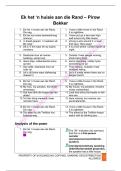
1. Ek het ‘n huisie aan die Rand. 1. I have a little home in the Rand.
Dis nag. It is nighttime.
2. Ek het my huisie tweemanhoog 2. I have put up a two-man high
ommuur; wall around my little house;
3. ‘n draad gespan; ‘n kopbeen sê: 3. strung a wire around it; a skull
Bly weg! that says: Stay away!
4. Dit is ‘n fort waar ek my saans 4. It is a fort where I shield myself at
verskans. night.
5. Daarbuite hoor ek mense 5. Outside I hear people running,
hardloop, skote knal, shots being fired,
6. deure klap, rubberbande snerp 6. doors slamming, rubber tyres
op teer. screeching on tar.
7. Dan stilte. Daarbuite hoor ek 7. Then silence. Outside I hear
ruite val windows falling
8. (of is dit binne waar diefwering 8. (or is it inside where there are no
makeer?) burglar bars?)
9. Ek het ‘n huisie aan die Rand. 9. I have a little house in the Rand.
Dis nag. It is nighttime.
10. My huis, my paradys, bly lekker 10. My house, my paradise, remains
onversteur. nicely undisturbed.
11. Kyk hoe blink die koppe aan die 11. Look how shiny the heads on the
draad. wire are.
12. Tot hier dring niemand, maar 12. Here nobody, but nobody can
niemand deur. penetrate/enter.
13. Ek het ‘n huisie aan die Rand. 13. I have a little house in the Rand.
Dis nag. It is nighttime.
14. Die alarm by die Trellidor hou 14. The alarm by the Trellidor keeps
knipoog wag. watch with its blinking eye.
Analysis of the poem
1. Ek het ‘n huisie aan die Rand.
The “Ek” indicates (dui aan/wys)
Dis nag.
that this is a first-person
(a)
narrator
(eerstepersoonsverteller/ek-
spreker).
Literally/denotatively speaking
(letterlike/denotatief gesproke),
the speaker has a little house
PROPERTY OF M SOUNES NO COPYING, SHARING OR DISTRIBUTION
1
ALLOWED
, “aan die Rand” which is
somewhere (iewers) in
Gauteng, maybe
Witwatersrand, and he reveals
(onthul) not only the setting
(ruimte) but also that it is
nighttime.
On a figurative/connotative
level (figuurlike/konnotatiewe
vlak), the “Rand” may refer to
(verwys na) the speaker’s house
being on the edge (op die rand)
of safety (veiligheid) and
danger (gevaar/onveiligheid).
The fact that he calls it a
“huisie”, using the diminutive
form (verkleiningsvorm) might
be because of the intertextual
reference (intertekstuele
verwysing) of H.A. Fagan’s
poem, but it could also be an
indication of (aanduiding van)
vulnerability (weerloosheid).
Night is usually a more
dangerous (gevaarlik) time of
the day, pertaining to break-ins
(wat inbrake betref) and the like
thereof, which creates (skep)
tension (spanning) right of the
bat (heel van die begin af). This
is the literal/denotative
meaning
(letterlike/denotatiewe
betekenis).
When someone says “Dis nag” it
refers to a problem or some
trouble (moeilikheid) on a
figurative/connotative level
(figuurlike/konnotatiewe vlak).
The short, staccato (kort)
sentences serve to heighten
the tension (verhoog die
spanning).
2. Ek het my huisie tweemanhoog
The speaker put up a high (hoë)
ommuur;
wall (muur) around his house:
(b)
this is the first thing he does to
PROPERTY OF M SOUNES NO COPYING, SHARING OR DISTRIBUTION
2
ALLOWED
Bekker
1. Ek het ‘n huisie aan die Rand. 1. I have a little home in the Rand.
Dis nag. It is nighttime.
2. Ek het my huisie tweemanhoog 2. I have put up a two-man high
ommuur; wall around my little house;
3. ‘n draad gespan; ‘n kopbeen sê: 3. strung a wire around it; a skull
Bly weg! that says: Stay away!
4. Dit is ‘n fort waar ek my saans 4. It is a fort where I shield myself at
verskans. night.
5. Daarbuite hoor ek mense 5. Outside I hear people running,
hardloop, skote knal, shots being fired,
6. deure klap, rubberbande snerp 6. doors slamming, rubber tyres
op teer. screeching on tar.
7. Dan stilte. Daarbuite hoor ek 7. Then silence. Outside I hear
ruite val windows falling
8. (of is dit binne waar diefwering 8. (or is it inside where there are no
makeer?) burglar bars?)
9. Ek het ‘n huisie aan die Rand. 9. I have a little house in the Rand.
Dis nag. It is nighttime.
10. My huis, my paradys, bly lekker 10. My house, my paradise, remains
onversteur. nicely undisturbed.
11. Kyk hoe blink die koppe aan die 11. Look how shiny the heads on the
draad. wire are.
12. Tot hier dring niemand, maar 12. Here nobody, but nobody can
niemand deur. penetrate/enter.
13. Ek het ‘n huisie aan die Rand. 13. I have a little house in the Rand.
Dis nag. It is nighttime.
14. Die alarm by die Trellidor hou 14. The alarm by the Trellidor keeps
knipoog wag. watch with its blinking eye.
Analysis of the poem
1. Ek het ‘n huisie aan die Rand.
The “Ek” indicates (dui aan/wys)
Dis nag.
that this is a first-person
(a)
narrator
(eerstepersoonsverteller/ek-
spreker).
Literally/denotatively speaking
(letterlike/denotatief gesproke),
the speaker has a little house
PROPERTY OF M SOUNES NO COPYING, SHARING OR DISTRIBUTION
1
ALLOWED
, “aan die Rand” which is
somewhere (iewers) in
Gauteng, maybe
Witwatersrand, and he reveals
(onthul) not only the setting
(ruimte) but also that it is
nighttime.
On a figurative/connotative
level (figuurlike/konnotatiewe
vlak), the “Rand” may refer to
(verwys na) the speaker’s house
being on the edge (op die rand)
of safety (veiligheid) and
danger (gevaar/onveiligheid).
The fact that he calls it a
“huisie”, using the diminutive
form (verkleiningsvorm) might
be because of the intertextual
reference (intertekstuele
verwysing) of H.A. Fagan’s
poem, but it could also be an
indication of (aanduiding van)
vulnerability (weerloosheid).
Night is usually a more
dangerous (gevaarlik) time of
the day, pertaining to break-ins
(wat inbrake betref) and the like
thereof, which creates (skep)
tension (spanning) right of the
bat (heel van die begin af). This
is the literal/denotative
meaning
(letterlike/denotatiewe
betekenis).
When someone says “Dis nag” it
refers to a problem or some
trouble (moeilikheid) on a
figurative/connotative level
(figuurlike/konnotatiewe vlak).
The short, staccato (kort)
sentences serve to heighten
the tension (verhoog die
spanning).
2. Ek het my huisie tweemanhoog
The speaker put up a high (hoë)
ommuur;
wall (muur) around his house:
(b)
this is the first thing he does to
PROPERTY OF M SOUNES NO COPYING, SHARING OR DISTRIBUTION
2
ALLOWED