
Integration
Reversing Differentiation
● Integration is the inverse function to differentiation
● If you are given the derivative function and want to find the original
function you must integrate (also called solving a differential equation)
● Shown by the sign ∫
Basic Rules
xn+1
∫ xn = n+1 + c
kxn+1
∫ kxn = n+1 + c
Finding the Constant
● When integrating indefinitely (ie when you’re not given points between
which to integrate) you do not know the constant
● To find the constant, substituting given information
● E.G substituting given x-value to get a given y-value and solving for c
● Also called finding the particular solution of a differential equation
Definite Integration
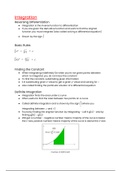
● Integration finds the area under a curve
● Often useful to find the area between two points on a curve
b
● Called definite integration and is shown by the sign ∫ (where you
a
integrating between a and b )
● Found by finding the original function by integrating - call it g(x) - and by
finding g(b) - g(a)
● Will get a number - negative number means majority of the curve is below
the x-axis, positive number means majority of the curve is above the x-axis
Courtesy of Maths Mutt
Reversing Differentiation
● Integration is the inverse function to differentiation
● If you are given the derivative function and want to find the original
function you must integrate (also called solving a differential equation)
● Shown by the sign ∫
Basic Rules
xn+1
∫ xn = n+1 + c
kxn+1
∫ kxn = n+1 + c
Finding the Constant
● When integrating indefinitely (ie when you’re not given points between
which to integrate) you do not know the constant
● To find the constant, substituting given information
● E.G substituting given x-value to get a given y-value and solving for c
● Also called finding the particular solution of a differential equation
Definite Integration
● Integration finds the area under a curve
● Often useful to find the area between two points on a curve
b
● Called definite integration and is shown by the sign ∫ (where you
a
integrating between a and b )
● Found by finding the original function by integrating - call it g(x) - and by
finding g(b) - g(a)
● Will get a number - negative number means majority of the curve is below
the x-axis, positive number means majority of the curve is above the x-axis
Courtesy of Maths Mutt


