Change
April 27, 2018
Alzheimer’s Disease
≈ Dementia and Alzheimer’s Disease:
– Alois Alzheimer (1901, 1902) patient, Auguste D:
52 year-old woman with profound cognitive and Behavioural impairments
Took sample of the brain and identified “tangles” in it (First to link to brain)
– Progressive neurodegenerative disorder
– AD contributes 62% to the presentation of symptoms of dementia
– Dementia is increasing worldwide
Because people are living longer due to better nutrition and medicine
This is encouraging people to study dementia to find a cure or delay the onset
– Common types of dementia:
Alzheimer's disease (50–80% of cases)
Vascular dementia (20–30% of cases)
Frontotemporal dementia (5–10% of cases)
Dementia with Lewy bodies (<5% of cases)
≈ Common Symptoms of Alzheimer's:
– Everyday Life:
Regularly misplacing everyday items and then forgetting or even denying
having done so
Problems with everyday tasks
General disorientation
Difficulty finding words or using inappropriate words.
Diminished judgement (e.g. wearing inappropriate clothes)
Mood or behavioural problems which may resemble depression
– DSM V (Neurocognitive disorder due to Alzheimers Disease)
Either: Evidence of a causative genetic mutation from family history or
genetic testing
Or all three of the following:
Clear evidence of decline in memory and learning based on
neuropsychological testing
Steadily progressive gradual decline in cognition
NO evidence of other causes (e.g. neurological, cerebrovascular or other
condition)
– Gradual loss of brain tissue over time – gets worse at the disease progresses
≈ Histopathological Features:
– There is no evidence of causation JUST CORRELATION
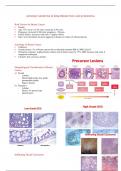
– Amyloid plaques:
Neuritic plaques: dystrophic and degenerating neuronal processes. Large
bulbous structures
Diffuse plaques: contain b-amyloid (or Ab) protein fibres and some
unstructured amyloid-earliest
– Neurofibrillary Tangles and helical filaments:
pairs of filaments wound around each other in a helical arrangement
Composed mainly of abnormal tau (protein) but also immunoreactive for a
number of other substances
– Gives a schema of how different pathologies express over the different stages of
Alzheimer’s Disease (Perrin et al, 2009):
April 27, 2018
Alzheimer’s Disease
≈ Dementia and Alzheimer’s Disease:
– Alois Alzheimer (1901, 1902) patient, Auguste D:
52 year-old woman with profound cognitive and Behavioural impairments
Took sample of the brain and identified “tangles” in it (First to link to brain)
– Progressive neurodegenerative disorder
– AD contributes 62% to the presentation of symptoms of dementia
– Dementia is increasing worldwide
Because people are living longer due to better nutrition and medicine
This is encouraging people to study dementia to find a cure or delay the onset
– Common types of dementia:
Alzheimer's disease (50–80% of cases)
Vascular dementia (20–30% of cases)
Frontotemporal dementia (5–10% of cases)
Dementia with Lewy bodies (<5% of cases)
≈ Common Symptoms of Alzheimer's:
– Everyday Life:
Regularly misplacing everyday items and then forgetting or even denying
having done so
Problems with everyday tasks
General disorientation
Difficulty finding words or using inappropriate words.
Diminished judgement (e.g. wearing inappropriate clothes)
Mood or behavioural problems which may resemble depression
– DSM V (Neurocognitive disorder due to Alzheimers Disease)
Either: Evidence of a causative genetic mutation from family history or
genetic testing
Or all three of the following:
Clear evidence of decline in memory and learning based on
neuropsychological testing
Steadily progressive gradual decline in cognition
NO evidence of other causes (e.g. neurological, cerebrovascular or other
condition)
– Gradual loss of brain tissue over time – gets worse at the disease progresses
≈ Histopathological Features:
– There is no evidence of causation JUST CORRELATION
– Amyloid plaques:
Neuritic plaques: dystrophic and degenerating neuronal processes. Large
bulbous structures
Diffuse plaques: contain b-amyloid (or Ab) protein fibres and some
unstructured amyloid-earliest
– Neurofibrillary Tangles and helical filaments:
pairs of filaments wound around each other in a helical arrangement
Composed mainly of abnormal tau (protein) but also immunoreactive for a
number of other substances
– Gives a schema of how different pathologies express over the different stages of
Alzheimer’s Disease (Perrin et al, 2009):