

Lecture 8
Communication and promotion
DEFINITIO OF MARKETING COMMUNICATIONS
- “marketing communications is a management process through which an
organisation attempts to engage with its various audiences. By understanding an
audience’s communications environment, organisations seek to develop and present
message for its identifies stakeholder groups, before evaluating and acting upon any
responses. By conveying messages that are significant value, audiences are
encouraged to offer attitudinal and behavioural responses”
Fill, 2013
- Tailor communication through engagement with customers
- Engaging is about creating a connection
- Audiences = segmentation – who we might want to sell to – different behaviours
within an audience
- Who are we trying to convince – audience
- Responses = tell somebody else about your experience of the company – customer
service
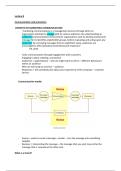
Communication model:
- Source = wants to send a message = sender – turn the message into something
tangible
- Receiver = interpreting the message – the message that you sent may not be the
message that is received at the other end.
What is a brand?
, - ‘a name, term, sign, symbol or design or a combination, intended to identify the
goods, or services of one seller or group of sellers, and to differentiate them from
these of competitors’
Kotler and Keller, 2006
Why do buyers like brands?
- Indicator of product quality
- Offer of consistency: trust in a brand evolves from the delivery of consistent benefits
over time
- Increasing shopping efficiency/simplify the purchase decision
- Their symbolic value (by association)
Why do sellers like brands?
- Enables premium pricing
- Helps differentiate the product
- Develops customer trust/ loyalty/ retention/ repeat
- Contributes to corporate identity programmes
- Provides some legal protection
brand identity prism (Kapferer)
Promotional mix: communication tools
Communication and promotion
DEFINITIO OF MARKETING COMMUNICATIONS
- “marketing communications is a management process through which an
organisation attempts to engage with its various audiences. By understanding an
audience’s communications environment, organisations seek to develop and present
message for its identifies stakeholder groups, before evaluating and acting upon any
responses. By conveying messages that are significant value, audiences are
encouraged to offer attitudinal and behavioural responses”
Fill, 2013
- Tailor communication through engagement with customers
- Engaging is about creating a connection
- Audiences = segmentation – who we might want to sell to – different behaviours
within an audience
- Who are we trying to convince – audience
- Responses = tell somebody else about your experience of the company – customer
service
Communication model:
- Source = wants to send a message = sender – turn the message into something
tangible
- Receiver = interpreting the message – the message that you sent may not be the
message that is received at the other end.
What is a brand?
, - ‘a name, term, sign, symbol or design or a combination, intended to identify the
goods, or services of one seller or group of sellers, and to differentiate them from
these of competitors’
Kotler and Keller, 2006
Why do buyers like brands?
- Indicator of product quality
- Offer of consistency: trust in a brand evolves from the delivery of consistent benefits
over time
- Increasing shopping efficiency/simplify the purchase decision
- Their symbolic value (by association)
Why do sellers like brands?
- Enables premium pricing
- Helps differentiate the product
- Develops customer trust/ loyalty/ retention/ repeat
- Contributes to corporate identity programmes
- Provides some legal protection
brand identity prism (Kapferer)
Promotional mix: communication tools


