

Airway Pharmacology
There are five common drugs used in respiratory diseases, these will be explored,
their mechanism, effect and disease used for. These drugs include:
-Salbutamol+Salmeterol
-Ipratropium+Tiotropium
-Theophylline (aminophylline) – don’t use as much as makes people vomit
-Montelukast
-Glucocorticosteroid
Parasympathetic Innervation
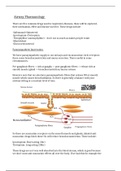
We have parasympathetic supply to our airways and via muscarinic (Ach) receptors
these cause bronchoconstriction and mucus secretion. This is useful in some
circumstances,
Pre-ganglionic fibres -> Ach at ganglia -> post-ganglionic fibres -> release Ach at
smooth muscle/gland -> bronchoconstriction/mucus release
However note that we also have parasympathetic fibres that release NO at smooth
muscle which causes bronchodilation. So there is generally a balance with your
airways sitting at a constant level of tone.
So there are muscarinic receptors on the smooth muscle and glands, inhaled anti-
muscarinic drugs block these! So will reduce bronchoconstriction. These include:
Ipratropium: Short acting (3hr)
Tiotropium: Long acting (24hr)
These drugs are not very well absorbed into the blood stream, which is good because
we don’t want anti-muscarinic effects all over the body. If we had this for example the
, heart would speed up (as Ach normally slows the heart). If you had trouble getting air
in your body and heart speeds up this would be worse because your heart is
demanding more oxygen and you can’t supply it. If it got into circulation you’d also
expect urinary retention and dry mouth (latter more common side effect)
These drugs are routinely used in COPD -> as have combined bronchodilator and anti-
mucus effect, but with regards to asthma we only use it for severe acute asthma.
So parasympathetic innervation we can manipulate with anti-muscarinics!
Sympathetic Innervation
Humans have no sympathetic innervation to their airway smooth muscle. The smooth
muscle does contain beta2 receptors however, adrenaline gets to this via the blood
causing bronchodilation.
Henry Hyde Salter found that frightening someone was a good remedy for asthma, this
was because of the adrenaline released acting on beta receptors -> bronchodilation.
He also noticed a very strong cup of coffee is a good remedy for asthma attack, this is
because it contains theophylline.
The Inflammatory Soup—
Bronchoconstriction is probably mediated by multiple mediators such as:
acetylcholine, histamine, leukotrienes, prostaglandins, endothelins and others.
You can’t possibly block all their receptors, so it is easier to give a drug that causes
relaxation of airway smooth muscle (rather than blocking everything that causes
bronchoconstriction.
The last thing you want during an asthma attack is increased O2 demands of the heart.
This is why we use β2 selective agonists, as β2 are in the lungs while β1 are in the
heart. (Note there are some β2 receptors in the heart.)
Adrenaline
There are five common drugs used in respiratory diseases, these will be explored,
their mechanism, effect and disease used for. These drugs include:
-Salbutamol+Salmeterol
-Ipratropium+Tiotropium
-Theophylline (aminophylline) – don’t use as much as makes people vomit
-Montelukast
-Glucocorticosteroid
Parasympathetic Innervation
We have parasympathetic supply to our airways and via muscarinic (Ach) receptors
these cause bronchoconstriction and mucus secretion. This is useful in some
circumstances,
Pre-ganglionic fibres -> Ach at ganglia -> post-ganglionic fibres -> release Ach at
smooth muscle/gland -> bronchoconstriction/mucus release
However note that we also have parasympathetic fibres that release NO at smooth
muscle which causes bronchodilation. So there is generally a balance with your
airways sitting at a constant level of tone.
So there are muscarinic receptors on the smooth muscle and glands, inhaled anti-
muscarinic drugs block these! So will reduce bronchoconstriction. These include:
Ipratropium: Short acting (3hr)
Tiotropium: Long acting (24hr)
These drugs are not very well absorbed into the blood stream, which is good because
we don’t want anti-muscarinic effects all over the body. If we had this for example the
, heart would speed up (as Ach normally slows the heart). If you had trouble getting air
in your body and heart speeds up this would be worse because your heart is
demanding more oxygen and you can’t supply it. If it got into circulation you’d also
expect urinary retention and dry mouth (latter more common side effect)
These drugs are routinely used in COPD -> as have combined bronchodilator and anti-
mucus effect, but with regards to asthma we only use it for severe acute asthma.
So parasympathetic innervation we can manipulate with anti-muscarinics!
Sympathetic Innervation
Humans have no sympathetic innervation to their airway smooth muscle. The smooth
muscle does contain beta2 receptors however, adrenaline gets to this via the blood
causing bronchodilation.
Henry Hyde Salter found that frightening someone was a good remedy for asthma, this
was because of the adrenaline released acting on beta receptors -> bronchodilation.
He also noticed a very strong cup of coffee is a good remedy for asthma attack, this is
because it contains theophylline.
The Inflammatory Soup—
Bronchoconstriction is probably mediated by multiple mediators such as:
acetylcholine, histamine, leukotrienes, prostaglandins, endothelins and others.
You can’t possibly block all their receptors, so it is easier to give a drug that causes
relaxation of airway smooth muscle (rather than blocking everything that causes
bronchoconstriction.
The last thing you want during an asthma attack is increased O2 demands of the heart.
This is why we use β2 selective agonists, as β2 are in the lungs while β1 are in the
heart. (Note there are some β2 receptors in the heart.)
Adrenaline


