

Membrane Structure, Synthesis and Function
Key points:
Composition
Structure and assembly
Function – transport, energy production, receptors and cell
communication
Biological and clinical significance
There are some common features that membranes have, diverse as they are –
They are two molecules thick and form closed boundaries of the cell, they consist of
lipids and proteins and also contain specific proteins to mediate distinctive cell
functions.
They have a non-covalent arrangement and are asymmetric, it is also known as fluid-
mosaic model. Importantly, membranes are electrically polarised which plays a key
role in transport.
So what is the molecular composition of the lipids in the membrane, in general all
consist of a hydrophilic head and a hydrophobic tail.
The main lipids are phospholipids with the phosphate head, cholesterol with a –OH
head and glycolipids with a large carbohydrate head on the outside and a lipid group
in the membrane.
Cholesterol in the membrane regulates membrane fluidity
Phospholipids and glycolipids are amphipathic (meaning they possess both
hydrophilic/water-loving/polar and lipophilic/fat-loving properties).
They both readily from bimolecular sheets (bilayer) in aqueous media and they ability
to form liposomes might have clinical uses such as the delivery of drugs or DNA.
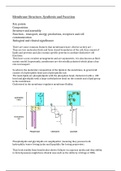
, They could adopt either of these arrangements,
the one on the left is more like a micelle, whereas the one on the left a bilayer
Liposome
Membranes are not static, rigid structures rather they are fluid. Lipids can move
across the surface (lateral movement/diffusion) rapidly. However swapping from one
side to the other (transverse movement/diffusion) is slow, rarer and requires the
action of the enzyme flippase. This is because it takes a lot of energy to get the
hydrophilic head through the fatty membrane.
There are various factors that will alter the fluidity of a membrane, these include
-Temperature
-Fatty acid composition
-Chain length
-Degree and extend of saturation
-Cholesterol content
Key points:
Composition
Structure and assembly
Function – transport, energy production, receptors and cell
communication
Biological and clinical significance
There are some common features that membranes have, diverse as they are –
They are two molecules thick and form closed boundaries of the cell, they consist of
lipids and proteins and also contain specific proteins to mediate distinctive cell
functions.
They have a non-covalent arrangement and are asymmetric, it is also known as fluid-
mosaic model. Importantly, membranes are electrically polarised which plays a key
role in transport.
So what is the molecular composition of the lipids in the membrane, in general all
consist of a hydrophilic head and a hydrophobic tail.
The main lipids are phospholipids with the phosphate head, cholesterol with a –OH
head and glycolipids with a large carbohydrate head on the outside and a lipid group
in the membrane.
Cholesterol in the membrane regulates membrane fluidity
Phospholipids and glycolipids are amphipathic (meaning they possess both
hydrophilic/water-loving/polar and lipophilic/fat-loving properties).
They both readily from bimolecular sheets (bilayer) in aqueous media and they ability
to form liposomes might have clinical uses such as the delivery of drugs or DNA.
, They could adopt either of these arrangements,
the one on the left is more like a micelle, whereas the one on the left a bilayer
Liposome
Membranes are not static, rigid structures rather they are fluid. Lipids can move
across the surface (lateral movement/diffusion) rapidly. However swapping from one
side to the other (transverse movement/diffusion) is slow, rarer and requires the
action of the enzyme flippase. This is because it takes a lot of energy to get the
hydrophilic head through the fatty membrane.
There are various factors that will alter the fluidity of a membrane, these include
-Temperature
-Fatty acid composition
-Chain length
-Degree and extend of saturation
-Cholesterol content


