Thorax I – Thoracic Wall and Intercostal Space
Key Points:
Bones: Vertebrae, sternum, ribs
Movements during breathing
Muscles of the Thorax
Changes with Age
Landmarks: midaxillary line
Vessels of the Thorax
Nerves of the Thorax (dermatomes)
Mammary Gland/Breast
Bones and Joints of the Thoracic Wall
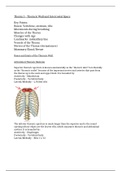
Articulated Thoracic Skeleton
Superior thoracic aperture is known anatomically as the “thoracic inlet” but clinically
as the “thoracic outlet” because of the important nerves and arteries that pass from
the thorax up to the neck and upper limb. It is bounded by:
Anteriorly – Manubrium
Posteriorly – Vertebral body
Lateral/Medially – L/R first ribs
The inferior thoracic aperture is much larger than the superior and is the round
opening whose edges are the lowest ribs, which separates thoracic and abdominal
cavities. It is bounded by:
Anteriorly – Diaphragm
Posteriorly – Vertebral body
Lateral/Medially – Ribs 11/12
,Thoracic Vertebrae
We have 12 thoracic vertebrae, these have various features including-
Vertebral body (big round bit), arch and foramen (hole in middle)
Pedicle and lamina (which form the arch)
Transverse (pointing out to sides and back) and Spinous (pointing back and down)
processes
Superior and Inferior articular processes (articulate with vertebrae below/above)
Superior and Inferior vertebral notches
Costal facets (superior and inferior, transverse) (articulate with ribs)
,
Key Points:
Bones: Vertebrae, sternum, ribs
Movements during breathing
Muscles of the Thorax
Changes with Age
Landmarks: midaxillary line
Vessels of the Thorax
Nerves of the Thorax (dermatomes)
Mammary Gland/Breast
Bones and Joints of the Thoracic Wall
Articulated Thoracic Skeleton
Superior thoracic aperture is known anatomically as the “thoracic inlet” but clinically
as the “thoracic outlet” because of the important nerves and arteries that pass from
the thorax up to the neck and upper limb. It is bounded by:
Anteriorly – Manubrium
Posteriorly – Vertebral body
Lateral/Medially – L/R first ribs
The inferior thoracic aperture is much larger than the superior and is the round
opening whose edges are the lowest ribs, which separates thoracic and abdominal
cavities. It is bounded by:
Anteriorly – Diaphragm
Posteriorly – Vertebral body
Lateral/Medially – Ribs 11/12
,Thoracic Vertebrae
We have 12 thoracic vertebrae, these have various features including-
Vertebral body (big round bit), arch and foramen (hole in middle)
Pedicle and lamina (which form the arch)
Transverse (pointing out to sides and back) and Spinous (pointing back and down)
processes
Superior and Inferior articular processes (articulate with vertebrae below/above)
Superior and Inferior vertebral notches
Costal facets (superior and inferior, transverse) (articulate with ribs)
,