Immunological Functions of the (alimentary tract) Mucosal
Tissues
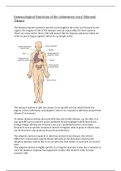
The human immune system is spread out throughout the body (not focused in one
organ), the origins of cells of the immune system is generally the bone marrow.
There are areas where these cells will mature like the thymus and areas which are
active in protecting us against infection e.g. lymph nodes.
The immune system is split into innate (non-specific activity which blocks the
ingress of new infections) and adaptive (where we respond to infection and prevent
disease if necessary).
So innate immune system prevents infection and avoids disease, e.g. the skin. It is
non-specific has no memory and is mediated by macrophages which hunt down
foreign things (all they see is that it’s not you), epithelial barriers, secretions.
Because it is non-specific it means it doesn’t recognise what is good or what is bad,
nor do they have any memory for previous infections.
The adaptive system responds to infection and prevents disease, the critical
difference is that innate system blocks infection in the first place whereas the
adaptive immune system has to see an infection first before it can block it a second
time.
The adaptive system is highly specific to a targeted microbe, it also has a memory so
once the immune response has happened certain cells (some B-cells) become
memory cells.
, Adaptive is primarily mediated by the lymphocytes (B and T) and antibodies.
Mucosal Immune System
There are two immune systems running in the body, the systemic immune system
which is the one that is well characterised.
The other part which is equally if not more important is the immunity that happens
at our mucosal surfaces.
The mucosal surfaces are essentially all the wet parts of our body: Oral, nasal,
lacrimal surfaces, GI tract, bronchial tract, genitourinary tract and mammary glands.
Most infective agents find it very hard to enter our skin, so most infections enter
through the mucosal membranes which are easier to penetrate (we get lung, eye
infections more commonly).
The mucosal membranes are also normally colonised by microbes in the first place,
there are pathogens fighting with our commensal organisms for the right to stay
there. So we get a problem when an imbalance is struck between the two.
As well as this, the mucosal area represents are much larger surface area than the
skin.
We produce secretions at our mucosal membranes and one of the functions of these
secretions is to wash away anything that is there (e.g. saliva, cilia), so bacteria must
be able to adapt to try adhere and not be washed away.
Innate mechanisms of protection (in gut) include: mucin, peristalsis, antimicrobial
peptides and proteins e.g. lysozyme, lactoferrin (accumulates iron and doesn’t allow
it to become available for bacterial growth); phagocytes.
(the same enzymes in stomach and gut that break down proteins will break down
bacterial proteins, the acid as well does this!)
Adaptive mechanisms are also present, these are largely mediated by antibodies
(mucosal/secretory immune system).
One of the hardest things for the mucosal immune system is to differentiate between
harmful pathogens and harmless antigens (e.g. foods and commensal bacteria, this is
all good! So we have to have a way to discriminate between what is good and bad).
The mucosal barrier:
Innate
-Natural barriers (e.g. stomach)
-Mucin
-Peristalsis
-Proteolysis
Immunological
-Secretory IgA/IgM and IgG
Sources of serum, saliva and local antibodies in the oral cavity:
Tissues
The human immune system is spread out throughout the body (not focused in one
organ), the origins of cells of the immune system is generally the bone marrow.
There are areas where these cells will mature like the thymus and areas which are
active in protecting us against infection e.g. lymph nodes.
The immune system is split into innate (non-specific activity which blocks the
ingress of new infections) and adaptive (where we respond to infection and prevent
disease if necessary).
So innate immune system prevents infection and avoids disease, e.g. the skin. It is
non-specific has no memory and is mediated by macrophages which hunt down
foreign things (all they see is that it’s not you), epithelial barriers, secretions.
Because it is non-specific it means it doesn’t recognise what is good or what is bad,
nor do they have any memory for previous infections.
The adaptive system responds to infection and prevents disease, the critical
difference is that innate system blocks infection in the first place whereas the
adaptive immune system has to see an infection first before it can block it a second
time.
The adaptive system is highly specific to a targeted microbe, it also has a memory so
once the immune response has happened certain cells (some B-cells) become
memory cells.
, Adaptive is primarily mediated by the lymphocytes (B and T) and antibodies.
Mucosal Immune System
There are two immune systems running in the body, the systemic immune system
which is the one that is well characterised.
The other part which is equally if not more important is the immunity that happens
at our mucosal surfaces.
The mucosal surfaces are essentially all the wet parts of our body: Oral, nasal,
lacrimal surfaces, GI tract, bronchial tract, genitourinary tract and mammary glands.
Most infective agents find it very hard to enter our skin, so most infections enter
through the mucosal membranes which are easier to penetrate (we get lung, eye
infections more commonly).
The mucosal membranes are also normally colonised by microbes in the first place,
there are pathogens fighting with our commensal organisms for the right to stay
there. So we get a problem when an imbalance is struck between the two.
As well as this, the mucosal area represents are much larger surface area than the
skin.
We produce secretions at our mucosal membranes and one of the functions of these
secretions is to wash away anything that is there (e.g. saliva, cilia), so bacteria must
be able to adapt to try adhere and not be washed away.
Innate mechanisms of protection (in gut) include: mucin, peristalsis, antimicrobial
peptides and proteins e.g. lysozyme, lactoferrin (accumulates iron and doesn’t allow
it to become available for bacterial growth); phagocytes.
(the same enzymes in stomach and gut that break down proteins will break down
bacterial proteins, the acid as well does this!)
Adaptive mechanisms are also present, these are largely mediated by antibodies
(mucosal/secretory immune system).
One of the hardest things for the mucosal immune system is to differentiate between
harmful pathogens and harmless antigens (e.g. foods and commensal bacteria, this is
all good! So we have to have a way to discriminate between what is good and bad).
The mucosal barrier:
Innate
-Natural barriers (e.g. stomach)
-Mucin
-Peristalsis
-Proteolysis
Immunological
-Secretory IgA/IgM and IgG
Sources of serum, saliva and local antibodies in the oral cavity: