

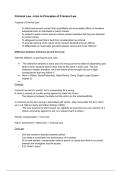
Criminal Law - Intro to Principles of Criminal Law
Purpose of Criminal Law:
- To forbid and prevent conduct that unjustifiably and inexcusably inflicts or threatens
substantial harm to individuals or public interest.
- To subject to public control persons whose conduct indicates that they are disposed
to commit crimes
- To safeguard conduit that is fault from condemnation as criminal
- To give fair warning of the nature of the conduct declared to be an offence
- To differentiate on reasonable grounds between serious and minor offences
Difference between Criminal Law and Civil Law
Glanville Williams, in learning the Law, said:
● “The distinction between a crime and civil wrong cannot be stated as depending upon
what is done, because what is done may be the same in each case. The true
distinction resides, therefore, not in the nature of the wrongful act but in legal
consequences that may follow it.”
● (Also in Wilson, Steve/Rutherford, Helen/Storey, Toney. English Legal System -
chapter 2)
●
Criminal:
Criminal Law aims to punish, not to compensate for a wrong.
A crime is viewed as a public wrong against the state/ the Crown.
- The dispute is between the state (not the victim) an the Individual/Entity.
In criminal Law the term wrong is associated with ‘public’, often wwe prefer the term ‘harm’
as in J.S. Mill on Liberty and Other Writings (1859):
- “The only purpose for which power can rightfully be exercised over any member of a
civilian community against his will, is to present harm to others.”
Wrong= compensation -> Civil Law
Harm= punishment + deterrence -> Criminal Law
Civil Law:
- Civil law concerns disputes between parties
- Can relate to conclusion and performance of a contract
- Or to seek redress, compensation when a person is injured and there is no cntract
between the wrongdoer and the injured.
- E,G, Smith v jones
,Classifications of Offences
By Source (Common Law or statutory)
By references to Mode of Trial (Summary; indictable; either way offences)
By effect on the Law of Arrest (Serious arrestable offences; arrestable offences; other
offences)
By Subject Matter (against the person; against property; mixed offences)
By Fault-Base:
- Offences requiring proof mens rea (a guilty mind) which may be intended or
recklessness or a special mental state.
- Offences satisfied by proof of negligence (lack of care) and
- Strict liability offences which do not require proof of full fault.
Result: Result offences, Conduct offences.
‘Think Like a Lawyer’ - IRAC
Identify the relevant parties and the relevant offence(s); Identify the legal issue
Establish the legal Rules that apply re actus reus, mens rea and any defences
Understand and be able to explain what the law requires for those elements to be satisfied.
Apply the law to the facts of your case
Conclude
IRAC: Issue, R=Rule or Legal Principle, A= Apply to facts and analysis, C=Conclude
,The Basic Elements of Criminal Liability
‘Actus non facit reum nisi mens sit rea’
‘An act does not make a person guilty of a crime unless their mind is also guilty’
Actus Reus - Guilty Act
Mens Rea - Guilty Mind
Lack of Defence
Defining Actus Reus - (Smith & Hogan)
● ‘An act, omission or other event indicated in the definition of the crime, with any
surrounding circumstances (other than D’s state of mind) and any required
consequences of the act.’
(Omission - Failure to act)
Actus Reus of an offence may include:
- Conduct: act or omission
- events/ State of affairs (possession)
- Surrounding Circumstances
- Consequences of the accused’s actions (results)
I.e all of the elements in the definition of a crime except D’s state of mind (which is the mens
rea)
Always Discuss Actus Reus first, then Mens Rea
, Besides Acts and Omissions, other elements of the Actus Reus could be:
- Events or states of affairs (eg Larsoneur; Winzar) or possession offences as in s25
Theft Act (child & Ormerod, ch 2.3)
- Circumstances: e.g Theft, dishonestly appropriating property belonging to another
- Consequences e.g, Murder “killing” is both conduct and the result element of Actus
Reus (R v White
Causation (As an Element of Actus Reus of a Crime)
Conduct Crimes and Result Crimes
Result Crimes - There must be a causal link between the conduct of the defendant and the
result.
- Factual Causation (the ‘but for’ test)
- Legal Causation ( is defendant's conduct blameworthy, substantial and operating
cause? Is the chain of causation broken due to interbeining cast or events?)
Causation - question of fact for the jury
Factual Causation
- Determined by use of the “but for” test:
- Has it been established that the result would not have occurred as & when it did but
for D’s conduct? I.e “But for D’s conduct, would the result have come as and when it
did?
- If it would have happened anyways, D had no liability for End result
- R v White (1910) 2 KB 124
R V White IRAC
- Facts : W gave poison to his mother. M died of a heart attack.
- Issue: Is W guilty of Murder?
- Rule: Definition of Murder (Write in full) Includes ‘Killing’ i.e Causal link between W’s
conduct and end result - M’s death
Purpose of Criminal Law:
- To forbid and prevent conduct that unjustifiably and inexcusably inflicts or threatens
substantial harm to individuals or public interest.
- To subject to public control persons whose conduct indicates that they are disposed
to commit crimes
- To safeguard conduit that is fault from condemnation as criminal
- To give fair warning of the nature of the conduct declared to be an offence
- To differentiate on reasonable grounds between serious and minor offences
Difference between Criminal Law and Civil Law
Glanville Williams, in learning the Law, said:
● “The distinction between a crime and civil wrong cannot be stated as depending upon
what is done, because what is done may be the same in each case. The true
distinction resides, therefore, not in the nature of the wrongful act but in legal
consequences that may follow it.”
● (Also in Wilson, Steve/Rutherford, Helen/Storey, Toney. English Legal System -
chapter 2)
●
Criminal:
Criminal Law aims to punish, not to compensate for a wrong.
A crime is viewed as a public wrong against the state/ the Crown.
- The dispute is between the state (not the victim) an the Individual/Entity.
In criminal Law the term wrong is associated with ‘public’, often wwe prefer the term ‘harm’
as in J.S. Mill on Liberty and Other Writings (1859):
- “The only purpose for which power can rightfully be exercised over any member of a
civilian community against his will, is to present harm to others.”
Wrong= compensation -> Civil Law
Harm= punishment + deterrence -> Criminal Law
Civil Law:
- Civil law concerns disputes between parties
- Can relate to conclusion and performance of a contract
- Or to seek redress, compensation when a person is injured and there is no cntract
between the wrongdoer and the injured.
- E,G, Smith v jones
,Classifications of Offences
By Source (Common Law or statutory)
By references to Mode of Trial (Summary; indictable; either way offences)
By effect on the Law of Arrest (Serious arrestable offences; arrestable offences; other
offences)
By Subject Matter (against the person; against property; mixed offences)
By Fault-Base:
- Offences requiring proof mens rea (a guilty mind) which may be intended or
recklessness or a special mental state.
- Offences satisfied by proof of negligence (lack of care) and
- Strict liability offences which do not require proof of full fault.
Result: Result offences, Conduct offences.
‘Think Like a Lawyer’ - IRAC
Identify the relevant parties and the relevant offence(s); Identify the legal issue
Establish the legal Rules that apply re actus reus, mens rea and any defences
Understand and be able to explain what the law requires for those elements to be satisfied.
Apply the law to the facts of your case
Conclude
IRAC: Issue, R=Rule or Legal Principle, A= Apply to facts and analysis, C=Conclude
,The Basic Elements of Criminal Liability
‘Actus non facit reum nisi mens sit rea’
‘An act does not make a person guilty of a crime unless their mind is also guilty’
Actus Reus - Guilty Act
Mens Rea - Guilty Mind
Lack of Defence
Defining Actus Reus - (Smith & Hogan)
● ‘An act, omission or other event indicated in the definition of the crime, with any
surrounding circumstances (other than D’s state of mind) and any required
consequences of the act.’
(Omission - Failure to act)
Actus Reus of an offence may include:
- Conduct: act or omission
- events/ State of affairs (possession)
- Surrounding Circumstances
- Consequences of the accused’s actions (results)
I.e all of the elements in the definition of a crime except D’s state of mind (which is the mens
rea)
Always Discuss Actus Reus first, then Mens Rea
, Besides Acts and Omissions, other elements of the Actus Reus could be:
- Events or states of affairs (eg Larsoneur; Winzar) or possession offences as in s25
Theft Act (child & Ormerod, ch 2.3)
- Circumstances: e.g Theft, dishonestly appropriating property belonging to another
- Consequences e.g, Murder “killing” is both conduct and the result element of Actus
Reus (R v White
Causation (As an Element of Actus Reus of a Crime)
Conduct Crimes and Result Crimes
Result Crimes - There must be a causal link between the conduct of the defendant and the
result.
- Factual Causation (the ‘but for’ test)
- Legal Causation ( is defendant's conduct blameworthy, substantial and operating
cause? Is the chain of causation broken due to interbeining cast or events?)
Causation - question of fact for the jury
Factual Causation
- Determined by use of the “but for” test:
- Has it been established that the result would not have occurred as & when it did but
for D’s conduct? I.e “But for D’s conduct, would the result have come as and when it
did?
- If it would have happened anyways, D had no liability for End result
- R v White (1910) 2 KB 124
R V White IRAC
- Facts : W gave poison to his mother. M died of a heart attack.
- Issue: Is W guilty of Murder?
- Rule: Definition of Murder (Write in full) Includes ‘Killing’ i.e Causal link between W’s
conduct and end result - M’s death


