Contract Law Intro - Week 3
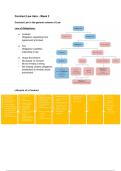
Contract Law in the general scheme of Law
Law of Obligations:
● Contract
- Obligation originating from
agreement/ promises
● Tort
- Obligation/ Liabilities
originating in law
● Unjust Enrichment
- Not based on consent
- Not to remedy a wrong
- But instead creates obligations
(restitution) to remedy unjust
enrichment.
Lifecycle of a Contract
,What is a contract?
• Promise - voluntariness and seriousness of the undertaking given by a
Promisor
• Agreement - Bilateral or multilateral, reach to a consensus with others
regarding rights and liberties
• Recognition by law - State/Crown provides the legal apparatus to enforce
contracts which makes it reliable and fills in any gap in trust and sanctions
between the parties by guaranteeing redress by breach enforced by the
power of the state. Court usually determines :
I. When and what the parties agreed to
II. If one party can escape from contract
III. Remedies of breach
IV. What happens when a contract is uncertain on a disputed matter
,Firstly a court looks for an agreement between the parties. Court:
A. Adopts an objective test of the parties intention.
B. Adopts the mirror image approach to finding agreement : the party’s offer must be
mirrored by others acceptance
C. Requires sufficient certainty of agreement
D. Presumes that commercial agreements has Agreement but family and friends do not
have the intention to create legal relations
Secondly they take a test of enforceability to be able to sue on a promise:
A. Consideration - Claimant has given/promised something in exchange for the
defendants promise
B. Promissory estoppel - Claimant has relied on the defendants promise and it is
inequitable (unfair) for the D to renege (pussy out) on a promise.
C. Formalities - The defendant's promise has complied with formalities requirements.
privity: who can acquire rights or be subjected to liabilities by a properly made contract (ie
who can sue on or be sued under the contract)? The privity rule confines the legal impact of
contracts to the contract parties. It seems right that contract parties should not be able to
impose burdens on third parties. However, the traditional position that they cannot give third
parties the right to enforce a contract made for their benefit is subject to a wide range of
common law and statutory exceptions.
vitiation: when can a party be excused from (get out of) the contract?
Contract law contains defeasibility rules determining when arrangements that satisfy the
requirements of contract formation will, nevertheless, not receive legal support. Namely,
when there is: misrepresentation, mistake, frustration (ie radical change of circumstances),
duress, undue influence, unconscionability, an improvident guarantee, incapacity, or illegality
or contravention of public policy.
contents of the contract: what are each party’s respective rights and liabilities under the
contract? Contract law breaks this question into smaller ones, namely:
(i) What are the express terms?
(ii) What do these terms mean?
(iii) Are there any implied terms or collateral terms that should be added?
(iv) Are any of the terms invalid and so should be subtracted?
(v) Is the whole contract unenforceable for being illegal or contrary to public policy?
Remedies for breach; when one party does not perform the contract, What can the law do?
(i) If the parties have explicitly agreed on what should happen on breach, contract law
decides whether the agreed remedies are enforceable.
(ii) If they are not or if the parties have not expressly agreed on the remedies, contract law
provides a menu of default remedies to the aggrieved claimant who satisfies their
requirements, so long as there is no double recovery: termination—the claimant may be
allowed to discontinue her own contractual performance; damages—the claimant may be
, awarded a sum of money designed to put her in the position she would have been in had the
contract been performed; and actual performance—the claimant may be able to compel the
contract- breaker to perform the contract.
Elements of a contract
- Offer
- Acceptance
- Consideration
- Intention to create legal relation
- Legal Capacity
Intention to enter into legal reactions
Parties must intend to be legally bound by a contract
- In certain situations, the law assumes that an intention to create legal relations exists.
In other situations there is no presumptions
- In commercial agreements, there is a presumption in favour of an intention to create
legal relations
- Esso Petroleum LTD v Commissioners of Customs and Excise [1976] 1 WLR 1 - WC
Coins
- Edwards v Skyways ltd [1964] 1 WLR 349 - Pay - ex gratia
Legal Capacity
- Legally Capable of entering a contract
- Some people regarded unable to legally contract
- Under 18’s not allowed, unless necessaries - D A Child, Re 2019 UKSC 42
- Mentally incapacitated (Hart v O’connor 1985 AC 1000)
- Incapacity caused by alcohol - intoxicated as such that they can not understand
coupled with the other party’s actual knowledge of intoxication. (If other party knows
ur drunk then no contract)
Offer
An expression of willingness to contract on certain terms, made with the intention that it
shall become binding as soon as it is accepted by the person to whom it is addressed
Central Part of a Contract
It is the expression by words or conduct of a willingness to enter into a legally binding
contract and it must specify the terms of the contract which will be formed, should the offer
be accepted
See: Assuranceforeningen Gard Gjensidig v International Oil Pollution Compoensation Fund [2014] EWHC 3369 (comm)
Contract Law in the general scheme of Law
Law of Obligations:
● Contract
- Obligation originating from
agreement/ promises
● Tort
- Obligation/ Liabilities
originating in law
● Unjust Enrichment
- Not based on consent
- Not to remedy a wrong
- But instead creates obligations
(restitution) to remedy unjust
enrichment.
Lifecycle of a Contract
,What is a contract?
• Promise - voluntariness and seriousness of the undertaking given by a
Promisor
• Agreement - Bilateral or multilateral, reach to a consensus with others
regarding rights and liberties
• Recognition by law - State/Crown provides the legal apparatus to enforce
contracts which makes it reliable and fills in any gap in trust and sanctions
between the parties by guaranteeing redress by breach enforced by the
power of the state. Court usually determines :
I. When and what the parties agreed to
II. If one party can escape from contract
III. Remedies of breach
IV. What happens when a contract is uncertain on a disputed matter
,Firstly a court looks for an agreement between the parties. Court:
A. Adopts an objective test of the parties intention.
B. Adopts the mirror image approach to finding agreement : the party’s offer must be
mirrored by others acceptance
C. Requires sufficient certainty of agreement
D. Presumes that commercial agreements has Agreement but family and friends do not
have the intention to create legal relations
Secondly they take a test of enforceability to be able to sue on a promise:
A. Consideration - Claimant has given/promised something in exchange for the
defendants promise
B. Promissory estoppel - Claimant has relied on the defendants promise and it is
inequitable (unfair) for the D to renege (pussy out) on a promise.
C. Formalities - The defendant's promise has complied with formalities requirements.
privity: who can acquire rights or be subjected to liabilities by a properly made contract (ie
who can sue on or be sued under the contract)? The privity rule confines the legal impact of
contracts to the contract parties. It seems right that contract parties should not be able to
impose burdens on third parties. However, the traditional position that they cannot give third
parties the right to enforce a contract made for their benefit is subject to a wide range of
common law and statutory exceptions.
vitiation: when can a party be excused from (get out of) the contract?
Contract law contains defeasibility rules determining when arrangements that satisfy the
requirements of contract formation will, nevertheless, not receive legal support. Namely,
when there is: misrepresentation, mistake, frustration (ie radical change of circumstances),
duress, undue influence, unconscionability, an improvident guarantee, incapacity, or illegality
or contravention of public policy.
contents of the contract: what are each party’s respective rights and liabilities under the
contract? Contract law breaks this question into smaller ones, namely:
(i) What are the express terms?
(ii) What do these terms mean?
(iii) Are there any implied terms or collateral terms that should be added?
(iv) Are any of the terms invalid and so should be subtracted?
(v) Is the whole contract unenforceable for being illegal or contrary to public policy?
Remedies for breach; when one party does not perform the contract, What can the law do?
(i) If the parties have explicitly agreed on what should happen on breach, contract law
decides whether the agreed remedies are enforceable.
(ii) If they are not or if the parties have not expressly agreed on the remedies, contract law
provides a menu of default remedies to the aggrieved claimant who satisfies their
requirements, so long as there is no double recovery: termination—the claimant may be
allowed to discontinue her own contractual performance; damages—the claimant may be
, awarded a sum of money designed to put her in the position she would have been in had the
contract been performed; and actual performance—the claimant may be able to compel the
contract- breaker to perform the contract.
Elements of a contract
- Offer
- Acceptance
- Consideration
- Intention to create legal relation
- Legal Capacity
Intention to enter into legal reactions
Parties must intend to be legally bound by a contract
- In certain situations, the law assumes that an intention to create legal relations exists.
In other situations there is no presumptions
- In commercial agreements, there is a presumption in favour of an intention to create
legal relations
- Esso Petroleum LTD v Commissioners of Customs and Excise [1976] 1 WLR 1 - WC
Coins
- Edwards v Skyways ltd [1964] 1 WLR 349 - Pay - ex gratia
Legal Capacity
- Legally Capable of entering a contract
- Some people regarded unable to legally contract
- Under 18’s not allowed, unless necessaries - D A Child, Re 2019 UKSC 42
- Mentally incapacitated (Hart v O’connor 1985 AC 1000)
- Incapacity caused by alcohol - intoxicated as such that they can not understand
coupled with the other party’s actual knowledge of intoxication. (If other party knows
ur drunk then no contract)
Offer
An expression of willingness to contract on certain terms, made with the intention that it
shall become binding as soon as it is accepted by the person to whom it is addressed
Central Part of a Contract
It is the expression by words or conduct of a willingness to enter into a legally binding
contract and it must specify the terms of the contract which will be formed, should the offer
be accepted
See: Assuranceforeningen Gard Gjensidig v International Oil Pollution Compoensation Fund [2014] EWHC 3369 (comm)