Geology 109 BYU Radebaugh
Study online at https://quizlet.com/_4semyi
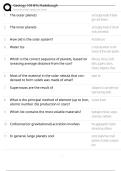
1. The outer planets are largely made of hydo-
gen and helium
2. The inner planets are largely made of silicate
rocks and metals
3. How old is the solar system? 4.6 billion yrs
4. Water Ice is most abundant on the
moons of the outer planets
5. Which is the correct sequence of planets, based on Mercury, Venus, Earth,
icreasing average distance from the sun? Mars, Jupiter, Saturn,
Uranus, Neptune, Pluto
6. Most of the material in the solar nebula that con- water ice
densed to form solids was made of what?
7. Supernovas are the result of collapse of a star with mul-
tiple burning shells
8. What is the principal method of element (up to Iron, nuclear fusion
atomic number 26) production in stars?
9. Which list contains the most volatile materials? hydrogen, helium, argon,
ammonia, methane
10. Collisional (or gravitational) accretion involves the aggregation of plan-
etismals by collision
11. In general, large planets cool more slowly than small
planets of similar composi-
tion
1/2
Study online at https://quizlet.com/_4semyi
1. The outer planets are largely made of hydo-
gen and helium
2. The inner planets are largely made of silicate
rocks and metals
3. How old is the solar system? 4.6 billion yrs
4. Water Ice is most abundant on the
moons of the outer planets
5. Which is the correct sequence of planets, based on Mercury, Venus, Earth,
icreasing average distance from the sun? Mars, Jupiter, Saturn,
Uranus, Neptune, Pluto
6. Most of the material in the solar nebula that con- water ice
densed to form solids was made of what?
7. Supernovas are the result of collapse of a star with mul-
tiple burning shells
8. What is the principal method of element (up to Iron, nuclear fusion
atomic number 26) production in stars?
9. Which list contains the most volatile materials? hydrogen, helium, argon,
ammonia, methane
10. Collisional (or gravitational) accretion involves the aggregation of plan-
etismals by collision
11. In general, large planets cool more slowly than small
planets of similar composi-
tion
1/2