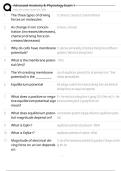
Advanced Anatomy & Physiology Exam 1
Study online at https://quizlet.com/_3k8xfx
1. The three types of driving 1) chemical 2) electrical 3) electrochemical
forces on molecules:
2. As change in ion concen- increases, increases
tration (increases/decreases),
chemical driving force (in-
creases/decreases)
3. Why do cells have membrane 1) selective permeability 2)chemical driving forces/diffusion
potentials? gradients 3)electrical driving forces
4. What is the membrane poten- -70mV
tial (Vm)?
5. The Vm (resting membrane sum of equilibrium potentials for all permeant ions * their
potential) is the ___________ relative permeabilities
6. Equilibrium potential the voltage at which the chemical driving force and electrical
driving forces are equal and opposite
7. What does a positive or nega- If +, the electrical driving force is going OUT of the cell, if -, the
tive equilibrium potential sign electrical driving force is going IN the cell
mean?
8. What does equilibrium poten- Concentration gradient (largely influences equilibrium poten-
tial magnitude depend on? tial)
9. What is EqK+? equilibrium potential of potassium: -90mV
10. What is EqNa+? equilibrium potential of sodium: +60mV
11. Magnitude of electrical dri- 1) size of the membrane potential 2) quantity of charge carried
ving force on an ion depends by the ion
on:
, Advanced Anatomy & Physiology Exam 1
Study online at https://quizlet.com/_3k8xfx
12. electrochemical driving force 1) the ion's tendency to be pushed down a gradient (chemical)
2) the ion's tendency to be pushed in a direction by membrane
potential (electrical)
13. Nernst Equation Ex = (+/-) 61mV * log [Co]/[Ci] --> equilibrium potential =
+/-61mV times the log of the concentration moving out over
concentration moving in
14. Separation of charge Unbalanced movement of an ion across the membrane; basis
for potential difference across the plasma membrane (mem-
brane potential)
15. What is the concentration of 290mOsm/L (same inside and outside the cell)
ions in body fluids?
16. Na+-K+ ATPase 2 Na+ out, 3 K+ in
17. PMCA moves Ca2+ out
18. Why is it important for a cell The potential energy can be utilized: ex. action potential
to have different charges on
either side of the membrane?
19. Why can't sodium achieve a Because there is always potassium leaving (K+ leak channels)
resting membrane potential --> more negative
of +60?
20. Electrochemical driving force Vm - Ex (membrane potential - equilibrium potential of that
equals: ion)
21. Electrochemical driving force -70 - 60 = -130 so driving force is 130mV IN
of sodium given that Vm = -70
and ENa = 60?
, Advanced Anatomy & Physiology Exam 1
Study online at https://quizlet.com/_3k8xfx
22. Simple diffusion depends on: concentration, surface area, and permeability
23. Facilitated diffusion utilizes channels and carriers
24. Primary active transport requires energy such as ATP, ex. Na-K ATPase
25. Secondary active transport utilizes electrochemical gradients, ex. glucose-Na pump
26. facilitated diffusion protein-mediated, NO input of energy, ex. glucose
27. channels no binding to substance being transported
28. simple diffusion no protein mediator
29. Carrier-mediated transport is 1) saturation 2) specificity 3) competition for the binding site
affected by:
30. osmosis water uses aquaporins, moves towards areas of greater solute
concentration
31. osmolarity ability to draw in water - the greater the solute, the more water
will come
32. Digitalis Affects sodium-potassium pump, thereby reducing the amount
of sodium leaving the cell, reducing the amount of sodium
returning to the cell, and thus retaining more calcium inside
the cell (more contraction)
33. osmotic pressure the amount of pressure required to oppose osmosis; the
amount of pressure that accounts for the movement of water
34. Receptor responses depend 1) affinity for ligand 2) concentration of ligand 3) number of
on: receptors per cell
35. Intracellular receptors 1) Steroid hormones 2) thyroid hormones 3) 1,25 vitamin D3
Study online at https://quizlet.com/_3k8xfx
1. The three types of driving 1) chemical 2) electrical 3) electrochemical
forces on molecules:
2. As change in ion concen- increases, increases
tration (increases/decreases),
chemical driving force (in-
creases/decreases)
3. Why do cells have membrane 1) selective permeability 2)chemical driving forces/diffusion
potentials? gradients 3)electrical driving forces
4. What is the membrane poten- -70mV
tial (Vm)?
5. The Vm (resting membrane sum of equilibrium potentials for all permeant ions * their
potential) is the ___________ relative permeabilities
6. Equilibrium potential the voltage at which the chemical driving force and electrical
driving forces are equal and opposite
7. What does a positive or nega- If +, the electrical driving force is going OUT of the cell, if -, the
tive equilibrium potential sign electrical driving force is going IN the cell
mean?
8. What does equilibrium poten- Concentration gradient (largely influences equilibrium poten-
tial magnitude depend on? tial)
9. What is EqK+? equilibrium potential of potassium: -90mV
10. What is EqNa+? equilibrium potential of sodium: +60mV
11. Magnitude of electrical dri- 1) size of the membrane potential 2) quantity of charge carried
ving force on an ion depends by the ion
on:
, Advanced Anatomy & Physiology Exam 1
Study online at https://quizlet.com/_3k8xfx
12. electrochemical driving force 1) the ion's tendency to be pushed down a gradient (chemical)
2) the ion's tendency to be pushed in a direction by membrane
potential (electrical)
13. Nernst Equation Ex = (+/-) 61mV * log [Co]/[Ci] --> equilibrium potential =
+/-61mV times the log of the concentration moving out over
concentration moving in
14. Separation of charge Unbalanced movement of an ion across the membrane; basis
for potential difference across the plasma membrane (mem-
brane potential)
15. What is the concentration of 290mOsm/L (same inside and outside the cell)
ions in body fluids?
16. Na+-K+ ATPase 2 Na+ out, 3 K+ in
17. PMCA moves Ca2+ out
18. Why is it important for a cell The potential energy can be utilized: ex. action potential
to have different charges on
either side of the membrane?
19. Why can't sodium achieve a Because there is always potassium leaving (K+ leak channels)
resting membrane potential --> more negative
of +60?
20. Electrochemical driving force Vm - Ex (membrane potential - equilibrium potential of that
equals: ion)
21. Electrochemical driving force -70 - 60 = -130 so driving force is 130mV IN
of sodium given that Vm = -70
and ENa = 60?
, Advanced Anatomy & Physiology Exam 1
Study online at https://quizlet.com/_3k8xfx
22. Simple diffusion depends on: concentration, surface area, and permeability
23. Facilitated diffusion utilizes channels and carriers
24. Primary active transport requires energy such as ATP, ex. Na-K ATPase
25. Secondary active transport utilizes electrochemical gradients, ex. glucose-Na pump
26. facilitated diffusion protein-mediated, NO input of energy, ex. glucose
27. channels no binding to substance being transported
28. simple diffusion no protein mediator
29. Carrier-mediated transport is 1) saturation 2) specificity 3) competition for the binding site
affected by:
30. osmosis water uses aquaporins, moves towards areas of greater solute
concentration
31. osmolarity ability to draw in water - the greater the solute, the more water
will come
32. Digitalis Affects sodium-potassium pump, thereby reducing the amount
of sodium leaving the cell, reducing the amount of sodium
returning to the cell, and thus retaining more calcium inside
the cell (more contraction)
33. osmotic pressure the amount of pressure required to oppose osmosis; the
amount of pressure that accounts for the movement of water
34. Receptor responses depend 1) affinity for ligand 2) concentration of ligand 3) number of
on: receptors per cell
35. Intracellular receptors 1) Steroid hormones 2) thyroid hormones 3) 1,25 vitamin D3