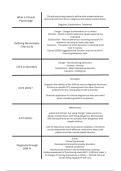
Clinical psychology seeks to define what makes behaviour
What is Clinical
abnormal and then aims to diagnose and explain mental illness.
Psychology
Diagnosis, Explanations, Treatment.
Danger - Danger to themselves or to others
Distress - Extent to which behaviour causes upset to the
individual
Dysfunction - Persons behaviour not being successful in
relation to carrying out every day tasks
Defining Abnormality
Deviance - The extent to which behaviour is deemed to be
(The 4 D'S) 'rare' in society
Davies (2009) Suggested that Duration may be the 5th D.
How long behaviour lasts.
Danger - Nicotine/Drug addictions
Distress - Anxiety
4 D'S in Disorders
Dysfunction - Major Depressive disorder
Deviance - Pedophilia
Strengths:
Supports the validity of the DSM as various diagnosis are shown
4 D'S (AO3) + to focus on specific D'S, showing each has value. Davis has
evidence for this, linking each D with a disorder.
Practical application for clinical diagnosis as they are useful
when considering patients symptoms.
Weaknesses:
Labels are formed. E.g. using 'Danger' leads society to
equate mental illness with being dangerous. Most people
4 D'S (AO3) - with Schizophrenia are not actually more dangerous than
people without.
Lack of objectivity raises issues about reliability. 2 Clinicians
could subjectively reach different conclusions about that
patient and their mental health disorder.
5 Axis:
Clinical Syndromes
Developmental and Personality disorders
Diagnosis through
Medical conditions
DSM IV Psychosocial stressors like homelessness, bullying
Global assessment of functioning scale (GAF) - 100Point scale. 1-
10 Danger of hurting themselves or others ... 90-100 'Normal'
human being capable of self care.
, A disorder which involves a clinically significant impairment or
distress in ones personal, social or occupational life.
What is a Mental In the ICD - 10, All disorders are grouped as part of a family so they
Disorder + ICD-10 are all given the code F followed by a number which represents
that family. For example, F32 for depression. Mental and
Behavioural disorders are the 5th chapter in the ICD-10.
Strengths:
With diagnosis, you can get appropriate treatment. This is a
Diagnostic Tools good opportunity for the patient to better their symptoms.
(AO3) +
When 2 doctors use the DSM-5, they should come close to the
same diagnosis. Acts as guidance for a more effective
diagnosis routine.
What counts as a mental illness changes over time. For
example, homosexuality used to be in the DSM but is no longer
considered a mental illness. This suggests that diagnosis is not
entirely objective. It can reflect moral, political, or cultural
Diagnostic Tools norms.
(AO3) -
The result of a diagnosis can simply just be a label that tells us
nothing relevant about the cause of the illness. This limits the
usefulness of diagnosis.
Diagnosis - Process of deciding what mental illness (if any) a
patient is suffering from based on symptoms.
Key Terms Prognosis - Prediction regarding the course that the disorder is
likely to take and possible outcomes with/without treatment.
Aetiology - The causes of a disorder.
Reliability refers to the consistency of something. If one
person goes to 2 clinicians with the same symptoms and gets
2 different diagnosis, there is no reliability.
Reliability (AO1)
Subjective nature of diagnosis can affect reliability. Reliability
can also be affected by information given by the patient.
Strengths:
Galeazzi (2004) - 2 researchers asessed 110 clients through a
joint interview using the ICD-10 and found kappa reliability
values of 0.69-0.97 (kappa scale ranges from -1 to 1 where -1 is
perfect disagreement and 1 is perfect agreement).
Reliability (AO3) +
Many psychological studies use standardised methods, such as
structured interviews, controlled lab experiments, or specific
instructions for all participants. This means the study can be
replicated under the same conditions, producing consistent
results.
, Weaknesses:
Cooper et al (1972) - New york psychiatrists were found to be 2x
more likely to diagnose Schizophrenia than London psychiatrists
Reliability (AO3) - who were 2x more likely to diagnose depression when shown the
same videotaped clinical interviews. Low inter-rater reliability.
Even with standardised procedures, participants responses may
vary due to mood, motivation, or external distractions, making their
behaviour less predictable.
Descriptive - How accurately a study describes what actually
happened
Predictive - The extent to which a test or assessment can
predict a future outcome or behavior
Types of Validity Aetiological - Patients with the same diagnosis should have
developed the disorder through the same cause
Concurrent - type of criterion related validity that measures
how well a new test correlates with an existing, validated test
that measures the same or a similar construct
Descriptive - Eysenck(1997) found that two thirds of patients with
anxiety disorder were diagnosed with one or more additional
anxiety disorders
Predictive - Heather (1978) found a 50% chance of predicting
Validity (AO3) +
which treatment will be given by diagnosis
Aetiological - Schizophrenia may be genetic in some cases
Concurrent - Pihlajamaa (2008) demonstrated concurrent validity
between DSM5 and ICD-10 diagnosis.
If a diagnosis is valid then it should be possible to predict the
Implications for prognosis and course of the disorder as well as suitable
Diagnosis treatment.
Any unreliability or low validity results in meaningless
prognosis and treatment of disorders.
5 Main symptoms:
Delusions - False beliefs
Hallucinations - Auditory/Visual experiences which arent real
Schizophrenia in Disorganised speech - frequent derailment of conversation
Disorganised behaviour - Repetitive movements/gestures
the DSM V
Negative symptoms - symptoms which stunt the ability to
experience/do things like lack of emotion or unwillingness to
speak.
Of these 5, 2 are required for a diagnosis with 1 being either
Delusions of Hallucinations.
What is Clinical
abnormal and then aims to diagnose and explain mental illness.
Psychology
Diagnosis, Explanations, Treatment.
Danger - Danger to themselves or to others
Distress - Extent to which behaviour causes upset to the
individual
Dysfunction - Persons behaviour not being successful in
relation to carrying out every day tasks
Defining Abnormality
Deviance - The extent to which behaviour is deemed to be
(The 4 D'S) 'rare' in society
Davies (2009) Suggested that Duration may be the 5th D.
How long behaviour lasts.
Danger - Nicotine/Drug addictions
Distress - Anxiety
4 D'S in Disorders
Dysfunction - Major Depressive disorder
Deviance - Pedophilia
Strengths:
Supports the validity of the DSM as various diagnosis are shown
4 D'S (AO3) + to focus on specific D'S, showing each has value. Davis has
evidence for this, linking each D with a disorder.
Practical application for clinical diagnosis as they are useful
when considering patients symptoms.
Weaknesses:
Labels are formed. E.g. using 'Danger' leads society to
equate mental illness with being dangerous. Most people
4 D'S (AO3) - with Schizophrenia are not actually more dangerous than
people without.
Lack of objectivity raises issues about reliability. 2 Clinicians
could subjectively reach different conclusions about that
patient and their mental health disorder.
5 Axis:
Clinical Syndromes
Developmental and Personality disorders
Diagnosis through
Medical conditions
DSM IV Psychosocial stressors like homelessness, bullying
Global assessment of functioning scale (GAF) - 100Point scale. 1-
10 Danger of hurting themselves or others ... 90-100 'Normal'
human being capable of self care.
, A disorder which involves a clinically significant impairment or
distress in ones personal, social or occupational life.
What is a Mental In the ICD - 10, All disorders are grouped as part of a family so they
Disorder + ICD-10 are all given the code F followed by a number which represents
that family. For example, F32 for depression. Mental and
Behavioural disorders are the 5th chapter in the ICD-10.
Strengths:
With diagnosis, you can get appropriate treatment. This is a
Diagnostic Tools good opportunity for the patient to better their symptoms.
(AO3) +
When 2 doctors use the DSM-5, they should come close to the
same diagnosis. Acts as guidance for a more effective
diagnosis routine.
What counts as a mental illness changes over time. For
example, homosexuality used to be in the DSM but is no longer
considered a mental illness. This suggests that diagnosis is not
entirely objective. It can reflect moral, political, or cultural
Diagnostic Tools norms.
(AO3) -
The result of a diagnosis can simply just be a label that tells us
nothing relevant about the cause of the illness. This limits the
usefulness of diagnosis.
Diagnosis - Process of deciding what mental illness (if any) a
patient is suffering from based on symptoms.
Key Terms Prognosis - Prediction regarding the course that the disorder is
likely to take and possible outcomes with/without treatment.
Aetiology - The causes of a disorder.
Reliability refers to the consistency of something. If one
person goes to 2 clinicians with the same symptoms and gets
2 different diagnosis, there is no reliability.
Reliability (AO1)
Subjective nature of diagnosis can affect reliability. Reliability
can also be affected by information given by the patient.
Strengths:
Galeazzi (2004) - 2 researchers asessed 110 clients through a
joint interview using the ICD-10 and found kappa reliability
values of 0.69-0.97 (kappa scale ranges from -1 to 1 where -1 is
perfect disagreement and 1 is perfect agreement).
Reliability (AO3) +
Many psychological studies use standardised methods, such as
structured interviews, controlled lab experiments, or specific
instructions for all participants. This means the study can be
replicated under the same conditions, producing consistent
results.
, Weaknesses:
Cooper et al (1972) - New york psychiatrists were found to be 2x
more likely to diagnose Schizophrenia than London psychiatrists
Reliability (AO3) - who were 2x more likely to diagnose depression when shown the
same videotaped clinical interviews. Low inter-rater reliability.
Even with standardised procedures, participants responses may
vary due to mood, motivation, or external distractions, making their
behaviour less predictable.
Descriptive - How accurately a study describes what actually
happened
Predictive - The extent to which a test or assessment can
predict a future outcome or behavior
Types of Validity Aetiological - Patients with the same diagnosis should have
developed the disorder through the same cause
Concurrent - type of criterion related validity that measures
how well a new test correlates with an existing, validated test
that measures the same or a similar construct
Descriptive - Eysenck(1997) found that two thirds of patients with
anxiety disorder were diagnosed with one or more additional
anxiety disorders
Predictive - Heather (1978) found a 50% chance of predicting
Validity (AO3) +
which treatment will be given by diagnosis
Aetiological - Schizophrenia may be genetic in some cases
Concurrent - Pihlajamaa (2008) demonstrated concurrent validity
between DSM5 and ICD-10 diagnosis.
If a diagnosis is valid then it should be possible to predict the
Implications for prognosis and course of the disorder as well as suitable
Diagnosis treatment.
Any unreliability or low validity results in meaningless
prognosis and treatment of disorders.
5 Main symptoms:
Delusions - False beliefs
Hallucinations - Auditory/Visual experiences which arent real
Schizophrenia in Disorganised speech - frequent derailment of conversation
Disorganised behaviour - Repetitive movements/gestures
the DSM V
Negative symptoms - symptoms which stunt the ability to
experience/do things like lack of emotion or unwillingness to
speak.
Of these 5, 2 are required for a diagnosis with 1 being either
Delusions of Hallucinations.