
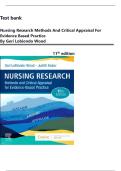
Test bank
Nursing Research Methods And Critical Appraisal For
Evidence Based Practice
By Geri Lobiondo Wood
11th edition
,Table of contents
Part i. Overview of research and evidence-based practice
Research vignette
1. Integrating research, evidence-based practice, and quality improvement processes
2. Research questions, hypotheses, and clinical questions
3. Gathering and appraising the literature
4. Theoretical frameworks for research
Part ii. Processes and evidence related to qualitative research
Research vignette
5. Introduction to qualitative research
6. Qualitative approaches to research
7. Appraising qualitative research
Part iii. Processes and evidence related to quantitative research
Research vignette
8. Introduction to quantitative research
9. Experimental and quasi-experimental designs
10. Nonexperimental designs
11. Systematic reviews and clinical practice guidelines
12. Sampling
13. Legal and ethical issues
14. Data collection methods
15. Reliability and validity
16. Data analysis: descriptive and inferential statistics
17. Understanding research findings
18. Appraising quantitative research
Part iv. Application of research: evidence-based practice
Research vignette
19. Strategies and tools for developing an evidence-based practice
20. Developing an evidence-based practice
21. Quality improvement
,Chapter 01: integrating research, evidence-based practice, and quality improvement
processes
test bank
Multiple choice
1. Nursing research is significant to the profession of nursing because it promotes what?
a. More specifically defined nursing practice responsibilities
b. Decreased liability within the practice of nursing
c. Generation of a specialized body of nursing knowledge for use in nursing practice
d. Expansion of the scope of nursing practice into areas formerly reserved for other
disciplines
ANS: c
Feedback
A Research aids in documenting accountability of nurses, but professional
Guidelines already exist regarding responsibility. Each state has a nurse practice
act with rules and regulations that define scope of practice.
B Liability is a legal concept related to a nurse’s legal scope of practice and
professional standards of practice. Research does not change a nurse’s liability.
C Nursing research generates a specialized scientific knowledge base that
empowers the nursing profession to anticipate and meet constantly shifting
Challenges of health care delivery to multiple populations. It provides a
foundation for evidence-based nursing care and quality improvement activities.
D Although research can document nursing accountability, each state’s nurse
practice act defines the scope of nursing practice for that state.
Dif: cognitive level: understanding (comprehension) ref: page 6
2. Which aspect of the scientific investigation of nursing practice is also a fundamental concept
of american nurses association (ana)’s code for nurses?
a. Professional accountability
b. Standards of care
c. Legal scope of practice
d. Advanced practice nursing activities
ANS: a
Feedback
A Scientific investigation promotes accountability, a hallmark of the nursing
profession and a fundamental concept of the ana’s code for nurses.
B Standards of care are defined by ana, as well as specialty nursing
Organizations. The code for nurses states that nurses should conform to
standards, but standards per se are not part of the code.
, C Legal scope of practice is defined by each state’s nurse practice act and elaborated
in its rules and regulations.
D The ana code applies to nursing practice in general, not advanced practice.
Dif: cognitive level: remembering (knowledge) ref: page 6
3. Nurses who do not conduct research need to understand the nursing research process for
which of these reasons?
a. To identify potential subjects for clinical research studies
b. To assist as accurate data collectors in clinical research studies
c. To teach patients and their families about the usefulness of consenting to
participate in research
d. To be able to evaluate nursing research reports for relevance to their own clinical
practice
ANS: d
Feedback
A Subject identification is determined by the nurse researcher.
B Data collectors need to understand their role in the study; they do not need to
understand the entire research process.
C Subject recruitment is the responsibility of the nurse researcher.
D Nurses need to understand the research process in order to critically read
Research reports and determine if nursing practice should incorporate the
research findings as valid evidence.
Dif: cognitive level: understanding (comprehension) ref: page 7
4. Which of these actions demonstrates the role of a knowledgeable consumer of nursing
research?
a. Designing a nursing research study
b. Analyzing data to determine a study’s outcomes
c. Evaluating the credibility of research findings
d. Implementing an intervention found to be effective in one clinical case study
ANS: c
Feedback
A A consumer uses and applies research to practice but is not responsible for
designing a study.
B A consumer does not conduct data analysis of a study; the study’s primary
investigator analyzes data.
C A consumer of nursing research needs to understand the research process to
determine the merit and relevance of evidence presented in research studies.
D A consumer would not implement an intervention on the basis of a single case
study.
Dif: cognitive level: understanding (comprehension) ref: page 7
Nursing Research Methods And Critical Appraisal For
Evidence Based Practice
By Geri Lobiondo Wood
11th edition
,Table of contents
Part i. Overview of research and evidence-based practice
Research vignette
1. Integrating research, evidence-based practice, and quality improvement processes
2. Research questions, hypotheses, and clinical questions
3. Gathering and appraising the literature
4. Theoretical frameworks for research
Part ii. Processes and evidence related to qualitative research
Research vignette
5. Introduction to qualitative research
6. Qualitative approaches to research
7. Appraising qualitative research
Part iii. Processes and evidence related to quantitative research
Research vignette
8. Introduction to quantitative research
9. Experimental and quasi-experimental designs
10. Nonexperimental designs
11. Systematic reviews and clinical practice guidelines
12. Sampling
13. Legal and ethical issues
14. Data collection methods
15. Reliability and validity
16. Data analysis: descriptive and inferential statistics
17. Understanding research findings
18. Appraising quantitative research
Part iv. Application of research: evidence-based practice
Research vignette
19. Strategies and tools for developing an evidence-based practice
20. Developing an evidence-based practice
21. Quality improvement
,Chapter 01: integrating research, evidence-based practice, and quality improvement
processes
test bank
Multiple choice
1. Nursing research is significant to the profession of nursing because it promotes what?
a. More specifically defined nursing practice responsibilities
b. Decreased liability within the practice of nursing
c. Generation of a specialized body of nursing knowledge for use in nursing practice
d. Expansion of the scope of nursing practice into areas formerly reserved for other
disciplines
ANS: c
Feedback
A Research aids in documenting accountability of nurses, but professional
Guidelines already exist regarding responsibility. Each state has a nurse practice
act with rules and regulations that define scope of practice.
B Liability is a legal concept related to a nurse’s legal scope of practice and
professional standards of practice. Research does not change a nurse’s liability.
C Nursing research generates a specialized scientific knowledge base that
empowers the nursing profession to anticipate and meet constantly shifting
Challenges of health care delivery to multiple populations. It provides a
foundation for evidence-based nursing care and quality improvement activities.
D Although research can document nursing accountability, each state’s nurse
practice act defines the scope of nursing practice for that state.
Dif: cognitive level: understanding (comprehension) ref: page 6
2. Which aspect of the scientific investigation of nursing practice is also a fundamental concept
of american nurses association (ana)’s code for nurses?
a. Professional accountability
b. Standards of care
c. Legal scope of practice
d. Advanced practice nursing activities
ANS: a
Feedback
A Scientific investigation promotes accountability, a hallmark of the nursing
profession and a fundamental concept of the ana’s code for nurses.
B Standards of care are defined by ana, as well as specialty nursing
Organizations. The code for nurses states that nurses should conform to
standards, but standards per se are not part of the code.
, C Legal scope of practice is defined by each state’s nurse practice act and elaborated
in its rules and regulations.
D The ana code applies to nursing practice in general, not advanced practice.
Dif: cognitive level: remembering (knowledge) ref: page 6
3. Nurses who do not conduct research need to understand the nursing research process for
which of these reasons?
a. To identify potential subjects for clinical research studies
b. To assist as accurate data collectors in clinical research studies
c. To teach patients and their families about the usefulness of consenting to
participate in research
d. To be able to evaluate nursing research reports for relevance to their own clinical
practice
ANS: d
Feedback
A Subject identification is determined by the nurse researcher.
B Data collectors need to understand their role in the study; they do not need to
understand the entire research process.
C Subject recruitment is the responsibility of the nurse researcher.
D Nurses need to understand the research process in order to critically read
Research reports and determine if nursing practice should incorporate the
research findings as valid evidence.
Dif: cognitive level: understanding (comprehension) ref: page 7
4. Which of these actions demonstrates the role of a knowledgeable consumer of nursing
research?
a. Designing a nursing research study
b. Analyzing data to determine a study’s outcomes
c. Evaluating the credibility of research findings
d. Implementing an intervention found to be effective in one clinical case study
ANS: c
Feedback
A A consumer uses and applies research to practice but is not responsible for
designing a study.
B A consumer does not conduct data analysis of a study; the study’s primary
investigator analyzes data.
C A consumer of nursing research needs to understand the research process to
determine the merit and relevance of evidence presented in research studies.
D A consumer would not implement an intervention on the basis of a single case
study.
Dif: cognitive level: understanding (comprehension) ref: page 7


