Chapter 1 Operations Management
What is operations management?
Operations management is the activity of managing the resources that create and deliver services
and products.
All organizations have ‘operations’ that produce some mix of services and products.
Operations managers are the people who have particular responsibility for managing some, or all, of
the resources that make up the operations function.
Operations in the organization
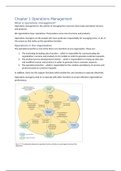
The operations function is one of the three core functions of any organization. These are:
1. The marketing (including sales) function – which is responsible for communicating the
organization’s services and products to its markets in order to generate customer requests;
2. The product/service development function – which is responsible for coming up with new
and modified services and products in order to generate future customer requests;
3. The operations function – which is responsible for the creation and delivery of services and
products based on customer requests.
In addition, there are the support functions which enable the core functions to operate effectively.
Operations managers need to co-operate with other functions to ensure effective organizational
performance.
, Why is operations management important in all types of organization?
The economic sector of an operation is less important in determining how it should be managed
than its intrinsic characteristics.
Operations management in five different organizations:
1. Automobile assembly factory: operations management uses machines to effectively
assemble products that satisfy current customer demands.
2. Physician (general practitioner): operations management uses knowledge to effectively
diagnose conditions in order to treat real and perceived patient concerns.
3. Management consultant: operations management uses people to effectively create the
services that will address current and potential client needs.
4. Disaster relief charity: operations management uses ours and our partners’ resources to
speedily provide the supplies and services that relieve community suffering.
5. Advertising agency: operations management uses our staff’s knowledge and experience to
creatively present ideas that delight clients and address their real needs.
Operations management uses ‘resources to appropriately create outputs that fulfil defined market
requirements’.
Operations management in the smaller organization
Operations management is just as important in small organizations as it is in large ones. Irrespective
of their size, all companies need to create and deliver their service and products efficiently and
effectively.
Operations management in not-for-profit organizations
Managing the operations in an animal welfare charity, hospital, research organization or government
department is essentially the same as in commercial organizations. However, the strategic objectives
of not-for-profit organizations may be more complex and involve a mixture of political, economic,
social or environmental objectives.
What is operations management?
Operations management is the activity of managing the resources that create and deliver services
and products.
All organizations have ‘operations’ that produce some mix of services and products.
Operations managers are the people who have particular responsibility for managing some, or all, of
the resources that make up the operations function.
Operations in the organization
The operations function is one of the three core functions of any organization. These are:
1. The marketing (including sales) function – which is responsible for communicating the
organization’s services and products to its markets in order to generate customer requests;
2. The product/service development function – which is responsible for coming up with new
and modified services and products in order to generate future customer requests;
3. The operations function – which is responsible for the creation and delivery of services and
products based on customer requests.
In addition, there are the support functions which enable the core functions to operate effectively.
Operations managers need to co-operate with other functions to ensure effective organizational
performance.
, Why is operations management important in all types of organization?
The economic sector of an operation is less important in determining how it should be managed
than its intrinsic characteristics.
Operations management in five different organizations:
1. Automobile assembly factory: operations management uses machines to effectively
assemble products that satisfy current customer demands.
2. Physician (general practitioner): operations management uses knowledge to effectively
diagnose conditions in order to treat real and perceived patient concerns.
3. Management consultant: operations management uses people to effectively create the
services that will address current and potential client needs.
4. Disaster relief charity: operations management uses ours and our partners’ resources to
speedily provide the supplies and services that relieve community suffering.
5. Advertising agency: operations management uses our staff’s knowledge and experience to
creatively present ideas that delight clients and address their real needs.
Operations management uses ‘resources to appropriately create outputs that fulfil defined market
requirements’.
Operations management in the smaller organization
Operations management is just as important in small organizations as it is in large ones. Irrespective
of their size, all companies need to create and deliver their service and products efficiently and
effectively.
Operations management in not-for-profit organizations
Managing the operations in an animal welfare charity, hospital, research organization or government
department is essentially the same as in commercial organizations. However, the strategic objectives
of not-for-profit organizations may be more complex and involve a mixture of political, economic,
social or environmental objectives.