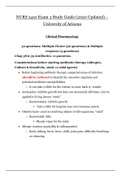
NURS 3410 Exam 3 Study Guide (2020 Updated) – University of Arizona | NURS3410 Exam 3 Study Guide
NURS 3410 Exam 3 Study Guide (2020 Updated) – University of Arizona Clinical Pharmacology 50 questions: Multiple Choice (36 questions) & Multiple response (4 questions) Chap 38 & 39 Antibiotics- 11 questions Considerations before starting antibiotic therapy (allergies, Culture & Sensitivity, static vs cidal agents) • Before beginning antibiotic therapy, suspected areas of infection should be cultured to identify the causative organism and potential antibiotic susceptibilities o It can take a while for the culture to come back w/ results • Antiseptics- inhibits growth but does not necessarily kill them. Can be applied to living tissues “static” - - - - - - - - - - - - - - - - - - - - - - - - - - - - se effects monitored ISONIAZID • Administered solely for prophylaxis or Part of combo w/ other antitubercular drugs for treatment Rifampin • Used alone for prevention of TB or in combo for treatment of TB • Causes body fluids to turn red-orange-brown Pyrazinamide • Used in combo w/ other drugs for treatment of TB Ethambutol • Suppresses RNA synthesis • Used in combo w/ other drugs for treatment of TB • Is D/C after testing Chap 40-Anti-viral- 1 question Side effects of zidovudine p. 654 o First & original HIV med Major dose limiting Adverse Effect= bone marrow suppression Chap 42-Anti-fungal-1 question Considerations of using amphotericin BAmphotericin B (Fungizone)/ Ampho B • Severe systemic fungal infections • Many adverse effects! IV most patients have o Extravasation, Fever, chills, hypotension, tachycardia, malaise, muscle & joint pain, anorexia, N/V, HeadAche o Typically requires pre-treatment- will need to give pt. a fluid bolus to increase their blood pressure ▪ Pretreatment can include antipyretics, antihistamines, antiemetics, corticosteroids o Lipid formulations available (but expensive) to decrease SE • Contraindicated in renal impairment & bone marrow suppression o Bone marrow- pancytopenia (low blood count) Chap 18 Adrenergic: 6 questions Effects & therapeutic outcomes of adrenergic agonists • Direct stimulating • Binds directly to receptor to cause response • Ex: Epinephrine • Increase dosing increase binding increases reaction • Indirect stimulating • Causes release of stored catecholamine • Ex: Amphetamine • Targets the release of the epi and norepi • Mixed acting • Causes both actions • Ex: Ephedrine• Selective vs Non-Selective • The selectiveness can also depend on dosages • Dopamine: smaller doses increase kidney perfusion (helps flushing), higher doses affect CV system • Classified based upon • Specific receptor activities • Clinical effects • Alpha Adrenergic Receptors: • Alpha 1: post synaptic effector (tissues, muscles, organ) cells • Vasoconstriction, relaxation of GI tract, uterus and bladder contraction, male ejaculation, pupil dilation • Alpha 2: presynaptic nerve terminals that release neurotransmitters • Primary alpha adrenergic agonist response is vasoconstriction & CNS stimulation • Beta Adrenergic Receptors: • Beta 1: heart • Positive inotrope/chronotrope effects, increase in conduction of impulse through AV noted, increase in renin from kidney • Beta 2: Smooth muscles of bronchioles, arterioles, visceral organs • Bronchodilation, uterus relaxation, glucose release from liver• Primary beta-adrenergic agonist response is bronchial, GI and uterine smooth muscle relaxation, glycogenolysis (increase blood glucose) & cardiac stimulation (increase heart rate) • Dopaminergic receptors • Primary response is dilatation of renal (increase urine output), mesenteric, coronary (increase O2 to the heart) and cerebral (increase O2 to the brain) arteries Chronotron- drug that has an impact to the heart rate Positive- increase HR Negative- decrease HR Inotrope- strength of a contraction Positive- increase contraction Negative- decrease contraction Indications & Adverse effects of epi drug book Indication Alpha and beta vasopressor • Classic nonselective prototype • Emergency drug (the no #1 drug of cardiac arrest, continually re-dosed throughout the code, only drug used if there is no electrical activity) o 1:1,000 1 mg/mL- usually used in cardiac arrest o 1: 10,000 0.1mg/mL • Low dosages: Treat acute asthma and anaphylactic shock Adverse Effects= palpation, tachycardia, anxiety, acute hypertension, arrhythmias, headache, N/V/D, disorientationAdverse effects of dobutamine pg. 301 Beta1 Selective vasopressor • Positive inotrope, increases stroke volume, increase cardiac output in pt w/ heart failure • Tachycardia, hypertension Mild tremors, headache, nervousness, dizziness, palpations, increase heart rate, fluctuations of BP Indications for norepi (Levophed) • Primarily works on alpha receptors, limited beta 1 action vasopressor • Metabolized to dopamine • Continuous infusion for shock & hypotension Chap 19 Adrenergic Blockers: 7 questions B Blockers: names, Complications, adverse effects, education • Cardio selective negative chronotrope, slows conduction through AV node, prolongs SA node recovery, negative inotrope which decreases myocardial O2 demand • Nonselective has additional effects of bronchio-constriction & can cause hypo or hyperglycemia, and the release of fatty acids from adipose tissues affecting cholesterol • Don’t give beta blockers to pt. with lung problemsAsthma or COPD • Check for pulse < or = 60 should be assess if given Indications• Angina, MI, cardiac dysrhythmias, hypertension, heart failure (Only used in compensating state of heart failure, have to stop meds when they are in decompensated state) • Decompensated state pt. will experience shock, decreased perfusion, disorientation, chest pain, decrease urine output • Can be cardioprotective by inhibiting myocardium response to circulating catecholamines • Post MI • Lipophilicity means some can pass blood brain barrier • Migraine headaches • Ocular drops for glaucoma to decrease IOP Contraindication and AE • Contraindicated: allergies, uncompensated heart failure, cardiogenic shock, heart block, bradycardia (HR less than 60), pregnancy, severe lung disease (asthma or COPD), Raynaud’s • Therapy has to be tapered over 1-2 weeks and not stopped abruptly • Increase risk of MI or rebound hypertension • Need to teach pt. to not stop without advisement Adverse effects can get better over time • Bradycardia, depression, impotence, constipation, fatigue, delayed recovery from hypoglycemia (may mask S/S of hypoglycemia) • Toxicity can be tx with atropine (anticholinergic), pacemaker, vasopressors, HD Atenolol (Tenormin) CardioselectivePrimary cardioprotective BB post MI Carvedilol (Coreg) Non-selective, also has alpha blocker, calcium channel blocker and antioxidant properties Primarily used in heart failure. Has Immediate release and Controlled release formularies Esmolol (Breviblock) Potent, short acting beta1 action IV only, Acute, rapid control of ventricle dysrhythmias Labetalol Blocks alpha and beta receptors Used for the heart and blood pressure IV use for Hypertensive emergencies Metoprolol (Lopressor) Most common beta1 blocker Protective post MI properties, and antihypertensive Propranolol (Inderal) Nonselective B1 & B2 - - - - - - - - - - - - -- - - - - - - - - - - - - - - - - - - - s & indications of muscle relaxers pg. 196-7 • Indication= Used to treat pain with skeletal muscle spasms and work predominately in the CNS BACLOFEN (Lioresal) • can be used for hiccups • Oral or implantable pump (chronic spasticity i.e. Spinal cord injury) CYCLOBENAZPRINE (Flexeril) • Closest chemical structure to TCA • Marked sedation common effect DANTROLENE • Works outside CNS directly on the skeletal muscle ▪ Decreases response of muscle to stimuli by decreasing amount of calcium released from muscle fibers o Used for relief of painful musculoskeletal conditions like spasms following low back strain or spasticity with chronic disorders like MS, cerebral lesions • Can be given IV for spasms associated with malignant hyperthermia Meds for migraine prophylaxis • Abortive o Triptans/SSRA (first line): ▪ Selective Serotonin (5-HT) receptor agonists that are firstline therapy (SSRAs) • Stimulate 5-HT receptors cerebral arteries that cause vasoconstriction & elimination of symptoms▪ Abortive therapy (work on symptoms that have already developed) ▪ Used cautiously in those with severe CV disease o Ergot Alkaloids (second line) ▪ Replaced by triptans, not used often due to a lot of Adverse Effects ▪ Constrict blood vessels in brain o Other (second line) abortive agents: NSAIDS, acetaminophen or ASA with a barbiturate and caffeine. • Preventative o If attacks occur on one or more days/week ▪ Propanolol- angenergic beta blocker that can pass through CFS ▪ Amitriptline- anti- depression ▪ Valproic Acid- anti- convulsant ▪ Topiramate- diuretic Chap 13 CNS Stimulants: 3 questions Methylphenidate education pg. 215 • Once a day dosing with ER dosing (avoid at school r/t stigma), don’t give 5-6 hours before bedtime to prevent insomnia • Use proper dosing for good control of ADHD • Monitor height and weight • Take Drug holidays: med-free for weekends, holidays, or vacations • Take on empty stomach before 30-45 mins before eating Names and indications of anorexiants pg. 202 Indications• Substances that suppress appetite • Used to promote weight loss in obesity (effectiveness not proven) • Suppress appetite control centers in the brain, may also increase basal metabolic rate ORLISTAT • works by inhibiting lipase (unrelated to other anorexiants) o Over the counter version is Alli PHENTERMINE (Ionamin) • sympathomimetic structurally r/t amphetamine with lower abuse potential Chap 14 Antiepileptic: 5 questions Gabapentin pg. 227 • Chemical analogue of GABA • Adjunct for partial seizures & prophylaxis of absent seizures • Most commonly used to treat neurologic pain rather than epilepsy/seizures • Adverse effects include CNS and GI o Dizziness, drowsiness, nausea, visual and speech changes, edema • Interacts with alcohol Phenytoin education, therapeutic monitoring • first line drug for tonic-clonic and partial seizures • Lethargy, abnormal movements, mental confusion, cognitive changes, gingival hyperplasia** (overgrowth of gums make sure they are doing good oral care), acne, hirsutism, hypertrophy of subq. facial tissue (Dilantin facies), osteoporosis• Therapeutic level= 10-20 o Serum concentrations of phenytoin, phenobarbital, carbamazepine, primidone correlate with seizure control and adverse effects vs some other drugs o If value is too high, contact provider before giving next dose o Goal is to slowly titrate to lowest EFFECTIVE serum drug level that controls seizures • Toxic levels can cause nystagmus, ataxia, dysarthria, encephalopathy Education: Maintain safety (fall precautions) Monitor airway Seizure precautions Close monitoring and maintain scheduled times for steady state Oral, take with full glass of water and small snack to minimize GI symptoms Avoid grapefruit and citrus with carbamazepine Watch drug-drug, drug-food interactions Avoid abrupt withdrawal (always taper) Meds for status epilepticus pg. 222 Table 14-3 • Status Epilepticus: multiple seizures with no recovery between them, med emergency that lasts more than 5 minutes o If not interrupted, can cause hypotension, hypoxia, brain damage and death DIAZEPAM (Valium) • First drug, widely used with indications across the spectrum • EMERGANCY: A first line treatment for status epilepticus (seizures that last more than 5 mins or multiple) – IV routeCompletely suppresses the brain activity PENTOBARBITAL • Short acting sedative, C-II o Primary use for preop anxiety and sedation o Can additionally be used for status epilepticus o Can be used to treat withdrawal for those dependent on barbiturates or hypnotics FOSPHENYTOIN • Injectable form of phenytoin developed that is not as burning to veins as phenytoin LORAZEPAM (Ativan) • off brand use, but still used for this purpose PHENYTOIN • Can be used Chap 15 Anti-Parkinson’s: 2 questions Action of carbidopa pg. 242 • Carbidopa has little to no pharmacological activity when given alone • Traditional cornerstone tx is levodopa (active ingrediency) • Levodopa is combined with carbidopa to decrease metabolism of levodopa before it reaches the brain. Slowing down metabolism decreases dose required & minimizes side effects that would occur with high doses of levodopa • With disease progression, adjunct agents added to levodopa (MOAI, COMT, NDDRA) Wearing off phenomenon pg. 237• For Parkinson’s: when medicine starts to lose effectiveness, despite maximal dosing as disease progresses Chap 16 Psychotherapeutic: 5 questions Anxiety: generalized anxiety, panic disorder, PTSD, OCD Affective disorders: mood disorders: mania, depression, bipolar Psychotic disorders: loss of contact w/ reality, schizophrenia, possibly r/t too much dopamine MAO interactions pg. 260 • many OTC and food, sympathomimetic, SSRIs (causes serotonin syndrome) • “wash out period” of 2-5 weeks before taking SSRIs, 14 days before TCA Antidepressants education pg. 274 • First 6-8 weeks of acute therapy to get a response and improve symptoms o Continue to take as prescribed even if they don’t feel a difference yet • Toxic lithium level=> 1.5 • Continue to assess for suicidal ideation- Black Box warning • Avoid St John’s Wart • Monitor for adverse effects in TCA • MAOI monitor for hypertensive crisis & food restrictions (high is tyramine- aged cheese & wine, smoked meats, soy sauce, fish sauerkraut) , monitor postural hypotension • Avoid other drugs within 14 days of MAOI• Second generation antidepressants o Cautious use in elderly, monitor for neuromuscular and GI symptoms, risk for serotonin syndrome S/S of serotonin syndrome pg. 261 Box 16-1 • Delirium, agitation, tachycardia, sweating, muscle spasms, shivering, coarse tremors, extensor planter muscle responses Adverse effects of antipsychotics pg. 264 • Blockade of alpha-adrenergic drugs, dopamine, endocrine, histamine and muscarinic receptors agranulocytosis, hemolytic anemia, drowsiness, neuroleptic malignant syndrome, EPS, tardive - - - - - - --
Written for
- Institution
- University Of Arizona
- Module
- Nursing (NURS3410)
Document information
- Uploaded on
- January 11, 2021
- Number of pages
- 26
- Written in
- 2020/2021
- Type
- Other
- Person
- Unknown
Subjects
-
nurs 3410 exam 3 study guide 2020 updated – university of arizona
-
nurs 3410 exam 3 study guide 2020 updated
-
nurs 3410 exam 3 study guide
-
exam 3 study guide 2020 updated – university of arizona
-
n

Also available in package deal