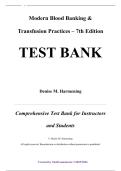
Modern Blood Banking &
Transfusion Practices – 7th Edition
ST
UV
TEST BANK
IA
?_
AP
Denise M. Harmening
PR
Comprehensive Test Bank for Instructors
OV
and Students
ED
© Denise M. Harmening
All rights reserved. Reproduction or distribution without permission is prohibited.
?
Created by MedConnoisseur ©2025/2026
, TABLE OF CONTENTS
Modern Blood Banking & Transfusion Practices – 7th Edition
ST
Denise M. Harmening
Part I: Fundamental Concepts
UV
1. Red Blood Cell and Platelet Preservation: Historical Perspectives and Current Trends
2. Basic Genetics
3. Fundamentals of Immunology
4. Concepts in Molecular Biology
IA
Part II: Blood Groups and Serological Testing
5. The Antiglobulin Test
6. The ABO Blood Group System
7. The Rh Blood Group System
?_
8. Blood Group Terminology & Common Blood Groups: The Lewis System, P, I, MNS, Kell,
Duffy, Kidd, Lutheran
9. Uncommon Blood Groups
10. Detection and Identification of Antibodies
11. Pre-transfusion Testing
AP
12. Blood Bank Testing Technologies and Automation
Part III: Transfusion Practices
13. Donor Selection
14. Transfusion-Transmitted Diseases
PR
15. Component Preparation
16. Transfusion Therapy
17. Adverse Effects of Blood Transfusion
18. Apheresis
19. Cellular Therapy in the Transplant Setting
20. Hemolytic Disease of the Fetus and Newborn
OV
21. Autoimmune Hemolytic Anemias
22. Tissue Banking
Part IV: Leukocyte Antigens and Relationship Testing
23. The HLA System
24. Relationship Testing
ED
Part V: Quality Management and Compliance
25. Quality Management in the Blood Bank
26. Patient Blood Management
27. Transfusion Safety and Federal Regulatory Requirements
?
28. Laboratory Information Systems in the Blood Bank
29. Medicolegal and Ethical Aspects of Providing Blood Collection and Transfusion Services
Created by MedConnoisseur ©2025/2026
,https://www.stuvia.com/
Chapter 1 RBCs and Platelet Preservation: Historical Perspectives and Current Trends
Multiple Choice
ST
Identify the choice that best completes the statement or answers the question.
1. Which metabolic pathway is responsible for generating 90% of the ATP for the RBC?
a. Pentose phosphate shunt c. Glycolysis
b. Luebering-Rapoport shunt d. Methemoglobin reductase
UV
2. A unit of blood was returned to the blood bank before it was spiked. Apparently the patient’s IV failed. The
unit of blood was outside the blood bank for 35 minutes. Which of the statements below is most accurate?
a. The unit of blood should be discarded immediately.
b. The unit of blood can be returned to inventory.
c. The unit of blood must be transfused within 4 hours or be discarded at the end of that time.
IA
d. The unit of blood must be transfused with 24 hours.
3. What is the average diameter of a platelet?
a. 5 to 10 µm c. 1 to 2 µm
b. 2 to 4 µm d. 4 to 6 µm
?_
4. In the normal hemoglobin-oxygen dissociation curve, what percentage of oxygen is released to the tissues
when PO2 averages 40 mm Hg?
a. 75% c. 100%
b. 25% d. 50%
AP
5. What factors are known to influence platelet metabolism and function?
a. Storage temperature c. Platelet count
b. Initial pH d. All of the above
6. Which of the following red blood cell morphologies may be present on the peripheral blood smear as a result
of loss of RBC membrane?
PR
a. Spherocytes c. Burr cells
b. Target cells d. Schistocytes
7. What does the term autologous transfusion refer to?
a. A parent donating blood for his or her child
b. An individual donating blood for a friend
OV
c. An individual donating blood for a relative
d. An individual donating blood for his or her own transfusion
8. What is the primary function of hemoglobin?
a. Iron metabolism c. Oxygen transport
b. Porphyrin synthesis d. Signal transduction
ED
9. All of the following areas of red blood cell biology are crucial for normal erythrocyte survival except:
a. Cellular metabolism. c. Site of the ABO antigen attachment.
b. RBC membrane. d. Hemoglobin structure.
?
This study source was downloaded by 100000826342158 from CourseHero.com on 09-15-2021 17:54:15 GMT -05:00
https://www.coursehero.com/file/25537437/ch01rtf/
,https://www.stuvia.com/
10. What is the correct biochemical composition of the RBC membrane?
a. 52% protein, 40% lipid, 8% carbohydrate
ST
b. 40% protein, 8% lipid, 52% carbohydrate
c. 8% protein, 52% lipid, 40% carbohydrate
d. 8% lipid, 40% carbohydrate, 52% protein
11. All of the following biochemical changes are associated with loss of red blood cell viability upon storage
UV
except:
a. Decreased pH. c. Increased ATP level.
b. Loss of red blood cell function. d. Decreased glucose consumption.
12. Which red blood cell preservative has a storage time of 35 days?
a. ACD c. AS-1
b. CPDA-1 d. CPD
IA
13. The RBC membrane is relatively permeable to all of the following except:
a. Chloride. c. Bicarbonate.
b. Sodium. d. Water.
?_
14. What percentage of platelets is sequestered in the spleen as functional reserve after being released from the
bone marrow?
a. 30% c. 10%
b. 50% d. 25%
AP
15. What is the major biochemical consideration in platelet storage?
a. Glucose metabolism c. Production of carbon dioxide
b. Oxygen supply d. Regulation of pH
16. What would the hemoglobin-oxygen dissociation curve depict in a patient exhibiting clinical signs of
alkalosis?
PR
a. Normal c. Shift to the right
b. Shift to the left d. None of the above
17. Name the main lipid components of a red blood cell membrane.
a. Phospholipid c. Glycolipid
b. Sphingomyelin d. Glycophorin A
OV
18. The ABO blood groups were discovered in 1901 by whom?
a. Charles Drew c. Loutit and Mollison
b. Karl Landsteiner d. Edward Lindeman
19. A standing order of platelets was shipped to your facility by your supplier. It was inadvertently left in the
corner of the department until discovered 36 hours later. What would the appropriate action be for the blood
ED
banker?
a. If the temperature in the box was 22 +/- 2°C and the platelet swirl seemed OK, it would be
OK to accept the unit into inventory.
b. The platelets have fallen outside the supplier’s quality assurance. The unit should be
discarded because the pH has probably dropped too low and platelet activation has been
?
compromised.
c. If the temperature was 1°C to 6°C and the platelet swirl seemed OK, it would be OK to
This study source was downloaded by 100000826342158 from CourseHero.com on 09-15-2021 17:54:15 GMT -05:00
https://www.coursehero.com/file/25537437/ch01rtf/
Transfusion Practices – 7th Edition
ST
UV
TEST BANK
IA
?_
AP
Denise M. Harmening
PR
Comprehensive Test Bank for Instructors
OV
and Students
ED
© Denise M. Harmening
All rights reserved. Reproduction or distribution without permission is prohibited.
?
Created by MedConnoisseur ©2025/2026
, TABLE OF CONTENTS
Modern Blood Banking & Transfusion Practices – 7th Edition
ST
Denise M. Harmening
Part I: Fundamental Concepts
UV
1. Red Blood Cell and Platelet Preservation: Historical Perspectives and Current Trends
2. Basic Genetics
3. Fundamentals of Immunology
4. Concepts in Molecular Biology
IA
Part II: Blood Groups and Serological Testing
5. The Antiglobulin Test
6. The ABO Blood Group System
7. The Rh Blood Group System
?_
8. Blood Group Terminology & Common Blood Groups: The Lewis System, P, I, MNS, Kell,
Duffy, Kidd, Lutheran
9. Uncommon Blood Groups
10. Detection and Identification of Antibodies
11. Pre-transfusion Testing
AP
12. Blood Bank Testing Technologies and Automation
Part III: Transfusion Practices
13. Donor Selection
14. Transfusion-Transmitted Diseases
PR
15. Component Preparation
16. Transfusion Therapy
17. Adverse Effects of Blood Transfusion
18. Apheresis
19. Cellular Therapy in the Transplant Setting
20. Hemolytic Disease of the Fetus and Newborn
OV
21. Autoimmune Hemolytic Anemias
22. Tissue Banking
Part IV: Leukocyte Antigens and Relationship Testing
23. The HLA System
24. Relationship Testing
ED
Part V: Quality Management and Compliance
25. Quality Management in the Blood Bank
26. Patient Blood Management
27. Transfusion Safety and Federal Regulatory Requirements
?
28. Laboratory Information Systems in the Blood Bank
29. Medicolegal and Ethical Aspects of Providing Blood Collection and Transfusion Services
Created by MedConnoisseur ©2025/2026
,https://www.stuvia.com/
Chapter 1 RBCs and Platelet Preservation: Historical Perspectives and Current Trends
Multiple Choice
ST
Identify the choice that best completes the statement or answers the question.
1. Which metabolic pathway is responsible for generating 90% of the ATP for the RBC?
a. Pentose phosphate shunt c. Glycolysis
b. Luebering-Rapoport shunt d. Methemoglobin reductase
UV
2. A unit of blood was returned to the blood bank before it was spiked. Apparently the patient’s IV failed. The
unit of blood was outside the blood bank for 35 minutes. Which of the statements below is most accurate?
a. The unit of blood should be discarded immediately.
b. The unit of blood can be returned to inventory.
c. The unit of blood must be transfused within 4 hours or be discarded at the end of that time.
IA
d. The unit of blood must be transfused with 24 hours.
3. What is the average diameter of a platelet?
a. 5 to 10 µm c. 1 to 2 µm
b. 2 to 4 µm d. 4 to 6 µm
?_
4. In the normal hemoglobin-oxygen dissociation curve, what percentage of oxygen is released to the tissues
when PO2 averages 40 mm Hg?
a. 75% c. 100%
b. 25% d. 50%
AP
5. What factors are known to influence platelet metabolism and function?
a. Storage temperature c. Platelet count
b. Initial pH d. All of the above
6. Which of the following red blood cell morphologies may be present on the peripheral blood smear as a result
of loss of RBC membrane?
PR
a. Spherocytes c. Burr cells
b. Target cells d. Schistocytes
7. What does the term autologous transfusion refer to?
a. A parent donating blood for his or her child
b. An individual donating blood for a friend
OV
c. An individual donating blood for a relative
d. An individual donating blood for his or her own transfusion
8. What is the primary function of hemoglobin?
a. Iron metabolism c. Oxygen transport
b. Porphyrin synthesis d. Signal transduction
ED
9. All of the following areas of red blood cell biology are crucial for normal erythrocyte survival except:
a. Cellular metabolism. c. Site of the ABO antigen attachment.
b. RBC membrane. d. Hemoglobin structure.
?
This study source was downloaded by 100000826342158 from CourseHero.com on 09-15-2021 17:54:15 GMT -05:00
https://www.coursehero.com/file/25537437/ch01rtf/
,https://www.stuvia.com/
10. What is the correct biochemical composition of the RBC membrane?
a. 52% protein, 40% lipid, 8% carbohydrate
ST
b. 40% protein, 8% lipid, 52% carbohydrate
c. 8% protein, 52% lipid, 40% carbohydrate
d. 8% lipid, 40% carbohydrate, 52% protein
11. All of the following biochemical changes are associated with loss of red blood cell viability upon storage
UV
except:
a. Decreased pH. c. Increased ATP level.
b. Loss of red blood cell function. d. Decreased glucose consumption.
12. Which red blood cell preservative has a storage time of 35 days?
a. ACD c. AS-1
b. CPDA-1 d. CPD
IA
13. The RBC membrane is relatively permeable to all of the following except:
a. Chloride. c. Bicarbonate.
b. Sodium. d. Water.
?_
14. What percentage of platelets is sequestered in the spleen as functional reserve after being released from the
bone marrow?
a. 30% c. 10%
b. 50% d. 25%
AP
15. What is the major biochemical consideration in platelet storage?
a. Glucose metabolism c. Production of carbon dioxide
b. Oxygen supply d. Regulation of pH
16. What would the hemoglobin-oxygen dissociation curve depict in a patient exhibiting clinical signs of
alkalosis?
PR
a. Normal c. Shift to the right
b. Shift to the left d. None of the above
17. Name the main lipid components of a red blood cell membrane.
a. Phospholipid c. Glycolipid
b. Sphingomyelin d. Glycophorin A
OV
18. The ABO blood groups were discovered in 1901 by whom?
a. Charles Drew c. Loutit and Mollison
b. Karl Landsteiner d. Edward Lindeman
19. A standing order of platelets was shipped to your facility by your supplier. It was inadvertently left in the
corner of the department until discovered 36 hours later. What would the appropriate action be for the blood
ED
banker?
a. If the temperature in the box was 22 +/- 2°C and the platelet swirl seemed OK, it would be
OK to accept the unit into inventory.
b. The platelets have fallen outside the supplier’s quality assurance. The unit should be
discarded because the pH has probably dropped too low and platelet activation has been
?
compromised.
c. If the temperature was 1°C to 6°C and the platelet swirl seemed OK, it would be OK to
This study source was downloaded by 100000826342158 from CourseHero.com on 09-15-2021 17:54:15 GMT -05:00
https://www.coursehero.com/file/25537437/ch01rtf/