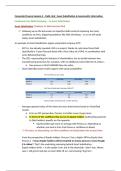
Corporate Finance Session 6 – Debt ctnd : Asset Substitution & Asymmetric Information
Continued from Debt Overhang … to Asset Substitution
Asset Substitution: Tendency to Take Excessive Risk
Following up on the discussion on imperfect debt contracts imposing too many
conditions on firms, triggering problems like Debt Overhang – or as we will study
today, Asset Substitution
An example of Asset Substitution (again using blank company XYZ):
- XYZ Co. has already invested £1M in a project, thanks to cash raised from Debt
(specifically a 1-year Discount Bond with a Face Value of £70M), in combination with
some Retained Earnings
- The CEO, representing the interests of shareholders, has to decide between two
manufacturing processes for a project, with no additional costs linked to his choice…
o One process is MUCH RISKIER than the other
- Good state/Bad state results happen with equal probabilities
- Average expected value of the Asset one year ahead varies based on Good/Bad
results:
o From an FCF perspective, Process 1 is better cause it pays more
o In terms of the cashflows that accrue to Equity holders (subtracting payment
to Debt holders) payoffs are the opposite
Equity holders get more on average with Process 2, depending on
whether you look at Free Cash Flows or cashflows to Equity
- /!\ No taxes, no discounting, no other cashflows are being taken into account here
- From the perspective of Equity holders, Process 2 has a higher NPV-to-Equity than
Process 1 > hence Equity holders will be tempted to choose process 2 even though
it is riskier!! That’s the underlying reasoning behind Asset Substitution.
- Equity holders think: « in the upside I win, but in the downside, I don’t lose. Worse
case, I will get £0 and pay as much debt off as I can knowing I’ll get £0 »
, o They are then much more concerned about what’s in it for them on the
good side of the results spectrum!
- Asset Substitution means Equity holders will choose Process 2, which is negative NPV,
whereas Process 1 is positive NPV no matter the results scenario that happens
- They’re GAMBLING W/ SOMEONE ELSE’S MONEY because at worse they get £0, and
hence are only interested in the upside (whereas it’s the opposite for lenders,
whose upside is capped anyway)
- Hence firms often seen adopting excessively risky strategies when going broke
- But it’s difficult for a debt contract to say « don’t take the risky project » …
So, how do creditors protect themselves against Asset Substitution?
- They realise they’re being reimbursed fully when things go well, but only getting
£40M if firms go for Process 2 and the result is bad
- Creditors will therefore estimate the Market Value of the Debt with the probability of
success of the project, and hence not offer that much money, to leave the Equity
holders with a profit of £0 no matter the result, which ensures the latter’s behaviour
is focused on the project that will generate value for the company with minimum risk
o For a £70M promised repayment (probability of success say, 0.5) and a
doomed scenario of £40M maximum repayment with £0 going to the
shareholders, creditors estimate the market value of the debt by doing:
MV = 0.5*70+0.5*40 = £55m
o Hence, they only offer £55m to the equity holders
- If Equity holders COULD commit to choosing the safer processes, they could get more
out of the investment (with a higher probability weight on the cashflows) but they
can’t… and must take the worse deal from creditors
o That is because of ASYMMETRIC INFORMATION / Dynamic Inconsistency
- If the overall cost of the project is still £100M, Equity holders have to put up the
remainder after they’ve borrowed the MV of the Debt (£55M), which is only £45M...
and which, in the bad scenario with a return of £40m or £45m only, leaves them with
£0 or negative return …
o If they were able to solve Asymmetric Information and commit to safer
projects, they could have maximized their return as well! We’ll see that below
Creative forms of asset substitution (as they manifest in the real economy)
Paying dividends when debt is risky (cf. Debt Overhang as well)
o Paying dividends is like contracting Debt, increasing overall Net Debt of the
company as you reduce your cash => increase your leverage
o It increases the proportion of debt in your overall Capital Structure
Continued from Debt Overhang … to Asset Substitution
Asset Substitution: Tendency to Take Excessive Risk
Following up on the discussion on imperfect debt contracts imposing too many
conditions on firms, triggering problems like Debt Overhang – or as we will study
today, Asset Substitution
An example of Asset Substitution (again using blank company XYZ):
- XYZ Co. has already invested £1M in a project, thanks to cash raised from Debt
(specifically a 1-year Discount Bond with a Face Value of £70M), in combination with
some Retained Earnings
- The CEO, representing the interests of shareholders, has to decide between two
manufacturing processes for a project, with no additional costs linked to his choice…
o One process is MUCH RISKIER than the other
- Good state/Bad state results happen with equal probabilities
- Average expected value of the Asset one year ahead varies based on Good/Bad
results:
o From an FCF perspective, Process 1 is better cause it pays more
o In terms of the cashflows that accrue to Equity holders (subtracting payment
to Debt holders) payoffs are the opposite
Equity holders get more on average with Process 2, depending on
whether you look at Free Cash Flows or cashflows to Equity
- /!\ No taxes, no discounting, no other cashflows are being taken into account here
- From the perspective of Equity holders, Process 2 has a higher NPV-to-Equity than
Process 1 > hence Equity holders will be tempted to choose process 2 even though
it is riskier!! That’s the underlying reasoning behind Asset Substitution.
- Equity holders think: « in the upside I win, but in the downside, I don’t lose. Worse
case, I will get £0 and pay as much debt off as I can knowing I’ll get £0 »
, o They are then much more concerned about what’s in it for them on the
good side of the results spectrum!
- Asset Substitution means Equity holders will choose Process 2, which is negative NPV,
whereas Process 1 is positive NPV no matter the results scenario that happens
- They’re GAMBLING W/ SOMEONE ELSE’S MONEY because at worse they get £0, and
hence are only interested in the upside (whereas it’s the opposite for lenders,
whose upside is capped anyway)
- Hence firms often seen adopting excessively risky strategies when going broke
- But it’s difficult for a debt contract to say « don’t take the risky project » …
So, how do creditors protect themselves against Asset Substitution?
- They realise they’re being reimbursed fully when things go well, but only getting
£40M if firms go for Process 2 and the result is bad
- Creditors will therefore estimate the Market Value of the Debt with the probability of
success of the project, and hence not offer that much money, to leave the Equity
holders with a profit of £0 no matter the result, which ensures the latter’s behaviour
is focused on the project that will generate value for the company with minimum risk
o For a £70M promised repayment (probability of success say, 0.5) and a
doomed scenario of £40M maximum repayment with £0 going to the
shareholders, creditors estimate the market value of the debt by doing:
MV = 0.5*70+0.5*40 = £55m
o Hence, they only offer £55m to the equity holders
- If Equity holders COULD commit to choosing the safer processes, they could get more
out of the investment (with a higher probability weight on the cashflows) but they
can’t… and must take the worse deal from creditors
o That is because of ASYMMETRIC INFORMATION / Dynamic Inconsistency
- If the overall cost of the project is still £100M, Equity holders have to put up the
remainder after they’ve borrowed the MV of the Debt (£55M), which is only £45M...
and which, in the bad scenario with a return of £40m or £45m only, leaves them with
£0 or negative return …
o If they were able to solve Asymmetric Information and commit to safer
projects, they could have maximized their return as well! We’ll see that below
Creative forms of asset substitution (as they manifest in the real economy)
Paying dividends when debt is risky (cf. Debt Overhang as well)
o Paying dividends is like contracting Debt, increasing overall Net Debt of the
company as you reduce your cash => increase your leverage
o It increases the proportion of debt in your overall Capital Structure