

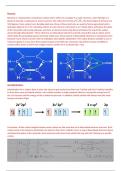
Benzene
Benzene is a hydrocarbon containing 6 carbon atoms which are arranged in a cyclic structure, and it belongs to a
group of aromatic compounds or arenes and have the molecular formula of C 6 H 6 . The bond angles of benzene are
120 degrees. Since carbon has 4 bonding electrons, three of those electrons are used to forma sigma bond with a
hydrogen adjacent to it. the remaining carbon on each electron will remain in a P orbital above and below the plane
of the ring which will overlap sideways and form an electron dense ring above and below the ring of the carbon
atoms through delocalization. These electrons are delocalised and form pi bonds around the ring of carbon atoms
which make the pi bonding system extremely stable since the pi system of delocalized electrons is maintained when
benzene reacts which is proven when it undergoes electrophilic substitution. This makes benzene suitable to use in
contrasts agents in x rays since they contain benzoic acid which has a benzene ring which has been modified to
contain iodine atone so that it has a higher atomic number for it to absorb the x rays.
sp2 Hybridisation
Hybridisation for a carbon atom is when the electron gets excited and then one S orbital and two P orbitals hybridise
to form three new sp2 hybrid orbitals. each orbital contains a single unpaired electron causing the energy level of
the s to increase and the energy of the p orbital to decrease. In addition, hybrid orbitals will always have the same
energy and same shape.
In benzene, all the carbon lengths between each carbon are the same due to its delocalised electron structure. Each
carbon atom in the benzene will donate one electron from the P orbital to form a ring of delocalised electrons above
and below the plane of the molecule, these electrons will move freely within the ring and don’t belong to a specific
carbon.
, Kekule’s structure of benzene and how it shaped our knowledge of benzene
Kekule had made a benzene structure which had a ring structure containing alternating single and double bonds as
shown below
Skeletal formula for Kekule’s
structure of benzene
Benzene’s stability, bond energies and delocalised ring
There were a lot of problems with Kekule’s structure of benzene. One problem was the stability The compound
cyclohexa-1,3,5-triene was similar to Kekule’s proposed structure of benzene. However, when cyclohexa-1,3,5-triene
goes through hydrogenation, an enthalpy change of -360 kj −1 is produced. In the same way when benzene goes
through hydrogenation, an enthalpy change of -208 kj −1 is produced. This shows us that benzene requires more
energy for its bonds to break and has stronger bonds due to its stable delocalised ring making benzene quite stable,
contradicting Kekule’s structure since his structure contains double bonds which would make benzene very reactive
as the pi bonds found in the double bonds are easier to break compared to the sigma or pi bonds found in the
delocalised ring of electrons.
Another problem of Kekule’s structure of benzene was the chemistry, benzene does not carry out electrophilic
addition and does not give a positive test for alkenes with bromine water however, cyclohexa-1,3,5-triene (a
compound similar to Kekule’s structure of benzene) does which shows that benzene does not have double bonds
because if Kekule’s structure of benzene was correct then the alternating single and double bonds should react like a
normal alkene and should be able to undergo electrophilic addition using the bromine water test. This is because of
benzenes stability due to the delocalised ring as benzene prefer to retain its ring causing it to undergo electrophilic
substitution reactions rather than electrophilic addition reactions
Structural formula for the correct
structure of benzene
Benzene’s bond length
Benzene is a hydrocarbon containing 6 carbon atoms which are arranged in a cyclic structure, and it belongs to a
group of aromatic compounds or arenes and have the molecular formula of C 6 H 6 . The bond angles of benzene are
120 degrees. Since carbon has 4 bonding electrons, three of those electrons are used to forma sigma bond with a
hydrogen adjacent to it. the remaining carbon on each electron will remain in a P orbital above and below the plane
of the ring which will overlap sideways and form an electron dense ring above and below the ring of the carbon
atoms through delocalization. These electrons are delocalised and form pi bonds around the ring of carbon atoms
which make the pi bonding system extremely stable since the pi system of delocalized electrons is maintained when
benzene reacts which is proven when it undergoes electrophilic substitution. This makes benzene suitable to use in
contrasts agents in x rays since they contain benzoic acid which has a benzene ring which has been modified to
contain iodine atone so that it has a higher atomic number for it to absorb the x rays.
sp2 Hybridisation
Hybridisation for a carbon atom is when the electron gets excited and then one S orbital and two P orbitals hybridise
to form three new sp2 hybrid orbitals. each orbital contains a single unpaired electron causing the energy level of
the s to increase and the energy of the p orbital to decrease. In addition, hybrid orbitals will always have the same
energy and same shape.
In benzene, all the carbon lengths between each carbon are the same due to its delocalised electron structure. Each
carbon atom in the benzene will donate one electron from the P orbital to form a ring of delocalised electrons above
and below the plane of the molecule, these electrons will move freely within the ring and don’t belong to a specific
carbon.
, Kekule’s structure of benzene and how it shaped our knowledge of benzene
Kekule had made a benzene structure which had a ring structure containing alternating single and double bonds as
shown below
Skeletal formula for Kekule’s
structure of benzene
Benzene’s stability, bond energies and delocalised ring
There were a lot of problems with Kekule’s structure of benzene. One problem was the stability The compound
cyclohexa-1,3,5-triene was similar to Kekule’s proposed structure of benzene. However, when cyclohexa-1,3,5-triene
goes through hydrogenation, an enthalpy change of -360 kj −1 is produced. In the same way when benzene goes
through hydrogenation, an enthalpy change of -208 kj −1 is produced. This shows us that benzene requires more
energy for its bonds to break and has stronger bonds due to its stable delocalised ring making benzene quite stable,
contradicting Kekule’s structure since his structure contains double bonds which would make benzene very reactive
as the pi bonds found in the double bonds are easier to break compared to the sigma or pi bonds found in the
delocalised ring of electrons.
Another problem of Kekule’s structure of benzene was the chemistry, benzene does not carry out electrophilic
addition and does not give a positive test for alkenes with bromine water however, cyclohexa-1,3,5-triene (a
compound similar to Kekule’s structure of benzene) does which shows that benzene does not have double bonds
because if Kekule’s structure of benzene was correct then the alternating single and double bonds should react like a
normal alkene and should be able to undergo electrophilic addition using the bromine water test. This is because of
benzenes stability due to the delocalised ring as benzene prefer to retain its ring causing it to undergo electrophilic
substitution reactions rather than electrophilic addition reactions
Structural formula for the correct
structure of benzene
Benzene’s bond length


