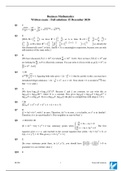
Business Mathematics
Written exam – Full solutions 15 December 2020
Q1 C
√𝑒 𝑥 𝑒 𝑦 √𝑒 𝑦 𝑒𝑦
[ 𝑒𝑥
= = √𝑒 𝑥 = √𝑒 𝑦 𝑒 −𝑥 = √𝑒 𝑦−𝑥 ]
√𝑒 𝑥
Q2 E
2 1 2 1 2 1 1 0
[With 𝐗 = ( ), we have 𝐗 ′ = ( ), so A is false. 𝐗 + 𝐈 = ( )+( )=
1 3 1 3 1 3 0 1
3 1 2 1 2 1
( ), so B is false. 𝐗 2 = ( )( ) = (2 ⋅ 2 + 1 ⋅ 1 ) = (5 ) so already the
1 2 1 3 1 3
first element tells you C is false. And 𝐗 + 3 is a meaningless expression, because you can only
add matrices of the same order.]
Q3 D
𝑑𝑓
[We have discussed 𝑓(𝑥) = 10𝑥 , for which = 10𝑥 ⋅ ln 10. Now we have 𝑓(𝜃, 𝜆) = 𝜃 𝜆 and
𝑑𝑥
𝜕𝑓
are looking for 𝜕𝜆, so 𝜃 is effectively constant. You can write it (if you wish) as 𝑔(𝜆) = 𝜃 𝜆 , so
𝑑𝑔
= 𝜃 𝜆 ⋅ ln 𝜃.]
𝑑𝜆
Q4 -1.00
−𝑥 −𝑥
[√−2𝑥√ = 1 Squaring both sides gives −2𝑥 ⋅ = 1 (but be careful: in this, you may have
2 2
−𝑥
introduced illegal solutions). −2𝑥 ⋅ 2
= 𝑥 2 , so 𝑥 = ±1. Now check: +1 is invalid (√−2 etc).
But −1 is valid.]
Q5 A
[We have log10 𝑄 = log10 𝐶𝐾 𝛼 𝐿𝛽 . Because 𝐶 and 𝐿 are constant, we can write this as
log10 𝑄 = log10 𝐷𝐾 𝛼 , where 𝐷 is a constant. This gives log10 𝑄 = log10 𝐷 + log10 𝐾 𝛼 =
log10 𝐷 + 𝛼 log10 𝐾. So in a (log10 𝐾 , log10 𝑄) the plot is a straight line with slope 𝛼 > 0.]
Q6 7.00
[∑2𝑖=0 2𝑖 = 20 + 21 + 22 = 1 + 2 + 4 = 7]
Q7 D
[𝐶 = 𝑘𝑑 + 𝑏𝑠 2 , with 𝐶 in euro. Therefore, 𝑏𝑠 2 is in euro. 𝑠 is in km/hr, so 𝑠 2 is in (km/hr)2.
Therefore, 𝑏 is in euro/((km/hr)2). This simplifies to euro·hr2/km2.]
Q8 -1.00;0.00;1.00
𝜕𝐾
𝜕𝑥
= 4𝑥 − 4𝑦 = 0
2 4
[𝐾 = 2𝑥 − 4𝑥𝑦 + 𝑦 + 2 has stationary points when {𝜕𝐾 . The first
3
𝜕𝑦
= −4𝑥 + 4𝑦 = 0
equation gives 𝑥 = 𝑦, and inserted in the second equation that yields −4𝑦 + 4𝑦 3 = 0, or
4𝑦(−1 + 𝑦 2 ) = 0. This gives 𝑦 = 0 ∨ 𝑦 2 = 1.]
Q9 E
2
𝜕2 𝐾 𝜕2 𝐾 𝜕2 𝐾
[In every stationary point (here, in (𝑥 ∗ , 𝑦 ∗ )), you should have 𝜕𝑥 2 𝜕𝑦 2
− (𝜕𝑥𝜕𝑦) > 0 to
guarantee it is an extreme value.]
Q10 E
BUSM 1 Exam full solutions
Written exam – Full solutions 15 December 2020
Q1 C
√𝑒 𝑥 𝑒 𝑦 √𝑒 𝑦 𝑒𝑦
[ 𝑒𝑥
= = √𝑒 𝑥 = √𝑒 𝑦 𝑒 −𝑥 = √𝑒 𝑦−𝑥 ]
√𝑒 𝑥
Q2 E
2 1 2 1 2 1 1 0
[With 𝐗 = ( ), we have 𝐗 ′ = ( ), so A is false. 𝐗 + 𝐈 = ( )+( )=
1 3 1 3 1 3 0 1
3 1 2 1 2 1
( ), so B is false. 𝐗 2 = ( )( ) = (2 ⋅ 2 + 1 ⋅ 1 ) = (5 ) so already the
1 2 1 3 1 3
first element tells you C is false. And 𝐗 + 3 is a meaningless expression, because you can only
add matrices of the same order.]
Q3 D
𝑑𝑓
[We have discussed 𝑓(𝑥) = 10𝑥 , for which = 10𝑥 ⋅ ln 10. Now we have 𝑓(𝜃, 𝜆) = 𝜃 𝜆 and
𝑑𝑥
𝜕𝑓
are looking for 𝜕𝜆, so 𝜃 is effectively constant. You can write it (if you wish) as 𝑔(𝜆) = 𝜃 𝜆 , so
𝑑𝑔
= 𝜃 𝜆 ⋅ ln 𝜃.]
𝑑𝜆
Q4 -1.00
−𝑥 −𝑥
[√−2𝑥√ = 1 Squaring both sides gives −2𝑥 ⋅ = 1 (but be careful: in this, you may have
2 2
−𝑥
introduced illegal solutions). −2𝑥 ⋅ 2
= 𝑥 2 , so 𝑥 = ±1. Now check: +1 is invalid (√−2 etc).
But −1 is valid.]
Q5 A
[We have log10 𝑄 = log10 𝐶𝐾 𝛼 𝐿𝛽 . Because 𝐶 and 𝐿 are constant, we can write this as
log10 𝑄 = log10 𝐷𝐾 𝛼 , where 𝐷 is a constant. This gives log10 𝑄 = log10 𝐷 + log10 𝐾 𝛼 =
log10 𝐷 + 𝛼 log10 𝐾. So in a (log10 𝐾 , log10 𝑄) the plot is a straight line with slope 𝛼 > 0.]
Q6 7.00
[∑2𝑖=0 2𝑖 = 20 + 21 + 22 = 1 + 2 + 4 = 7]
Q7 D
[𝐶 = 𝑘𝑑 + 𝑏𝑠 2 , with 𝐶 in euro. Therefore, 𝑏𝑠 2 is in euro. 𝑠 is in km/hr, so 𝑠 2 is in (km/hr)2.
Therefore, 𝑏 is in euro/((km/hr)2). This simplifies to euro·hr2/km2.]
Q8 -1.00;0.00;1.00
𝜕𝐾
𝜕𝑥
= 4𝑥 − 4𝑦 = 0
2 4
[𝐾 = 2𝑥 − 4𝑥𝑦 + 𝑦 + 2 has stationary points when {𝜕𝐾 . The first
3
𝜕𝑦
= −4𝑥 + 4𝑦 = 0
equation gives 𝑥 = 𝑦, and inserted in the second equation that yields −4𝑦 + 4𝑦 3 = 0, or
4𝑦(−1 + 𝑦 2 ) = 0. This gives 𝑦 = 0 ∨ 𝑦 2 = 1.]
Q9 E
2
𝜕2 𝐾 𝜕2 𝐾 𝜕2 𝐾
[In every stationary point (here, in (𝑥 ∗ , 𝑦 ∗ )), you should have 𝜕𝑥 2 𝜕𝑦 2
− (𝜕𝑥𝜕𝑦) > 0 to
guarantee it is an extreme value.]
Q10 E
BUSM 1 Exam full solutions