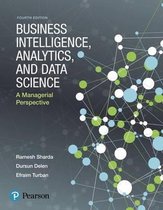
TEST BANK - Business Intelligence,
Analytics, and Data Science: A Managerial
Perspective 4th Edition by Ramesh Sharda
CHAPTER 1-8| ACCURATE ANSWERS
AND VERIFIED QUESTIONS
Ar
ch
Do
Page | 1
c
, TABLE OF CONTENT
1. An Overview of Business Intelligence, Analytics, and Data Science
2. Descriptive Analytics I: Nature of Data, Statistical Modeling, and Visualization
3. Descriptive Analytics II: Business Intelligence and Data Warehousing
4. Predictive Analytics I: Data Mining Process, Methods, and Algorithms
5. Predictive Analytics II: Text, Web, and Social Media Analytics
6. Prescriptive Analytics: Optimization and Simulation
7. Big Data Concepts and Tools
8. Future Trends, Privacy and Managerial Considerations in Analytics
Chapter 1 An Overview of Business Intelligence, Analytics, and Data Science
1) Computerized support is only used for organizational decisions that are responses to external pressures, not
for taking advantage of opportunities.
Accurate Answer> FALSE Diff: 2 Page Ref: 3
2) During the early days of analytics, data was often obtained from the domain experts using manual processes
to build mathematical or knowledge-based models.
Accurate Answer> TRUE
Diff: 2 Page Ref: 13
3) Computer applications have moved from transaction processing and monitoring activities to problem
analysis and solution applications.
Accurate Answer> TRUE
Diff: 1 Page Ref: 11
4) Business intelligence (BI) is a specific term that describes architectures and tools only.
Ar
Accurate Answer> FALSE
ch
Diff: 1 Page Ref: 16
Do
Page | 2
c
,5) The growth in hardware, software, and network capacities has had little impact on modern BI innovations.
Accurate Answer> FALSE
Diff: 1 Page Ref: 11
6) Managing data warehouses requires special methods, including parallel computing and/or Hadoop/Spark.
Accurate Answer> TRUE
Diff: 3 Page Ref: 11-12
7) Managing information on operations, customers, internal procedures and employee interactions is the
domain of cognitive science.
Accurate Answer> FALSE
Diff: 3 Page Ref: 12
8) Decision support system (DSS) and management information system (MIS) have precise definitions agreed
to by practitioners.
Accurate Answer> FALSE
Diff: 2 Page Ref: 13
9) In the 2000s, the DW-driven DSSs began to be called BI systems.
Accurate Answer> TRUE
Diff: 1 Page Ref: 14
10) Major commercial business intelligence (BI) products and services were well established in the early
1970s.
Accurate Answer> FALSE
Diff: 2 Page Ref: 15
11) Information systems that support such transactions as ATM withdrawals, bank deposits, and cash register
scans at the grocery store represent transaction processing, a critical branch of BI.
Ar
ch
Do
Page | 3
c
, 12) Many business users in the 1980s referred to their mainframes as "the black hole," because all the
information went into it, but little ever came back and ad hoc real-time querying was virtually impossible.
Accurate Answer> TRUE
Diff: 2 Page Ref: 20
13) Successful BI is a tool for the information systems department, but is not exposed to the larger
organization.
Accurate Answer> FALSE
Diff: 2 Page Ref: 20
14) BI represents a bold new paradigm in which the company's business strategy must be aligned to its
business intelligence analysis initiatives.
Accurate Answer> FALSE
Diff: 2 Page Ref: 20-21
15) Traditional BI systems use a large volume of static data that has been extracted, cleansed, and loaded into
a data warehouse to produce reports and analyses.
Accurate Answer> TRUE
Diff: 2 Page Ref: 21
16) Demands for instant, on-demand access to dispersed information decrease as firms successfully integrate
BI into their operations.
17) The use of dashboards and data visualizations is seldom effective in identifying issues in organizations, as
demonstrated by the Silvaris Corporation Case Study.
Accurate Answer> FALSE
Diff: 2 Page Ref: 24
18) The use of statistics in baseball by the Oakland Athletics, as described in the Moneyball case study, is an
example of the effectiveness of prescriptive analytics.
Ar
Accurate Answer> TRUE
ch
Diff: 2 Page Ref: 5
Do
Page | 4
c
Analytics, and Data Science: A Managerial
Perspective 4th Edition by Ramesh Sharda
CHAPTER 1-8| ACCURATE ANSWERS
AND VERIFIED QUESTIONS
Ar
ch
Do
Page | 1
c
, TABLE OF CONTENT
1. An Overview of Business Intelligence, Analytics, and Data Science
2. Descriptive Analytics I: Nature of Data, Statistical Modeling, and Visualization
3. Descriptive Analytics II: Business Intelligence and Data Warehousing
4. Predictive Analytics I: Data Mining Process, Methods, and Algorithms
5. Predictive Analytics II: Text, Web, and Social Media Analytics
6. Prescriptive Analytics: Optimization and Simulation
7. Big Data Concepts and Tools
8. Future Trends, Privacy and Managerial Considerations in Analytics
Chapter 1 An Overview of Business Intelligence, Analytics, and Data Science
1) Computerized support is only used for organizational decisions that are responses to external pressures, not
for taking advantage of opportunities.
Accurate Answer> FALSE Diff: 2 Page Ref: 3
2) During the early days of analytics, data was often obtained from the domain experts using manual processes
to build mathematical or knowledge-based models.
Accurate Answer> TRUE
Diff: 2 Page Ref: 13
3) Computer applications have moved from transaction processing and monitoring activities to problem
analysis and solution applications.
Accurate Answer> TRUE
Diff: 1 Page Ref: 11
4) Business intelligence (BI) is a specific term that describes architectures and tools only.
Ar
Accurate Answer> FALSE
ch
Diff: 1 Page Ref: 16
Do
Page | 2
c
,5) The growth in hardware, software, and network capacities has had little impact on modern BI innovations.
Accurate Answer> FALSE
Diff: 1 Page Ref: 11
6) Managing data warehouses requires special methods, including parallel computing and/or Hadoop/Spark.
Accurate Answer> TRUE
Diff: 3 Page Ref: 11-12
7) Managing information on operations, customers, internal procedures and employee interactions is the
domain of cognitive science.
Accurate Answer> FALSE
Diff: 3 Page Ref: 12
8) Decision support system (DSS) and management information system (MIS) have precise definitions agreed
to by practitioners.
Accurate Answer> FALSE
Diff: 2 Page Ref: 13
9) In the 2000s, the DW-driven DSSs began to be called BI systems.
Accurate Answer> TRUE
Diff: 1 Page Ref: 14
10) Major commercial business intelligence (BI) products and services were well established in the early
1970s.
Accurate Answer> FALSE
Diff: 2 Page Ref: 15
11) Information systems that support such transactions as ATM withdrawals, bank deposits, and cash register
scans at the grocery store represent transaction processing, a critical branch of BI.
Ar
ch
Do
Page | 3
c
, 12) Many business users in the 1980s referred to their mainframes as "the black hole," because all the
information went into it, but little ever came back and ad hoc real-time querying was virtually impossible.
Accurate Answer> TRUE
Diff: 2 Page Ref: 20
13) Successful BI is a tool for the information systems department, but is not exposed to the larger
organization.
Accurate Answer> FALSE
Diff: 2 Page Ref: 20
14) BI represents a bold new paradigm in which the company's business strategy must be aligned to its
business intelligence analysis initiatives.
Accurate Answer> FALSE
Diff: 2 Page Ref: 20-21
15) Traditional BI systems use a large volume of static data that has been extracted, cleansed, and loaded into
a data warehouse to produce reports and analyses.
Accurate Answer> TRUE
Diff: 2 Page Ref: 21
16) Demands for instant, on-demand access to dispersed information decrease as firms successfully integrate
BI into their operations.
17) The use of dashboards and data visualizations is seldom effective in identifying issues in organizations, as
demonstrated by the Silvaris Corporation Case Study.
Accurate Answer> FALSE
Diff: 2 Page Ref: 24
18) The use of statistics in baseball by the Oakland Athletics, as described in the Moneyball case study, is an
example of the effectiveness of prescriptive analytics.
Ar
Accurate Answer> TRUE
ch
Diff: 2 Page Ref: 5
Do
Page | 4
c