Week 8: Sleep
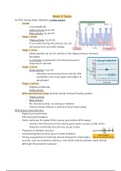
An EEG during sleep indicates 5 sleep stages:
- Awake
- Low amplitude
- Alpha activity (8-12 Hz)
- Beta activity (13-30 Hz)
- Stage 1 sleep
- Theta activity (3.5-8 Hz)
- If you wake during this period, you are
not aware that you were asleep
- Stage 2 sleep
- Sleep spindle (12-14 Hz): activity in the hippocampus; memory
formation
- K-complex (suppression of cortical arousal in
response to stimuli)
- Stage 3 sleep
- Delta activity (<3.5 Hz)
- Indicates synchronous brain activity (the
oscillations are more apart and higher in
amplitude)
- Stage 4 activity
- Highest amplitude
- Delta activity
- REM (paradoxical) sleep (activity similar to that of being awake)
- Theta activity
- Beta activity
- No muscle activity; no acting on dreams
- Almost always follows a period of slow-wave sleep
REM sleep characteristics:
- Rapid eye movements
- EEG desynchronization
- Ponto Geniculo Occipital (PGO) waves (just before REM sleep)
- Activity from the pons to the lateral geniculate nucleus (LGN) of the
thalamus and finally the primary visual cortex
- Paralysis of skeletal muscles
- Increased genital activity (also in small children)
- Strong suppression of external stimuli (except for meaningful
sounds, such as someone calling ur now (brain activity present upon stimuli
although the present is asleep)
, - Narrative dreaming
- No logic continuity in space or time; caused by absent frontal lobe
activity
- At waking, immediately alert (mainly because the brain is active during REM
sleep)
- Chance of dream recall 75-95%
- High probability of waking up spontaneously
Slow-wave sleep characteristics (stages 3-4):
- Strong suppression of external stimuli
- Low probability of waking up spontaneously
- At waking, drowsy and disoriented
- Chance of dream recall 20%
- Fragmentary dreams (unrelated snapshots) with
strong emotions (i.e., nightmares)
All mammals and birds need to sleep, even if it is not
convenient
- The hemispheres of the bottlenose dolphin take
turns in sleeping
- A special function that has evolved
Lack of sleep in patients (fatal familial insomnia) or animals
leads to
- Loss of thermoregulation
- Increased fat and sugar metabolism
- Severe weight loss
- Immune system disruption
- Death
However, in some people after voluntary deprivation (>10 days), no physiological
stress is observed
- Therefore, physical recovery does not seem to be the main function of sleep
Sleep deprivation does lead to cognitive problems
(concentration/perception-hallucinations)
- Sleep is required for recovery of the brain
If sleep is possible after a period of deprivation there is no complete catch-up on the
amount missed out, but sleep is regained for stages 4 and REM
- Therefore, these stages appear to be the most important to your brain
The function of slow-wave sleep is primarily restorative
- Build a sugar supply
- Glycogen is built up in astrocytes during sleep, and when energy is
needed, these astrocytes pass on the glycogen to the neurons
, - When neurons use up too much glycogen, astrocytes release
adenosine to signal the neurons to stop using up so much glycogen
- Therefore, an accumulation of adenosine occurs throughout the
day
- Clearing of chemicals accumulated due to brain activity
- Adenosine (inhibits neural activity when glycogen is low) is cleared
away
- Learning (especially consolidation of declarative memory)
- Remember events you can talk about
The function of REM sleep:
- Alertness (vigilance)
- Brain development
- Reduction in the proportion of REM sleep
with age
- Learning (in particular non-declarative)
- E.g., hold a picture in front of a mirror and
learn to draw it correctly
Physiological mechanisms of sleep:
- Possibility 1 (waking chemical): production during
sleep of a chemical that keeps you awake
- Possibility 2 (sleep chemical (i.e., adenosine):
production during wakefulness of a chemical that
makes you sleep
- Adenosine accumulates in the brain during waking
(inhibits cells when energy is low)
Similar to sleep, there are also different levels of alertness during
wakefulness. There are 5 neurotransmitter system involved:
- Acetylcholine: cortical activation
- Location: pons, basal forebrain, septum-hippocampus
An EEG during sleep indicates 5 sleep stages:
- Awake
- Low amplitude
- Alpha activity (8-12 Hz)
- Beta activity (13-30 Hz)
- Stage 1 sleep
- Theta activity (3.5-8 Hz)
- If you wake during this period, you are
not aware that you were asleep
- Stage 2 sleep
- Sleep spindle (12-14 Hz): activity in the hippocampus; memory
formation
- K-complex (suppression of cortical arousal in
response to stimuli)
- Stage 3 sleep
- Delta activity (<3.5 Hz)
- Indicates synchronous brain activity (the
oscillations are more apart and higher in
amplitude)
- Stage 4 activity
- Highest amplitude
- Delta activity
- REM (paradoxical) sleep (activity similar to that of being awake)
- Theta activity
- Beta activity
- No muscle activity; no acting on dreams
- Almost always follows a period of slow-wave sleep
REM sleep characteristics:
- Rapid eye movements
- EEG desynchronization
- Ponto Geniculo Occipital (PGO) waves (just before REM sleep)
- Activity from the pons to the lateral geniculate nucleus (LGN) of the
thalamus and finally the primary visual cortex
- Paralysis of skeletal muscles
- Increased genital activity (also in small children)
- Strong suppression of external stimuli (except for meaningful
sounds, such as someone calling ur now (brain activity present upon stimuli
although the present is asleep)
, - Narrative dreaming
- No logic continuity in space or time; caused by absent frontal lobe
activity
- At waking, immediately alert (mainly because the brain is active during REM
sleep)
- Chance of dream recall 75-95%
- High probability of waking up spontaneously
Slow-wave sleep characteristics (stages 3-4):
- Strong suppression of external stimuli
- Low probability of waking up spontaneously
- At waking, drowsy and disoriented
- Chance of dream recall 20%
- Fragmentary dreams (unrelated snapshots) with
strong emotions (i.e., nightmares)
All mammals and birds need to sleep, even if it is not
convenient
- The hemispheres of the bottlenose dolphin take
turns in sleeping
- A special function that has evolved
Lack of sleep in patients (fatal familial insomnia) or animals
leads to
- Loss of thermoregulation
- Increased fat and sugar metabolism
- Severe weight loss
- Immune system disruption
- Death
However, in some people after voluntary deprivation (>10 days), no physiological
stress is observed
- Therefore, physical recovery does not seem to be the main function of sleep
Sleep deprivation does lead to cognitive problems
(concentration/perception-hallucinations)
- Sleep is required for recovery of the brain
If sleep is possible after a period of deprivation there is no complete catch-up on the
amount missed out, but sleep is regained for stages 4 and REM
- Therefore, these stages appear to be the most important to your brain
The function of slow-wave sleep is primarily restorative
- Build a sugar supply
- Glycogen is built up in astrocytes during sleep, and when energy is
needed, these astrocytes pass on the glycogen to the neurons
, - When neurons use up too much glycogen, astrocytes release
adenosine to signal the neurons to stop using up so much glycogen
- Therefore, an accumulation of adenosine occurs throughout the
day
- Clearing of chemicals accumulated due to brain activity
- Adenosine (inhibits neural activity when glycogen is low) is cleared
away
- Learning (especially consolidation of declarative memory)
- Remember events you can talk about
The function of REM sleep:
- Alertness (vigilance)
- Brain development
- Reduction in the proportion of REM sleep
with age
- Learning (in particular non-declarative)
- E.g., hold a picture in front of a mirror and
learn to draw it correctly
Physiological mechanisms of sleep:
- Possibility 1 (waking chemical): production during
sleep of a chemical that keeps you awake
- Possibility 2 (sleep chemical (i.e., adenosine):
production during wakefulness of a chemical that
makes you sleep
- Adenosine accumulates in the brain during waking
(inhibits cells when energy is low)
Similar to sleep, there are also different levels of alertness during
wakefulness. There are 5 neurotransmitter system involved:
- Acetylcholine: cortical activation
- Location: pons, basal forebrain, septum-hippocampus