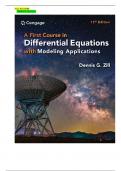
A First Course in Differential
Equations with Modeling
Applications, 12th Edition by
Dennis G. Zill
Complete Chapter Solutions Manual are
included (Ch 1 to 9)
** Immediate Download
** Swift Response
** All Chapters included
,Solution and Answer Guide: Zill, DIFFERENTIAL EQUATIONS With MODELING APPLICATIONS 2024, 9780357760192; Chapter #1:
Introduction to Differential Equations
Solution and Answer Guide
ZILL, DIFFERENTIAL EQUATIONS WITH MODELING APPLICATIONS 2024, 9780357760192; CHAPTER
#1: INTRODUCTION TO DIFFERENTIAL EQUATIONS
TABLE OF CONTENTS
End of Section Solutions ......................................................................................................................................................................... 1
Exercises 1.1 ................................................................................................................................................................................................... 1
Exercises 1.2 ................................................................................................................................................................................................. 14
Exercises 1.3 ................................................................................................................................................................................................. 22
Chapter 1 in Review Solutions .................................................................................................................................................. 30
END OF SECTION SOLUTIONS
EXERCISES 1.1
1. Second order; linear
2. Third order; nonlinear because of (dy/dx)4
3. Fourth order; linear
4. Second order; nonlinear because of cos(r + u)
√
5. Second order; nonlinear because of (dy/dx) or 2
1 + (dy/dx)2
6. Second order; nonlinear because of R2
7. Third order; linear
8. Second order; nonlinear because of ẋ 2
9. First order; nonlinear because of sin (dy/dx)
10. First order; linear
11. Writing the differential equation in the form x(dy/dx) + y2 = 1, we see that it is nonlinear in y because of
y2. However, writing it in the form (y2 — 1)(dx/dy) + x = 0, we see that it is linear in x.
12. Writing the differential equation in the form u(dv/du) + (1 + u)v = ueu we see that it is linear in v.
However, writing it in the form (v + uv — ueu)(du/dv) + u = 0, we see that it is nonlinear in u.
13. From y = e− x/2
we obtain yj = — 1 e− x/2
. Then 2yj + y = —e− x/2
+ e− x/2 = 0.
2
1
,Solution and Answer Guide: Zill, DIFFERENTIAL EQUATIONS With MODELING APPLICATIONS 2024, 9780357760192; Chapter #1:
Introduction to Differential Equations
6 6
14. From y = — e—20t we obtain dy/dt = 24e−20t , so that
5 5
dy + 20y = 24e−20t 6 6 −20t
+ 20 — e = 24.
dt 5 5
15. From y = e3x cos 2x we obtain yj = 3e3x cos 2x—2e3x sin 2x and yjj = 5e3x cos 2x—12e3x sin 2x, so that yjj
— 6yj + 13y = 0.
j
16. From y = — cos x ln(sec x + tan x) we obtain y = —1 + sin x ln(sec x + tan x) and
jj jj
y = tan x + cos x ln(sec x + tan x). Then y + y = tan x.
17. The domain of the function, found by solving x+2 ≥ 0, is [—2, ∞). From yj = 1+2(x+2)−1/2
we have
j 1/2−
(y —x)y = (y — x)[1 + (2(x + 2) ]
= y — x + 2(y —x)(x + 2)−1/2
= y — x + 2[x + 4(x + 2)1/2 —x](x + 2)−1/2
= y — x + 8(x + 2)1/2(x + 2)−1/2 = y — x + 8.
An interval of definition for the solution of the differential equation is (—2, ∞) because yj is not defined at x
= —2.
18. Since tan x is not defined for x = π/2 + nπ, n an integer, the domain of y = 5 tan 5x is
{x 5x /= π/2 + nπ}
or {x x /= π/10 + nπ/5}. From y j= 25 sec 25x we have
j
y = 25(1 + tan2 5x) = 25 + 25 tan2 5x = 25 + y 2 .
An interval of definition for the solution of the differential equation is (—π/10, π/10). An- other interval is
(π/10, 3π/10), and so on.
19. The domain of the function is {x 4 — x2 /= 0} or {x x /= —2 or x /= 2}. From y j =
2x/(4 — x2)2 we have
1 2
= 2xy2.
yj = 2x
4 — x2
An interval of definition for the solution of the differential equation is (—2, 2). Other inter- vals are (—∞,
—2) and (2, ∞).
√
20. The function is y = 1/ 1 — sin x , whose domain is obtained from 1 — sin x /= 0 or sin x /= 1.
Thus, the domain is {x x /= π/2 + 2nπ}. From y j= — (11 — sin x)2 −3/2 (— cos x) we have
2yj = (1 — sin x)−3/2 cos x = [(1 — sin x)−1/2]3 cos x = y3 cos x.
An interval of definition for the solution of the differential equation is (π/2, 5π/2). Another one is (5π/2,
9π/2), and so on.
2
, Solution and Answer Guide: Zill, DIFFERENTIAL EQUATIONS With MODELING APPLICATIONS 2024, 9780357760192; Chapter #1:
Introduction to Differential Equations
21. Writing Iln(2X I — I 1) I — I ln(X I — I 1) I I = I I t Iand Idifferentiating x
implicitly I we I obtain 4
— = I1 2
2X I— I1 I dt X I— I1 I dt
t
2 1 dX I I – I4 –2 2 4
— = I1
2X I— I1 X I— I1 dt
–2
– I4
dX
= I—(2X I— I1)(X I— I1) I= I(X I— I1)(1 I— I2X).
dt I
Exponentiating I both I sides I of I the I implicit I solution I we I obtain
2X I— I1 I t
= Ie
I X I— I1
2X I — I1 I= IXet I — Iet
(et I — I1) I= I(et I— I2)X
et 1
X I= I .
et I — I2 I
Solving Iet I — I2 I = I 0 Iwe Iget It I = I ln I2. I Thus, Ithe I solution Iis Idefined I on I(—∞, Iln I2) I or Ion I(ln I2, I∞). I The I graph
I of I the I solution I defined I on I (—∞, Iln I2) I is I dashed, I and I the I graph I of I the I solution I defined I on I (ln I 2, I ∞) I is
I solid.
22. Implicitly I differentiating I the I solution, I we I obtain y
2 I I dy dy 4
—2x I I — I4xy I+ I2y I = I0
dx I dx I 2
2
—x dy I— I2xy Idx I+ Iy Idy I= I0
I
x
2xy Idx I+ I(x2 I — Iy)dy I= I0. –4 –2 2 4
Using Ithe Iquadratic I formula Ito Isolve Iy2 I I — I 2x2y I — I 1 I I= I I 0 –2
√I √I
for Iy, Iwe Iget Iy I = 2x2 I I 4x24 I + I4 I I /2 I = 4I
± x + I1I.
I Ix –4
±
√I
Thus, Itwo Iexplicit Isolutions Iare Iy1 I I = I x2 I + x4 I + I1 I and
√II
y2 I I = I x2 I I— x4 I + I 1 I. I Both I solutions I are I defined I on I (—∞, I∞).
The I graph I of I y1(x) I is I solid I and I the I graph I of I y2 I I is I dashed.
3
Equations with Modeling
Applications, 12th Edition by
Dennis G. Zill
Complete Chapter Solutions Manual are
included (Ch 1 to 9)
** Immediate Download
** Swift Response
** All Chapters included
,Solution and Answer Guide: Zill, DIFFERENTIAL EQUATIONS With MODELING APPLICATIONS 2024, 9780357760192; Chapter #1:
Introduction to Differential Equations
Solution and Answer Guide
ZILL, DIFFERENTIAL EQUATIONS WITH MODELING APPLICATIONS 2024, 9780357760192; CHAPTER
#1: INTRODUCTION TO DIFFERENTIAL EQUATIONS
TABLE OF CONTENTS
End of Section Solutions ......................................................................................................................................................................... 1
Exercises 1.1 ................................................................................................................................................................................................... 1
Exercises 1.2 ................................................................................................................................................................................................. 14
Exercises 1.3 ................................................................................................................................................................................................. 22
Chapter 1 in Review Solutions .................................................................................................................................................. 30
END OF SECTION SOLUTIONS
EXERCISES 1.1
1. Second order; linear
2. Third order; nonlinear because of (dy/dx)4
3. Fourth order; linear
4. Second order; nonlinear because of cos(r + u)
√
5. Second order; nonlinear because of (dy/dx) or 2
1 + (dy/dx)2
6. Second order; nonlinear because of R2
7. Third order; linear
8. Second order; nonlinear because of ẋ 2
9. First order; nonlinear because of sin (dy/dx)
10. First order; linear
11. Writing the differential equation in the form x(dy/dx) + y2 = 1, we see that it is nonlinear in y because of
y2. However, writing it in the form (y2 — 1)(dx/dy) + x = 0, we see that it is linear in x.
12. Writing the differential equation in the form u(dv/du) + (1 + u)v = ueu we see that it is linear in v.
However, writing it in the form (v + uv — ueu)(du/dv) + u = 0, we see that it is nonlinear in u.
13. From y = e− x/2
we obtain yj = — 1 e− x/2
. Then 2yj + y = —e− x/2
+ e− x/2 = 0.
2
1
,Solution and Answer Guide: Zill, DIFFERENTIAL EQUATIONS With MODELING APPLICATIONS 2024, 9780357760192; Chapter #1:
Introduction to Differential Equations
6 6
14. From y = — e—20t we obtain dy/dt = 24e−20t , so that
5 5
dy + 20y = 24e−20t 6 6 −20t
+ 20 — e = 24.
dt 5 5
15. From y = e3x cos 2x we obtain yj = 3e3x cos 2x—2e3x sin 2x and yjj = 5e3x cos 2x—12e3x sin 2x, so that yjj
— 6yj + 13y = 0.
j
16. From y = — cos x ln(sec x + tan x) we obtain y = —1 + sin x ln(sec x + tan x) and
jj jj
y = tan x + cos x ln(sec x + tan x). Then y + y = tan x.
17. The domain of the function, found by solving x+2 ≥ 0, is [—2, ∞). From yj = 1+2(x+2)−1/2
we have
j 1/2−
(y —x)y = (y — x)[1 + (2(x + 2) ]
= y — x + 2(y —x)(x + 2)−1/2
= y — x + 2[x + 4(x + 2)1/2 —x](x + 2)−1/2
= y — x + 8(x + 2)1/2(x + 2)−1/2 = y — x + 8.
An interval of definition for the solution of the differential equation is (—2, ∞) because yj is not defined at x
= —2.
18. Since tan x is not defined for x = π/2 + nπ, n an integer, the domain of y = 5 tan 5x is
{x 5x /= π/2 + nπ}
or {x x /= π/10 + nπ/5}. From y j= 25 sec 25x we have
j
y = 25(1 + tan2 5x) = 25 + 25 tan2 5x = 25 + y 2 .
An interval of definition for the solution of the differential equation is (—π/10, π/10). An- other interval is
(π/10, 3π/10), and so on.
19. The domain of the function is {x 4 — x2 /= 0} or {x x /= —2 or x /= 2}. From y j =
2x/(4 — x2)2 we have
1 2
= 2xy2.
yj = 2x
4 — x2
An interval of definition for the solution of the differential equation is (—2, 2). Other inter- vals are (—∞,
—2) and (2, ∞).
√
20. The function is y = 1/ 1 — sin x , whose domain is obtained from 1 — sin x /= 0 or sin x /= 1.
Thus, the domain is {x x /= π/2 + 2nπ}. From y j= — (11 — sin x)2 −3/2 (— cos x) we have
2yj = (1 — sin x)−3/2 cos x = [(1 — sin x)−1/2]3 cos x = y3 cos x.
An interval of definition for the solution of the differential equation is (π/2, 5π/2). Another one is (5π/2,
9π/2), and so on.
2
, Solution and Answer Guide: Zill, DIFFERENTIAL EQUATIONS With MODELING APPLICATIONS 2024, 9780357760192; Chapter #1:
Introduction to Differential Equations
21. Writing Iln(2X I — I 1) I — I ln(X I — I 1) I I = I I t Iand Idifferentiating x
implicitly I we I obtain 4
— = I1 2
2X I— I1 I dt X I— I1 I dt
t
2 1 dX I I – I4 –2 2 4
— = I1
2X I— I1 X I— I1 dt
–2
– I4
dX
= I—(2X I— I1)(X I— I1) I= I(X I— I1)(1 I— I2X).
dt I
Exponentiating I both I sides I of I the I implicit I solution I we I obtain
2X I— I1 I t
= Ie
I X I— I1
2X I — I1 I= IXet I — Iet
(et I — I1) I= I(et I— I2)X
et 1
X I= I .
et I — I2 I
Solving Iet I — I2 I = I 0 Iwe Iget It I = I ln I2. I Thus, Ithe I solution Iis Idefined I on I(—∞, Iln I2) I or Ion I(ln I2, I∞). I The I graph
I of I the I solution I defined I on I (—∞, Iln I2) I is I dashed, I and I the I graph I of I the I solution I defined I on I (ln I 2, I ∞) I is
I solid.
22. Implicitly I differentiating I the I solution, I we I obtain y
2 I I dy dy 4
—2x I I — I4xy I+ I2y I = I0
dx I dx I 2
2
—x dy I— I2xy Idx I+ Iy Idy I= I0
I
x
2xy Idx I+ I(x2 I — Iy)dy I= I0. –4 –2 2 4
Using Ithe Iquadratic I formula Ito Isolve Iy2 I I — I 2x2y I — I 1 I I= I I 0 –2
√I √I
for Iy, Iwe Iget Iy I = 2x2 I I 4x24 I + I4 I I /2 I = 4I
± x + I1I.
I Ix –4
±
√I
Thus, Itwo Iexplicit Isolutions Iare Iy1 I I = I x2 I + x4 I + I1 I and
√II
y2 I I = I x2 I I— x4 I + I 1 I. I Both I solutions I are I defined I on I (—∞, I∞).
The I graph I of I y1(x) I is I solid I and I the I graph I of I y2 I I is I dashed.
3