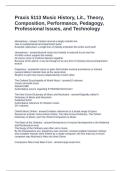
Praxis 5113 Music History, Lit., Theory,
Composition, Performance, Pedagogy,
Professional Issues, and Technology
Monophony - answer Centers around a single melodic line
Has no supplemental accompaniment parts
Example: plainchant- a single line of melody embodies the entire work itself
Homophony - answerSeveral voices but melody is reduced to just one line
All other voices support the melody
All voices move in rhythmic likeness together
Because of the above, it can be thought of as any form of melody and accompaniment
texture
Polyphony - answerAll voices or parts hold similar musical prominence or interest
(several distinct melodic lines at the same time)
Rhythm in each line moves independently of each other
The Garland Encyclopedia of World Music - answer10 volumes
Covers all world music
Started 1988
Authoritative source regarding ETHNOMUSICOLOGY
The New Grove Dictionary of Music and Musicians - answerOriginally called A
Dictionary of Music and Musicians
Published 1879
Authoritative reference for Western music
20+ volumes
Oxford Music Online - answerContains references to a broad range of topics
Resources include: Grove Music Online, The New Grove Dictionary, The Oxford
Dictionary of Music, and The Oxford Companion to Music
The Mass of the Ordinary - answerDriving force of musical development in the Medieval
and Renaissance eras
The liturgy of the Ordinary was often set to music
By the Renaissance era, polyphony was common, musical notation had been refined,
and complete masses were written by a single composer; the first mass by a known
composer was Machaut's Mess de Notre Dame
Composers Who Used Mass Form - answerLarge-scale form
,Duffy, Joaquin, Palestrina, Haydn, Mozart, Beethoven, Schubert, Webber, Berlioz,
Verdi, Wagner, Fauré, etc
Composers who used it in new musical settings: Hindemith, Stravinsky, Bernstein, etc.
The Ordinary - answerKyrie, Gloria, Credo, Sanctus, Agnus Dei
Renaissance Motet - answerReferred to more as a genre of music than to a certain form
or structure
By the mid-15th century, it was known as a polyphonic setting of any sacred Latin text,
not restricted to the liturgy
Renaissance composers introduced imitation, homophony, and 4-part harmony to the
motet
Medieval Motet - answerMotet derived from organum and clausulae
Featured tenor line derived from plainchant with one or more upper voices in French or
Latin
Tenor vocal line usually had a short, repeated rhythmic pattern, while the upper voice
had a contrasting, lively upper voices
Texts of upper voices were sometimes independent and in a different language from the
tenor line
Secular Music Evolution - answerBecome the driving force of musical development
Troubadours and trouvères saw drone accompaniment: had regular meter,
syncopations, polyphony, and harmony
Motet - answerPolyphonic vocal genre, secular in the Middle Ages but sacred or
devotional thereafter.
Mass - answerImportant religious ritual
Featured non-imitative polyphony
Most often in Latin or French
Organum - answerEarliest kind of polyphonic music, which developed from the custom
of adding voices above a plainchant; they first ran parallel to it at the interval of a fifth or
fourth and later moved more freely
Sacred
Middle Ages
Gregorian Chant - answerchurch music sung as a single vocal line in free rhythm and a
restricted scale (plainsong), in a style developed for the medieval Latin liturgy.
sacred and secular music - answerSacred: Gregorian Chant and Masses
Secular: music for dance and entertainment (troubadour/trouvère music)
RILM Abstracts of Music Literature - answerInternational database
, Focused on scholarship world-wide , relating to any aspect of the musical discipline;
subjects include historical musicology, ethnomusicology, instruments/voice, music
therapy, and dance
Requires a subscription and is regularly updated
Covers over 780,000 entries in over 117 languages from 1967 to present
RILM International Bibliography - answerContains books, catalogs, master's theses,
doctoral dissertations, articles, bibliographies, films, videos, ethnographic recordings,
conference proceedings, reviews, Festschriften, technical drawings, facsimile editions,
and iconographies
Entries are presented in the original language with an English translation of the title, an
abstract, and the full bibliographic data
RISM (The Repertoire Internationals des Sources Musicales Online) - answerFounded
in 1952 in Paris
One of the largest non-profit organizations of its kind
Operates internationally to document musical sources from around the world
RISM Publications - answerDivided into 3 parts: Series A- arranged by composer,
includes printed music ( Series A/1), and includes music manuscripts (Series A/11),
Series B- arranged by topic (Ancient Greek music theory/manuscripts in lute tablature,
and Series C- index of music libraries, private collections, and archives world-wide
RISM Part 111 - answerLargest portion of RISM inventory is Series A/11, consisting of
over 380,000 manuscripts by over 18,000 composers, theorists, and librettists after
1600
Series A/11 is now an online searchable database that lists the composer or author's
name, title, origin, and holding library for every entry
JSTOR (Journal Storage) - answerDigital database with 32+ scholarly journals
Titles include Early Music History, Music Analysis, The Music Quarterly, Perspectives of
New Music, and The Journal of Musicology
The Music Index Online - answerMusic periodicals and literature from 1973 to present
Contains 655+ international music journals
The International Index of the Music Periodicals - answerDigital database
425+ scholarly and popular music periodicals
Titles include International Journal of Music Education, Ethnomusicology, Jazz
Education Journal, Rock and Rap Confidential, and Rolling Stones
RIPM (Retrospective Index to Music Periodicals) - answerResources for 19th/20th
centuries
Scholarly writing on music history and culture
200+ music periodicals
Composition, Performance, Pedagogy,
Professional Issues, and Technology
Monophony - answer Centers around a single melodic line
Has no supplemental accompaniment parts
Example: plainchant- a single line of melody embodies the entire work itself
Homophony - answerSeveral voices but melody is reduced to just one line
All other voices support the melody
All voices move in rhythmic likeness together
Because of the above, it can be thought of as any form of melody and accompaniment
texture
Polyphony - answerAll voices or parts hold similar musical prominence or interest
(several distinct melodic lines at the same time)
Rhythm in each line moves independently of each other
The Garland Encyclopedia of World Music - answer10 volumes
Covers all world music
Started 1988
Authoritative source regarding ETHNOMUSICOLOGY
The New Grove Dictionary of Music and Musicians - answerOriginally called A
Dictionary of Music and Musicians
Published 1879
Authoritative reference for Western music
20+ volumes
Oxford Music Online - answerContains references to a broad range of topics
Resources include: Grove Music Online, The New Grove Dictionary, The Oxford
Dictionary of Music, and The Oxford Companion to Music
The Mass of the Ordinary - answerDriving force of musical development in the Medieval
and Renaissance eras
The liturgy of the Ordinary was often set to music
By the Renaissance era, polyphony was common, musical notation had been refined,
and complete masses were written by a single composer; the first mass by a known
composer was Machaut's Mess de Notre Dame
Composers Who Used Mass Form - answerLarge-scale form
,Duffy, Joaquin, Palestrina, Haydn, Mozart, Beethoven, Schubert, Webber, Berlioz,
Verdi, Wagner, Fauré, etc
Composers who used it in new musical settings: Hindemith, Stravinsky, Bernstein, etc.
The Ordinary - answerKyrie, Gloria, Credo, Sanctus, Agnus Dei
Renaissance Motet - answerReferred to more as a genre of music than to a certain form
or structure
By the mid-15th century, it was known as a polyphonic setting of any sacred Latin text,
not restricted to the liturgy
Renaissance composers introduced imitation, homophony, and 4-part harmony to the
motet
Medieval Motet - answerMotet derived from organum and clausulae
Featured tenor line derived from plainchant with one or more upper voices in French or
Latin
Tenor vocal line usually had a short, repeated rhythmic pattern, while the upper voice
had a contrasting, lively upper voices
Texts of upper voices were sometimes independent and in a different language from the
tenor line
Secular Music Evolution - answerBecome the driving force of musical development
Troubadours and trouvères saw drone accompaniment: had regular meter,
syncopations, polyphony, and harmony
Motet - answerPolyphonic vocal genre, secular in the Middle Ages but sacred or
devotional thereafter.
Mass - answerImportant religious ritual
Featured non-imitative polyphony
Most often in Latin or French
Organum - answerEarliest kind of polyphonic music, which developed from the custom
of adding voices above a plainchant; they first ran parallel to it at the interval of a fifth or
fourth and later moved more freely
Sacred
Middle Ages
Gregorian Chant - answerchurch music sung as a single vocal line in free rhythm and a
restricted scale (plainsong), in a style developed for the medieval Latin liturgy.
sacred and secular music - answerSacred: Gregorian Chant and Masses
Secular: music for dance and entertainment (troubadour/trouvère music)
RILM Abstracts of Music Literature - answerInternational database
, Focused on scholarship world-wide , relating to any aspect of the musical discipline;
subjects include historical musicology, ethnomusicology, instruments/voice, music
therapy, and dance
Requires a subscription and is regularly updated
Covers over 780,000 entries in over 117 languages from 1967 to present
RILM International Bibliography - answerContains books, catalogs, master's theses,
doctoral dissertations, articles, bibliographies, films, videos, ethnographic recordings,
conference proceedings, reviews, Festschriften, technical drawings, facsimile editions,
and iconographies
Entries are presented in the original language with an English translation of the title, an
abstract, and the full bibliographic data
RISM (The Repertoire Internationals des Sources Musicales Online) - answerFounded
in 1952 in Paris
One of the largest non-profit organizations of its kind
Operates internationally to document musical sources from around the world
RISM Publications - answerDivided into 3 parts: Series A- arranged by composer,
includes printed music ( Series A/1), and includes music manuscripts (Series A/11),
Series B- arranged by topic (Ancient Greek music theory/manuscripts in lute tablature,
and Series C- index of music libraries, private collections, and archives world-wide
RISM Part 111 - answerLargest portion of RISM inventory is Series A/11, consisting of
over 380,000 manuscripts by over 18,000 composers, theorists, and librettists after
1600
Series A/11 is now an online searchable database that lists the composer or author's
name, title, origin, and holding library for every entry
JSTOR (Journal Storage) - answerDigital database with 32+ scholarly journals
Titles include Early Music History, Music Analysis, The Music Quarterly, Perspectives of
New Music, and The Journal of Musicology
The Music Index Online - answerMusic periodicals and literature from 1973 to present
Contains 655+ international music journals
The International Index of the Music Periodicals - answerDigital database
425+ scholarly and popular music periodicals
Titles include International Journal of Music Education, Ethnomusicology, Jazz
Education Journal, Rock and Rap Confidential, and Rolling Stones
RIPM (Retrospective Index to Music Periodicals) - answerResources for 19th/20th
centuries
Scholarly writing on music history and culture
200+ music periodicals