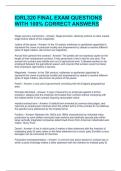
IDRL320 FINAL EXAM QUESTIONS
WITH 100% CORRECT ANSWERS
Wage recovery mechanism - Answer- Illegal provision, allowing workers to claim unpaid
wage before adjust of the magistrate.
Justice of the peace - Answer- In the 19 century noblemen or gentlemen appointed to
represent the crown in particular locality and empowered by statute to resolve different
types of legal matters, also known as magistrate.
Annual hire/ general hire contract - Answer- The parties did not expressly agree on the
length of their employment contract. It was presumed in law to last for one year. The
annual hire contract was initially born out of agricultural work. It allowed workers to be
employed between the agricultural season and ensured that workers would not leave
their employers right before a harvest.
Magistrate - Answer- In the 19th century, nobleman or gentlemen appointed to
represent the crown in particular locality and empowered by statute to resolve different
types of legal matters, also known as justice of the peace.
Parish - Answer- Local unit of government coinciding with the England geographical
area.
Wrongful dismissal - Answer- A type of lawsuit by an employee against a former
employer, alleging that the employer terminated their contract without complying with
the implied terms in the contract requiring reasonable notice.
Implied contract term - Answer- A default term invented by common law judges, and
read into an employment contract when the written terms of the contract do not address
the specific issue addressed by the implied terms.
Fordism - Answer- Between the 1920s and 1960s characterized by industrial mass
production by semi-skilled unionized male workers and relatively secured jobs within
large vertically integrated companies determined driven from American industrialist auto
maker, Henry Ford.
Deceit - Answer- A tort in which party A makes a false statement with the intention of
misleading party B; party relies on the false statement as a result; party B suffers a loss;
damages can be recovered for that loss.
Fraudulent misrepresentation - Answer- A common law action based on contract law in
which a party knowingly makes a false statement with the intention to mislead party B,
, and that statement induces party B to enter into a contract; in this case, party B may be
able to rescind the contract and seek damages for any suffered loss.
Rescind - Answer- To set aside a contract and put back into their pre-contract position.
Negligent misrepresentation - Answer- Which duty of an untrue statement without
sufficient care as to the statement's accuracy, which party then relies upon and suffers
loss as a result.
Duty of care - Answer- A special close relationship between two parties that creates an
obligation in law to take reasonable steps to avoid harming the other party.
Summary dismissal - Answer- The termination of an employment contract by an
employer, without notice to the employee in response to a serious breach of contract by
the employee.
Infant - Answer- A person under the age of 18 also referred to as a minor in legal
writing.
Voidable contract - Answer- Contract that may be declared void at the option of one of
the parties because of a deficiency an example as an employment contract involving an
employee who is considered mentally impaired.
Objective test - Answer- A legal test used in interpretation of contracts and statutes that
ask what would a reasonable person of normal intelligence.
Subjective test - Answer- A legal test used in interpretation of contracts and statutes
that asks what would this person actually think at the time.
Contract modification - Answer- A change to one or more terms of the contract during
the term of the contract.
Forbearance - Answer- A promise by one party and a contract to another party to refrain
from exercising and contractual right for period of time a forebearance by an employer
to not exercise the contractual right to terminate the employment contract contract may
constitute consideration, flowing to an employee.
Expressed contract terms - Answer- A term of a contract that the parties have explicitly
agreed to either orally or in writing.
Ancillary contract terms - Answer- Contract term found in written material that are
physically separated from an employment contract, but that includes rules that relate to
the employment relationship.
WITH 100% CORRECT ANSWERS
Wage recovery mechanism - Answer- Illegal provision, allowing workers to claim unpaid
wage before adjust of the magistrate.
Justice of the peace - Answer- In the 19 century noblemen or gentlemen appointed to
represent the crown in particular locality and empowered by statute to resolve different
types of legal matters, also known as magistrate.
Annual hire/ general hire contract - Answer- The parties did not expressly agree on the
length of their employment contract. It was presumed in law to last for one year. The
annual hire contract was initially born out of agricultural work. It allowed workers to be
employed between the agricultural season and ensured that workers would not leave
their employers right before a harvest.
Magistrate - Answer- In the 19th century, nobleman or gentlemen appointed to
represent the crown in particular locality and empowered by statute to resolve different
types of legal matters, also known as justice of the peace.
Parish - Answer- Local unit of government coinciding with the England geographical
area.
Wrongful dismissal - Answer- A type of lawsuit by an employee against a former
employer, alleging that the employer terminated their contract without complying with
the implied terms in the contract requiring reasonable notice.
Implied contract term - Answer- A default term invented by common law judges, and
read into an employment contract when the written terms of the contract do not address
the specific issue addressed by the implied terms.
Fordism - Answer- Between the 1920s and 1960s characterized by industrial mass
production by semi-skilled unionized male workers and relatively secured jobs within
large vertically integrated companies determined driven from American industrialist auto
maker, Henry Ford.
Deceit - Answer- A tort in which party A makes a false statement with the intention of
misleading party B; party relies on the false statement as a result; party B suffers a loss;
damages can be recovered for that loss.
Fraudulent misrepresentation - Answer- A common law action based on contract law in
which a party knowingly makes a false statement with the intention to mislead party B,
, and that statement induces party B to enter into a contract; in this case, party B may be
able to rescind the contract and seek damages for any suffered loss.
Rescind - Answer- To set aside a contract and put back into their pre-contract position.
Negligent misrepresentation - Answer- Which duty of an untrue statement without
sufficient care as to the statement's accuracy, which party then relies upon and suffers
loss as a result.
Duty of care - Answer- A special close relationship between two parties that creates an
obligation in law to take reasonable steps to avoid harming the other party.
Summary dismissal - Answer- The termination of an employment contract by an
employer, without notice to the employee in response to a serious breach of contract by
the employee.
Infant - Answer- A person under the age of 18 also referred to as a minor in legal
writing.
Voidable contract - Answer- Contract that may be declared void at the option of one of
the parties because of a deficiency an example as an employment contract involving an
employee who is considered mentally impaired.
Objective test - Answer- A legal test used in interpretation of contracts and statutes that
ask what would a reasonable person of normal intelligence.
Subjective test - Answer- A legal test used in interpretation of contracts and statutes
that asks what would this person actually think at the time.
Contract modification - Answer- A change to one or more terms of the contract during
the term of the contract.
Forbearance - Answer- A promise by one party and a contract to another party to refrain
from exercising and contractual right for period of time a forebearance by an employer
to not exercise the contractual right to terminate the employment contract contract may
constitute consideration, flowing to an employee.
Expressed contract terms - Answer- A term of a contract that the parties have explicitly
agreed to either orally or in writing.
Ancillary contract terms - Answer- Contract term found in written material that are
physically separated from an employment contract, but that includes rules that relate to
the employment relationship.