

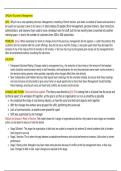
(BFGym) Structure & Management
INFO: BFGym has a clear operating structure. Management, consisting of former trainers, puts down a schedule of classes and sessions to
be taught and cascades it down to its trainers. In total employs 50 people (from management, personal trainers, class instructors,
administrators, and cleaners) Gym used to have a breakout room for staff, but this has recently been converted into another
training space -> due to the number of customers from 200 to 540 subscribers.
PROBLEMS: (Jane). When expressing her desire to change some of the exercises, management did not approve -> under the pretence that
customers did not complain with the current offerings, they did not see a need for change. Jo was quite upset when they decreased the
duration of one of her classes from 45 minutes to 30 minutes -> She now has to go by the agreed upon classes set by management who
often do amendments without consulting the instructors
SOLUTION:
Transparent Decision-Making: Changes made by management (e.g., the reduction of class times or the removal of the breakout
room) should be communicated clearly to staff members, with explanations for why those decisions were made. Involve trainers in
the decision-making process, when possible, especially when changes affect their roles directly.
Team Collaboration and Problem-Solving: Hold regular team meetings, like the one Kate initiated, but ensure that these meetings
are more inclusive and structured to give every trainer an equal opportunity to share their ideas. Management should facilitate
these meetings, ensuring all voices are heard and conflicts are resolved constructively
EVIDANCE AND THEORY: Socio-technical system. This theory was theorist by Eric Trist stating that is all about how the social and
technical aspect of a workplace fit together, as the goal is so that an organisation can run as smoothly as possible
o He conducted the study of coal mining industry, on how the social and technical aspects work together.
o With the changes the workers were grouped into shift, performing the same task
o Lack of communication, as workers were placed far apart
o Shift was supervised by one manager
Weitzel and Jonsson’s Model of Decline. This model shows the 5 stages of organisational decline, they stated at each stages an immediate
action can be taken to reduce or hold the decline
o Stage 1Blinded - This stage the organisation is blind and are unable to recognise the external & internal problems that is threaten
their long-term survival
o Stage 2 Inaction: This is where the gap between acceptable performance and actual performance increases. Little action to correct
performance
o Stage 3 Faulty action: Managers may have made wrong decision because of conflict at the top management team, or they may
have. Changed to little or late. major changes are required at this stage
, o Stage 4 Crisis: When organisation entries a turning point at the stage, due to the existence of the treats. This stage has 2-way
choice for the organisation, Fail or Survive. With in the boundaries of a very narrow temporal gap
o Stage 5 Dissolution: Decline is the option, as no choices are available, and organisation perishes
Due to the growth of customers from 200 to 540 subscribers, the gym has made changes, one of the changes they have made is the
breakout room, which was used for staff, but now it has converted into another training space. Due to this growth and changes, issues
have occurred regarding employees and management's approach to decision-making. For example, when trainer Jane expressed her desire
to change some of the exercises, management did not approve, because “under the pretence that customers did not complain with the
current offerings”, therefor they do not see a need for any changes. Similarly, Jo, another trainer in BFGym, was also quite upset when
they decreased the length of one of her classes from 45 minutes to 30 minutes. These changes that have been set by managers who often
do amendments without consulting the instructors, can negatively affect trainers feeling, as they feel controlled by managers and lack
independence over their work.
BFGym should adopt a more transparent and collaborative approach to management decisions to address these challenges. The
implemented solution emphasizes transparent communication, meaning that when changes like the reduction of class times or the
repurposing of the breakout room are made, the staff should receive clear communication and explanation of the reason. The trainers
must be involved directly in the decision-making process, especially when the changes affect them directly, like the classes offered and
time duration. This would require holding regular team meetings structured to allow everyone to share ideas and have an equal say.
Management's role in these meetings should be helped to open discussions where all voices are heard and conflicts resolved positively.
This approach is supported by the socio-technical systems theory, which emphasizes the importance of mixing social factors (like
communication and collaboration) with technical aspects of work to optimize efficiency and employee satisfaction. The socio-technical
theory highlights the importance of communication and that changes in one system (technical) can impact another system (social).
Furthermore, BFGym might be experiencing some aspects of Weitzel and Jonsson’s Model of Decline. The gym may be considered to be at
stage 1 and 2. Stage 1 represents when the organisation is blind and doesn’t recognise the internal and external problems. Stage 2
represents inaction in which there is a small to no action taken to correct performance and address the problems. This lack of
communication and reluctance to adapt or even consider the instructors' concerns suggests that the gym might be showing some signs of
these stages. Implementing the proposed solutions will allow the gym to avoid progressing to the other stages.
, Kate
INFO: She is the Head of BFGym, her main objectives are to keep the gym smoothly running and customer are satisfied, however she
realizes her objectives can only be achieved with a motivated workforce.
OWN SOLUTION: Her solution to this is by in her set out and asking her staff members to come up with solutions to their problems -> Kate
summoned the 5 trainers to a meeting tasking them to presenting their solutions -> at the upcoming management meeting they all did
not find it ideal to hold the meeting after working hours, due to the full schedule they had at the gym.
MY SOLUTION:
Employee Motivation and Engagement: For Kate she needs to improve her communication, as communicating effective is way to
keep employees informed, valued, and engaged.
Regular One-on-One Check-Ins: As Kate and the management team should have regular individual meetings with the trainers to
discuss their concerns, feedback, and aspirations. These check-ins can be informal but will provide an opportunity for trainers to
voice their opinions, which may help resolve issues before they escalate.
Encourage Open Dialogue and Feedback: Create a culture where trainers feel comfortable providing feedback and offering
suggestions for improvement. This could be facilitated through regular team meetings, anonymous suggestion boxes, or digital
platforms where trainers can voice their concerns
EVIDANCE AND THEORY Henri Fayol: Fire function & Fourteen principles of management. These five-function con used on a face-to-face
basis in a small-scale organization, however it becomes difficult for an organisation that is growing.
Fayol’s Fire function of management
o Planning/Forecasting – Look at the future
o Organising structure and resources
o Coordinating – giving orders
o Controlling – monitoring and looking to verify “the orders are going the way it is planned”
Fayd’s 14 classic principle of management
o Division of work should be divided among individuals and groups; this is to make sure that effort and attention are given to
a specific
o Atuthority & Responsibility it’s the rights to give orders and for things power (Authority) being accountable
o Discipline / strictness
o Unity of command-Clear line of responsibility across the hierarchy, as workers should receive order from one manager
o Unity of direction-Each area of the hierarchy. Should have objective
INFO: BFGym has a clear operating structure. Management, consisting of former trainers, puts down a schedule of classes and sessions to
be taught and cascades it down to its trainers. In total employs 50 people (from management, personal trainers, class instructors,
administrators, and cleaners) Gym used to have a breakout room for staff, but this has recently been converted into another
training space -> due to the number of customers from 200 to 540 subscribers.
PROBLEMS: (Jane). When expressing her desire to change some of the exercises, management did not approve -> under the pretence that
customers did not complain with the current offerings, they did not see a need for change. Jo was quite upset when they decreased the
duration of one of her classes from 45 minutes to 30 minutes -> She now has to go by the agreed upon classes set by management who
often do amendments without consulting the instructors
SOLUTION:
Transparent Decision-Making: Changes made by management (e.g., the reduction of class times or the removal of the breakout
room) should be communicated clearly to staff members, with explanations for why those decisions were made. Involve trainers in
the decision-making process, when possible, especially when changes affect their roles directly.
Team Collaboration and Problem-Solving: Hold regular team meetings, like the one Kate initiated, but ensure that these meetings
are more inclusive and structured to give every trainer an equal opportunity to share their ideas. Management should facilitate
these meetings, ensuring all voices are heard and conflicts are resolved constructively
EVIDANCE AND THEORY: Socio-technical system. This theory was theorist by Eric Trist stating that is all about how the social and
technical aspect of a workplace fit together, as the goal is so that an organisation can run as smoothly as possible
o He conducted the study of coal mining industry, on how the social and technical aspects work together.
o With the changes the workers were grouped into shift, performing the same task
o Lack of communication, as workers were placed far apart
o Shift was supervised by one manager
Weitzel and Jonsson’s Model of Decline. This model shows the 5 stages of organisational decline, they stated at each stages an immediate
action can be taken to reduce or hold the decline
o Stage 1Blinded - This stage the organisation is blind and are unable to recognise the external & internal problems that is threaten
their long-term survival
o Stage 2 Inaction: This is where the gap between acceptable performance and actual performance increases. Little action to correct
performance
o Stage 3 Faulty action: Managers may have made wrong decision because of conflict at the top management team, or they may
have. Changed to little or late. major changes are required at this stage
, o Stage 4 Crisis: When organisation entries a turning point at the stage, due to the existence of the treats. This stage has 2-way
choice for the organisation, Fail or Survive. With in the boundaries of a very narrow temporal gap
o Stage 5 Dissolution: Decline is the option, as no choices are available, and organisation perishes
Due to the growth of customers from 200 to 540 subscribers, the gym has made changes, one of the changes they have made is the
breakout room, which was used for staff, but now it has converted into another training space. Due to this growth and changes, issues
have occurred regarding employees and management's approach to decision-making. For example, when trainer Jane expressed her desire
to change some of the exercises, management did not approve, because “under the pretence that customers did not complain with the
current offerings”, therefor they do not see a need for any changes. Similarly, Jo, another trainer in BFGym, was also quite upset when
they decreased the length of one of her classes from 45 minutes to 30 minutes. These changes that have been set by managers who often
do amendments without consulting the instructors, can negatively affect trainers feeling, as they feel controlled by managers and lack
independence over their work.
BFGym should adopt a more transparent and collaborative approach to management decisions to address these challenges. The
implemented solution emphasizes transparent communication, meaning that when changes like the reduction of class times or the
repurposing of the breakout room are made, the staff should receive clear communication and explanation of the reason. The trainers
must be involved directly in the decision-making process, especially when the changes affect them directly, like the classes offered and
time duration. This would require holding regular team meetings structured to allow everyone to share ideas and have an equal say.
Management's role in these meetings should be helped to open discussions where all voices are heard and conflicts resolved positively.
This approach is supported by the socio-technical systems theory, which emphasizes the importance of mixing social factors (like
communication and collaboration) with technical aspects of work to optimize efficiency and employee satisfaction. The socio-technical
theory highlights the importance of communication and that changes in one system (technical) can impact another system (social).
Furthermore, BFGym might be experiencing some aspects of Weitzel and Jonsson’s Model of Decline. The gym may be considered to be at
stage 1 and 2. Stage 1 represents when the organisation is blind and doesn’t recognise the internal and external problems. Stage 2
represents inaction in which there is a small to no action taken to correct performance and address the problems. This lack of
communication and reluctance to adapt or even consider the instructors' concerns suggests that the gym might be showing some signs of
these stages. Implementing the proposed solutions will allow the gym to avoid progressing to the other stages.
, Kate
INFO: She is the Head of BFGym, her main objectives are to keep the gym smoothly running and customer are satisfied, however she
realizes her objectives can only be achieved with a motivated workforce.
OWN SOLUTION: Her solution to this is by in her set out and asking her staff members to come up with solutions to their problems -> Kate
summoned the 5 trainers to a meeting tasking them to presenting their solutions -> at the upcoming management meeting they all did
not find it ideal to hold the meeting after working hours, due to the full schedule they had at the gym.
MY SOLUTION:
Employee Motivation and Engagement: For Kate she needs to improve her communication, as communicating effective is way to
keep employees informed, valued, and engaged.
Regular One-on-One Check-Ins: As Kate and the management team should have regular individual meetings with the trainers to
discuss their concerns, feedback, and aspirations. These check-ins can be informal but will provide an opportunity for trainers to
voice their opinions, which may help resolve issues before they escalate.
Encourage Open Dialogue and Feedback: Create a culture where trainers feel comfortable providing feedback and offering
suggestions for improvement. This could be facilitated through regular team meetings, anonymous suggestion boxes, or digital
platforms where trainers can voice their concerns
EVIDANCE AND THEORY Henri Fayol: Fire function & Fourteen principles of management. These five-function con used on a face-to-face
basis in a small-scale organization, however it becomes difficult for an organisation that is growing.
Fayol’s Fire function of management
o Planning/Forecasting – Look at the future
o Organising structure and resources
o Coordinating – giving orders
o Controlling – monitoring and looking to verify “the orders are going the way it is planned”
Fayd’s 14 classic principle of management
o Division of work should be divided among individuals and groups; this is to make sure that effort and attention are given to
a specific
o Atuthority & Responsibility it’s the rights to give orders and for things power (Authority) being accountable
o Discipline / strictness
o Unity of command-Clear line of responsibility across the hierarchy, as workers should receive order from one manager
o Unity of direction-Each area of the hierarchy. Should have objective


