
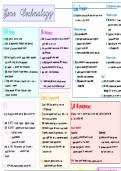
2) Transferring
Gene Transfer
to recipient
Gene Technology * extraction of
or same or
sections
diff species
of DNA from cell to insert into cell Plasmids
* has to
as vectors
be cut +
:
is same
used to cut plasmid + DNA
1) Obtaining
DNA Probes
required gene ends
Microarrays a) Restriction endonucleases * bases pair + DNA ligase io
* target specific sections of DNA * DNA chip made of solid glass / silicon base attached to * cuts sugar -
phosphate bonds after a recognition ( phosphodiester bonds )
* attach to complementary seauenceot bases /approx 201 grid 011000s or spout wells sequence 01 bases / hydrolysis ) A Donor DNA spliced into pla
* Also have a fluorescent / radioactive marker
* each spot attached to multiple copies 01 diff sequence oh specific for each gene 4> Recombinant DNA
DNA IDNA probe ) * leaves sticky ends / exposed SSDNAI or blunt ends
1) DNA that expected to contain target sequence hydrolysed * single stranded DNA / mRNA added Viruses as vectors :
into sections using restriction endonucleases * if added sample has complementary DNA →
hybridise b) Reverse transcription (makes single stranded DNA ? * bacteriophage virus have
2) DNA fragments → separated by get electrophoresis * fluorescent / Chemiluminescent tags light up A mRNA for required gene isolated 1- extracted in =
donor DNA + viral DNA
3) DNA sections transferred to nylon membrane + add fluorescently A more colour = more hybridisation * mRNA strand acts as template → form single
labelled DNA probe strand 01 DNA → cDNA ( complementary) HOW ? :
4) If target present , DNA probe will hybridise with it ; if not → Uses : compare many genes at once, identify mutation , A DNA polymerase used to make double p Host cells incubated v1 plasmids +
'
washed off
'
t removed stranded DNA A Heat shock
+ SNPs , provide info of expression 1h01 gene , membrane more permeable
5) Exposing membrane to UV light causes probe + target encourages cells to take up R plasm
Genetic Fingerprinting
sequence to fluoresce * small proportion will pick them up
1) Extract
p( µ 4M Microorganisms
DNA from sample e.
9. crime scene
* PCR Otten used #
* used to amplify selected section of DNA in very short time 2) Restriction enzymes target specific Miss 1- cut * Bacteria = ideal → relatively easy to insert donor DNA into bacterial DNA
DNA into diff sized fragments $ E. coli widely used
1) Heat to 95°C → break H bonds t separates strands 3) DNA fragments separated by size →
get electrophoresis
2) 1001 to 40 -60°C + add excess primer / binds to template ) 4) DNA heated →
separate DNA strands →
single stranded Insulin Production
Primers : * stop DNA rejoining 5) Fragments transferred to nylon membrane + DNA Advantages :
Disadvantages :
* complementary trantor med bacteria
probes added base pair complementary sequences) * previously
/ w/ * produced by in large extracted from pigs + came
* bracket DNA to be copied 6) Sample washed →
remove unpaired probes enough quantities for 9 no . diabetics → time consuming + ineffective ikgieidl
3) Heat to 70°C .
TAQ polymerase joins to primers t 7) X-ray / laser scan used to detect probes t DNA human insulin gene used . : identical to * non human siiqnnuditt to human
-
→
↳ withstand T temps
copies each strand fingerprint visible naturally produced Hi immune response ) could cause allergic rxns
4.) Repeat
Uses : criminal cases paternity ancestry
, , ,
tissue Other : human growth hormone , enzymes , adhesives , interferon
Uses : crime scenes sequencing pathogens
, ,
historical cases typing I transplant it , victim identification
Gene Transfer
to recipient
Gene Technology * extraction of
or same or
sections
diff species
of DNA from cell to insert into cell Plasmids
* has to
as vectors
be cut +
:
is same
used to cut plasmid + DNA
1) Obtaining
DNA Probes
required gene ends
Microarrays a) Restriction endonucleases * bases pair + DNA ligase io
* target specific sections of DNA * DNA chip made of solid glass / silicon base attached to * cuts sugar -
phosphate bonds after a recognition ( phosphodiester bonds )
* attach to complementary seauenceot bases /approx 201 grid 011000s or spout wells sequence 01 bases / hydrolysis ) A Donor DNA spliced into pla
* Also have a fluorescent / radioactive marker
* each spot attached to multiple copies 01 diff sequence oh specific for each gene 4> Recombinant DNA
DNA IDNA probe ) * leaves sticky ends / exposed SSDNAI or blunt ends
1) DNA that expected to contain target sequence hydrolysed * single stranded DNA / mRNA added Viruses as vectors :
into sections using restriction endonucleases * if added sample has complementary DNA →
hybridise b) Reverse transcription (makes single stranded DNA ? * bacteriophage virus have
2) DNA fragments → separated by get electrophoresis * fluorescent / Chemiluminescent tags light up A mRNA for required gene isolated 1- extracted in =
donor DNA + viral DNA
3) DNA sections transferred to nylon membrane + add fluorescently A more colour = more hybridisation * mRNA strand acts as template → form single
labelled DNA probe strand 01 DNA → cDNA ( complementary) HOW ? :
4) If target present , DNA probe will hybridise with it ; if not → Uses : compare many genes at once, identify mutation , A DNA polymerase used to make double p Host cells incubated v1 plasmids +
'
washed off
'
t removed stranded DNA A Heat shock
+ SNPs , provide info of expression 1h01 gene , membrane more permeable
5) Exposing membrane to UV light causes probe + target encourages cells to take up R plasm
Genetic Fingerprinting
sequence to fluoresce * small proportion will pick them up
1) Extract
p( µ 4M Microorganisms
DNA from sample e.
9. crime scene
* PCR Otten used #
* used to amplify selected section of DNA in very short time 2) Restriction enzymes target specific Miss 1- cut * Bacteria = ideal → relatively easy to insert donor DNA into bacterial DNA
DNA into diff sized fragments $ E. coli widely used
1) Heat to 95°C → break H bonds t separates strands 3) DNA fragments separated by size →
get electrophoresis
2) 1001 to 40 -60°C + add excess primer / binds to template ) 4) DNA heated →
separate DNA strands →
single stranded Insulin Production
Primers : * stop DNA rejoining 5) Fragments transferred to nylon membrane + DNA Advantages :
Disadvantages :
* complementary trantor med bacteria
probes added base pair complementary sequences) * previously
/ w/ * produced by in large extracted from pigs + came
* bracket DNA to be copied 6) Sample washed →
remove unpaired probes enough quantities for 9 no . diabetics → time consuming + ineffective ikgieidl
3) Heat to 70°C .
TAQ polymerase joins to primers t 7) X-ray / laser scan used to detect probes t DNA human insulin gene used . : identical to * non human siiqnnuditt to human
-
→
↳ withstand T temps
copies each strand fingerprint visible naturally produced Hi immune response ) could cause allergic rxns
4.) Repeat
Uses : criminal cases paternity ancestry
, , ,
tissue Other : human growth hormone , enzymes , adhesives , interferon
Uses : crime scenes sequencing pathogens
, ,
historical cases typing I transplant it , victim identification


