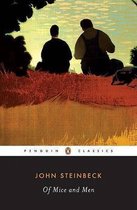
Of Mice and Men character essays
For Edexcel International GCSE English Literature
Key:
Topic sentence
Quotes
Historical context
,George
In the novel ‘Of Mice and Men’, the setting of the ranch acts as a microcosm of 1930s
America, with each character serving a narrative purpose. The protagonist, George, is used by
Steinbeck to symbolise typical ranch workers as products of society and their struggles
having to live a brutal ranch life.
George’s role as the protagonist in the novel highlights the struggles of a typical ranch
worker. The Dust Bowl in 1934 and 1936 was a period of severe dust storms causing
ecological and agricultural damage in America. Moreover, many people had lost their money
and property through bankruptcy due to the Great Depression. As a result, people were forced
to pack up their scant belongings and travelled around in hope of finding a job in a farm or in
cities. George is “dressed in denim trousers and in denim coats” which highlights his role as a
typical manual labourer. George also “carried tight blanket roles” which reflects his poverty
in owning few possessions and his struggles having to travel around a lot. The American
Dream was a capitalist promise that the perfect fortune could be achieved by working hard.
Moreover, California was seen by many as the ‘Golden State’ where there were plenty of job
opportunities and where people could achieve their American Dreams. George’s dream of
“bringin’ in [his] own crops ‘stead of doin’ all the work and not getting what comes outta the
ground” is typical of many ranch workers’. The way “his voice was growing warmer” when
he describes his dream of “catch[ing] a hundred of [salmon]” when they “run up the river’
and that the cream of his goats and cows “is so God damn thick that you need to cut it with a
knife” highlights the emotional impact of his dream. However, the hyperbolic images of
abundance in his dream also underlines the unrealistic aspect of many ranch workers’ dreams.
George’s friendship with Lennie throughout the novel highlights the rarity of friendships in
1930s America. Due to people constantly travelling around in search for a job during the
Great Depression, meaningful relationships were hard to come by. George acts as a parent in
their relationship whilst Lennie acts as a child and this can be shown by the way he “imitated
George exactly” and seeks George’s approval: “Look George. Look what I have done”.
Lennie is impulsive, childlike and is dependent on George whilst George is more sensible,
practical and in control. The life that George describes without Lennie is unfulfilling and
aimless: “I could stay in a cat house all night… get a gallon of whiskey, or set in a pool room
and play cards or shoot pool”. This shows that although George is frustrated of having to take
care of Lennie at times, it is only short-lived and that he relies on Lennie to keep him on the
right path as much as Lennie relies on him. Additionally, George and Lennie’s promise to
each other of “I got you to look after me and you got me to look after you” further
emphasises the rarity of friendships amongst itinerant workers hence their need to have each
other’s backs. The boss’ comment on their friendship when he says “I never seen a guy take
so much trouble for another guy” again, proves that friendships were rare and therefore was
treated with suspicion.
George is also presented by Steinbeck as a product of society as he holds normalised
prejudice and sexism. Sexism was prominent in the 1930s American society. Domesticity,
motherhood and homemaking were regarded as the only true proper roles for women.
George’s initial reaction to Curley’s Wife as “what a tramp” is a highly misogynistic
comment. When he says that “[he] never seen a jailbait worse than her”, George implies that
she gets men into prison. This reflects the preconception men had about women at the time
and highlights the commonality of women being blamed for crimes against them. George’s
casual use of misogynistic language is further emphasised when he says that “Andy’s in San
, Quentin right now on account of a tart”. This again, shows the victim-blaming on women due
to the normalised sexism in society. The Madonna-whore complex is used to describe a
masculine society that sees women as either promiscuous or virginal and George can be said
to view women through the lens of the Madonna-whore complex. Although George holds
normalised prejudice against women, his behaviour can be explained by him being a victim
of society. And so, Steinbeck uses George to condemn the sexist society in 1930s America.
At the end of the novel, the brutality of society is emphasised when George is forced to
shoot Lennie. George’s language breakdown when he says “guys like us got no fambly”
shows that he is struggling to speak and is fearful of what it is to come. By reciting his dream
of having “a cow, a pig an’ chickens… an’ a little piece alfafa” with Lennie, George wants
his friend to have a ‘good’ death compared to the one Curley has planned for him which
shows that he will not want to kill Lennie if he has the choice not to. George’s reluctance to
kill Lennie is further emphasised when his “hand shook violently” while he pulls the trigger.
The brutality of society is ultimately highlighted on the last line of the novel when Carlson
says “now what the hell ya suppose is eatin’ them two guys”. This insensitive comment
presents the ranch as an unfeeling place where the value of human emotions and relationships
are not recognised. This displays the brutality of society in which the grief following a brutal
death as Lennie’s is still not understood by many.
George plays a significant role in the novel in symbolising the struggles of typical ranch
workers and their desire for a better life. His friendship with Lennie amplifies the rarity of
genuine relationships due to the Great Depression and his normalised prejudice against
women is Steinbeck’s attempt to criticise the sexism in society. George’s ultimate decision to
shoot Lennie reflects the vicious cycle that ranch workers were stuck in in which they have to
look after themselves and their jobs above all else.
For Edexcel International GCSE English Literature
Key:
Topic sentence
Quotes
Historical context
,George
In the novel ‘Of Mice and Men’, the setting of the ranch acts as a microcosm of 1930s
America, with each character serving a narrative purpose. The protagonist, George, is used by
Steinbeck to symbolise typical ranch workers as products of society and their struggles
having to live a brutal ranch life.
George’s role as the protagonist in the novel highlights the struggles of a typical ranch
worker. The Dust Bowl in 1934 and 1936 was a period of severe dust storms causing
ecological and agricultural damage in America. Moreover, many people had lost their money
and property through bankruptcy due to the Great Depression. As a result, people were forced
to pack up their scant belongings and travelled around in hope of finding a job in a farm or in
cities. George is “dressed in denim trousers and in denim coats” which highlights his role as a
typical manual labourer. George also “carried tight blanket roles” which reflects his poverty
in owning few possessions and his struggles having to travel around a lot. The American
Dream was a capitalist promise that the perfect fortune could be achieved by working hard.
Moreover, California was seen by many as the ‘Golden State’ where there were plenty of job
opportunities and where people could achieve their American Dreams. George’s dream of
“bringin’ in [his] own crops ‘stead of doin’ all the work and not getting what comes outta the
ground” is typical of many ranch workers’. The way “his voice was growing warmer” when
he describes his dream of “catch[ing] a hundred of [salmon]” when they “run up the river’
and that the cream of his goats and cows “is so God damn thick that you need to cut it with a
knife” highlights the emotional impact of his dream. However, the hyperbolic images of
abundance in his dream also underlines the unrealistic aspect of many ranch workers’ dreams.
George’s friendship with Lennie throughout the novel highlights the rarity of friendships in
1930s America. Due to people constantly travelling around in search for a job during the
Great Depression, meaningful relationships were hard to come by. George acts as a parent in
their relationship whilst Lennie acts as a child and this can be shown by the way he “imitated
George exactly” and seeks George’s approval: “Look George. Look what I have done”.
Lennie is impulsive, childlike and is dependent on George whilst George is more sensible,
practical and in control. The life that George describes without Lennie is unfulfilling and
aimless: “I could stay in a cat house all night… get a gallon of whiskey, or set in a pool room
and play cards or shoot pool”. This shows that although George is frustrated of having to take
care of Lennie at times, it is only short-lived and that he relies on Lennie to keep him on the
right path as much as Lennie relies on him. Additionally, George and Lennie’s promise to
each other of “I got you to look after me and you got me to look after you” further
emphasises the rarity of friendships amongst itinerant workers hence their need to have each
other’s backs. The boss’ comment on their friendship when he says “I never seen a guy take
so much trouble for another guy” again, proves that friendships were rare and therefore was
treated with suspicion.
George is also presented by Steinbeck as a product of society as he holds normalised
prejudice and sexism. Sexism was prominent in the 1930s American society. Domesticity,
motherhood and homemaking were regarded as the only true proper roles for women.
George’s initial reaction to Curley’s Wife as “what a tramp” is a highly misogynistic
comment. When he says that “[he] never seen a jailbait worse than her”, George implies that
she gets men into prison. This reflects the preconception men had about women at the time
and highlights the commonality of women being blamed for crimes against them. George’s
casual use of misogynistic language is further emphasised when he says that “Andy’s in San
, Quentin right now on account of a tart”. This again, shows the victim-blaming on women due
to the normalised sexism in society. The Madonna-whore complex is used to describe a
masculine society that sees women as either promiscuous or virginal and George can be said
to view women through the lens of the Madonna-whore complex. Although George holds
normalised prejudice against women, his behaviour can be explained by him being a victim
of society. And so, Steinbeck uses George to condemn the sexist society in 1930s America.
At the end of the novel, the brutality of society is emphasised when George is forced to
shoot Lennie. George’s language breakdown when he says “guys like us got no fambly”
shows that he is struggling to speak and is fearful of what it is to come. By reciting his dream
of having “a cow, a pig an’ chickens… an’ a little piece alfafa” with Lennie, George wants
his friend to have a ‘good’ death compared to the one Curley has planned for him which
shows that he will not want to kill Lennie if he has the choice not to. George’s reluctance to
kill Lennie is further emphasised when his “hand shook violently” while he pulls the trigger.
The brutality of society is ultimately highlighted on the last line of the novel when Carlson
says “now what the hell ya suppose is eatin’ them two guys”. This insensitive comment
presents the ranch as an unfeeling place where the value of human emotions and relationships
are not recognised. This displays the brutality of society in which the grief following a brutal
death as Lennie’s is still not understood by many.
George plays a significant role in the novel in symbolising the struggles of typical ranch
workers and their desire for a better life. His friendship with Lennie amplifies the rarity of
genuine relationships due to the Great Depression and his normalised prejudice against
women is Steinbeck’s attempt to criticise the sexism in society. George’s ultimate decision to
shoot Lennie reflects the vicious cycle that ranch workers were stuck in in which they have to
look after themselves and their jobs above all else.