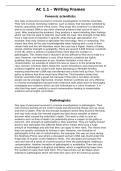
AC 1.1 – Writing Frames
Forensic scientists:
One type of personnel involved in criminal investigations is forensic scientists.
Their role involves reviewing evidence, such as blood, that has been collected by
forensic specialists at the crime scene. They study this evidence in a laboratory
and try to extract DNA or any other chemical evidence that can be of use in
court. After analysing the evidence, they produce a report detailing their findings
which can then be used to help the court with the case. One strength is that they
have a high level of expertise in specific areas through specialisation. For
example, they may choose to specialise into toxicology, fires or computing. This
means that they will be very knowledgeable when helping with a case in their
chosen field and this will therefore mean the case has a higher chance of being
solved. Another strength is availability. There are around 3,400 forensic scientists
in the UK, which is almost a hundred times more than the number of
pathologists. This means that it shouldn’t be too difficult to find one to help in a
case. However, one limitation is cost. Since forensic scientists are highly
qualified, they are expensive to use. Another limitation is the risk of
contamination. An example of where this was an issue is in the Amanda Knox
case, forensic scientists didn’t follow the correct procedures and examined lots of
evidence together and mixed it with items belonging to Meredith Kercher,
meaning that Kercher’s DNA was transferred onto a knife held by Knox. This led
police to believe that Knox must have killed her. This therefore shows that
forensic scientists hold a great risk because if their job is not done correctly,
people can be wrongly imprisoned. Overall, forensic scientists are very effective
in criminal investigations because their extensive skills allow them to thoroughly
investigate any evidence which can link individuals to a crime. However, it is
vital that they work carefully to avoid contamination leading to inadmissible
evidence and wrongful convictions.
Pathologists:
One type of personnel involved in criminal investigations is pathologists. Their
role involves working on the victim’s body and discovering things such as cause
and time of death. They do this through autopsies where they examine the body
and may even study the internal organs and take tissue samples to better
discover what caused the individual’s death. This work is vital in court as
evidence such as time of death can potentially prove a suspect to be guilty or
innocent. One strength of pathologists is their expertise. They are highly trained
doctors who specialise into different fields which means they have a huge
amount of knowledge and skill that they can apply to their work. This means that
they can greatly contribute to solving a case. However, one limitation of
pathologists is the risk of contamination. For example, this was an issue during
the Stephany Flores case where a deceased woman’s DNA was found under the
fingernails of murder victim Stephany Flores. This disrupted and set back the
case and was all a result of incorrect practice from the pathologists, leading to
contamination. Another limitation of pathologists is availability. There are only
around 35 pathologists in England and Wales, which is significantly lower than
the number of cases that need them. This means there can be delays when
waiting for pathologists which will mean the case can’t be solved as quickly.
Forensic scientists:
One type of personnel involved in criminal investigations is forensic scientists.
Their role involves reviewing evidence, such as blood, that has been collected by
forensic specialists at the crime scene. They study this evidence in a laboratory
and try to extract DNA or any other chemical evidence that can be of use in
court. After analysing the evidence, they produce a report detailing their findings
which can then be used to help the court with the case. One strength is that they
have a high level of expertise in specific areas through specialisation. For
example, they may choose to specialise into toxicology, fires or computing. This
means that they will be very knowledgeable when helping with a case in their
chosen field and this will therefore mean the case has a higher chance of being
solved. Another strength is availability. There are around 3,400 forensic scientists
in the UK, which is almost a hundred times more than the number of
pathologists. This means that it shouldn’t be too difficult to find one to help in a
case. However, one limitation is cost. Since forensic scientists are highly
qualified, they are expensive to use. Another limitation is the risk of
contamination. An example of where this was an issue is in the Amanda Knox
case, forensic scientists didn’t follow the correct procedures and examined lots of
evidence together and mixed it with items belonging to Meredith Kercher,
meaning that Kercher’s DNA was transferred onto a knife held by Knox. This led
police to believe that Knox must have killed her. This therefore shows that
forensic scientists hold a great risk because if their job is not done correctly,
people can be wrongly imprisoned. Overall, forensic scientists are very effective
in criminal investigations because their extensive skills allow them to thoroughly
investigate any evidence which can link individuals to a crime. However, it is
vital that they work carefully to avoid contamination leading to inadmissible
evidence and wrongful convictions.
Pathologists:
One type of personnel involved in criminal investigations is pathologists. Their
role involves working on the victim’s body and discovering things such as cause
and time of death. They do this through autopsies where they examine the body
and may even study the internal organs and take tissue samples to better
discover what caused the individual’s death. This work is vital in court as
evidence such as time of death can potentially prove a suspect to be guilty or
innocent. One strength of pathologists is their expertise. They are highly trained
doctors who specialise into different fields which means they have a huge
amount of knowledge and skill that they can apply to their work. This means that
they can greatly contribute to solving a case. However, one limitation of
pathologists is the risk of contamination. For example, this was an issue during
the Stephany Flores case where a deceased woman’s DNA was found under the
fingernails of murder victim Stephany Flores. This disrupted and set back the
case and was all a result of incorrect practice from the pathologists, leading to
contamination. Another limitation of pathologists is availability. There are only
around 35 pathologists in England and Wales, which is significantly lower than
the number of cases that need them. This means there can be delays when
waiting for pathologists which will mean the case can’t be solved as quickly.