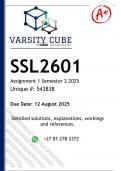
,IOS2601 Assignment 1 (COMPLETE ANSWERS) Semester 2 2025-
DUE August 2025;100% trusted ,comprehensive and complete
reliable solution with clear explanation
The Jaga v Dönges 1950 (4) SA 653 (A), which was delivered at the
height of apartheid, remains important for the interpretation of statutes
after the democratic transformation. Kindly read the case and answer the
following questions.
Introduction of the assignment
Statutory interpretation is a central function of the judiciary, as it
determines how laws are applied in practice. In South Africa, the
approach to interpretation has undergone significant transformation,
especially with the transition from a parliamentary sovereignty system to
constitutional supremacy in 1994. Before democracy, courts generally
applied the literal or textual approach, emphasizing the ordinary
grammatical meaning of statutory words and avoiding engagement with
broader social, moral, or constitutional considerations. This formalist
method was evident in the majority judgment in Jaga v Dönges 1950 (4)
SA 653 (A), where the court prioritized the plain wording of the Aliens
Act over contextual or purposive considerations. However, with the
adoption of the Constitution of the Republic of South Africa, 1996,
courts are now bound to interpret legislation in a manner that promotes
the spirit, purport, and objects of the Bill of Rights, as required by
section 39(2). This has ushered in a more purposive, value-driven, and
context-sensitive approach, as reflected in landmark cases such as Bato
Star Fishing (Pty) Ltd v Minister of Environmental Affairs 2004 (4) SA
, 490 (CC). This assignment critically examines the interpretive approach
before 1994, with specific reference to Jaga v Dönges, and contrasts it
with the constitutional approach post-1994.
A] BRIEFLY PROVIDE facts of the Jaga case.
(6)
1. Parties
Appellant (Jaga): An Indian immigrant who had resided in South
Africa for many years.
Respondent (Dönges): The then Minister of the Interior,
responsible for administering immigration and residency laws
under the Aliens Act.
2. Legal Background
The case concerned the Aliens Act 1 of 1937, apartheid-era
legislation which regulated the entry, residence, and deportation of
non-citizens in South Africa.
In terms of the Act, the Minister had the discretion to declare
certain individuals “prohibited persons” and to order their
deportation if they fell within categories defined by the statute.
DUE August 2025;100% trusted ,comprehensive and complete
reliable solution with clear explanation
The Jaga v Dönges 1950 (4) SA 653 (A), which was delivered at the
height of apartheid, remains important for the interpretation of statutes
after the democratic transformation. Kindly read the case and answer the
following questions.
Introduction of the assignment
Statutory interpretation is a central function of the judiciary, as it
determines how laws are applied in practice. In South Africa, the
approach to interpretation has undergone significant transformation,
especially with the transition from a parliamentary sovereignty system to
constitutional supremacy in 1994. Before democracy, courts generally
applied the literal or textual approach, emphasizing the ordinary
grammatical meaning of statutory words and avoiding engagement with
broader social, moral, or constitutional considerations. This formalist
method was evident in the majority judgment in Jaga v Dönges 1950 (4)
SA 653 (A), where the court prioritized the plain wording of the Aliens
Act over contextual or purposive considerations. However, with the
adoption of the Constitution of the Republic of South Africa, 1996,
courts are now bound to interpret legislation in a manner that promotes
the spirit, purport, and objects of the Bill of Rights, as required by
section 39(2). This has ushered in a more purposive, value-driven, and
context-sensitive approach, as reflected in landmark cases such as Bato
Star Fishing (Pty) Ltd v Minister of Environmental Affairs 2004 (4) SA
, 490 (CC). This assignment critically examines the interpretive approach
before 1994, with specific reference to Jaga v Dönges, and contrasts it
with the constitutional approach post-1994.
A] BRIEFLY PROVIDE facts of the Jaga case.
(6)
1. Parties
Appellant (Jaga): An Indian immigrant who had resided in South
Africa for many years.
Respondent (Dönges): The then Minister of the Interior,
responsible for administering immigration and residency laws
under the Aliens Act.
2. Legal Background
The case concerned the Aliens Act 1 of 1937, apartheid-era
legislation which regulated the entry, residence, and deportation of
non-citizens in South Africa.
In terms of the Act, the Minister had the discretion to declare
certain individuals “prohibited persons” and to order their
deportation if they fell within categories defined by the statute.