CRPC PRACTICE EXAM WITH QUESTIONS AND CORRECT GUIDED VERIFIED ANSWERS
WITH RATIONALE |ALREADY GRADED A+
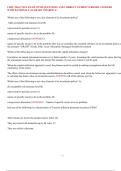
Which one of the following is not a key element of an investment policy?
A)the acceptable risk tolerance level B)
a provision for periodic review C)
names of specific stocks to be in the portfolio D) @#$%^&*()_+
a target asset allocation(ANSWER) C)
names of specific stocks to be in the portfolio One way to remember the essential elements of an investment policy is
the acronym "GRASP" (Goals, Risk, Asset Allocation, Strategies/Suitable Investment
Which of the following are correct statements about the capital utilization strategy?
It produces an annual retirement income over a finite number of years. Assuming the yield remains the same, the larg
the retirement income that is paid, the shorter the number of years over which it will be paid.
When the capital utilization approach is used, the planner must be careful in making assumptions about the life
expectancy of the client.
The effect of taxes on retirement savings and distributions should be consid- ered when the before-tax approach is use
to calculate the future value of retirement assets.(ANSWER) All of the options are true.
Which one of the following is not a key element of an investment policy? A)
the acceptable risk tolerance level B)
a provision for periodic review C)
names of specific stocks to be in the portfolio D)
a target asset allocation(ANSWER) C - Names of specific stocks to be in portfolio
hich one of the following is a characteristic of Treasury inflation-protected securities (TIPS)?
Their returns are tied to the producer price index. B)
They are issued with maturities up to 40 years. C)
They are sold at a discount.
,D)
The increase in principal is taxable each year.(ANSWER) D - Increase in principal is taxable each year
Assume your client has the following portfolio(ANSWER)
Stock Weight Beta BCD40% 1.15 EFG 25% .90 HIJ35%1.05
What is the overall weighted beta for this portfolio?(ANSWER) C - 1.05
Your client owns a bond fund with a duration of 6.5. If interest rates increase 1.5%, what is the expected change in price
for this fund?
A)
6.5% increase B)
9.75% decrease C)
6.5% decrease D)
9.75% increase(ANSWER) B - 9.75 decrease
The process of rebalancing is a key factor in A)
dynamic asset allocation. B)
tactical asset allocation. C)
strategic asset allocation. D)
institutional asset allocation.(ANSWER) C) strategic asset allocation.
What does alpha tell you? A)
The percentage by which a manager beat the market B)
The percentage of return that can be attributed to systematic risk C)
The percentage a manager over- or underperformed based on the amount of risk taken
D)
The percentage of return that can be attributed to unsystematic risk(ANSWER) C)
The percentage a manager over- or underperformed based on the amount of risk taken
, Which one of the following is used in fundamental analysis? A)
Graphs B)
Supply and demand of stocks C)
Moving averages D)
Financial statement ratios(ANSWER) D)
Financial statement ratios Moving averages, graphs, and statistics regarding the supply and demand of stocks are used
by technicians. Financial statement ratios are part of fundamental analysis.
When performing bond calculations, which of the following general as- sumptions should be made unless stated
otherwise?
A)
The coupon payment used in bond calculations is the annual amount. B)
On a financial calculator, bonds are calculated in the Begin mode. C)
The face value of the bond is $10,000. D)
The coupon rate is annualized but paid semiannually for U.S. bonds.(ANSWER) D) The coupon rate is annualized bu
paid semiannually for U.S. bonds. Explanation The face value of the bond should be assumed to be $1,000, not $10,0
The coupon rate is stated on an annual basis but is assumed to be paid semiannually
for U.S. bonds and the coupon payment is always made at the end of the period, not the beginning. All bonds, even zero
coupon bonds, are compounded semiannually in the End mode. This makes all bond YTM quotes standardized for easy
comparison.
Assume your client has a 5% bond, par value of $1,000, and 15 years to maturity. Comparable bonds are yielding 6%
What is the value of this bond? A)
$925
B)
$875
C)
$1,010
D)
$902(ANSWER) D)
$902 Explanation
WITH RATIONALE |ALREADY GRADED A+
Which one of the following is not a key element of an investment policy?
A)the acceptable risk tolerance level B)
a provision for periodic review C)
names of specific stocks to be in the portfolio D) @#$%^&*()_+
a target asset allocation(ANSWER) C)
names of specific stocks to be in the portfolio One way to remember the essential elements of an investment policy is
the acronym "GRASP" (Goals, Risk, Asset Allocation, Strategies/Suitable Investment
Which of the following are correct statements about the capital utilization strategy?
It produces an annual retirement income over a finite number of years. Assuming the yield remains the same, the larg
the retirement income that is paid, the shorter the number of years over which it will be paid.
When the capital utilization approach is used, the planner must be careful in making assumptions about the life
expectancy of the client.
The effect of taxes on retirement savings and distributions should be consid- ered when the before-tax approach is use
to calculate the future value of retirement assets.(ANSWER) All of the options are true.
Which one of the following is not a key element of an investment policy? A)
the acceptable risk tolerance level B)
a provision for periodic review C)
names of specific stocks to be in the portfolio D)
a target asset allocation(ANSWER) C - Names of specific stocks to be in portfolio
hich one of the following is a characteristic of Treasury inflation-protected securities (TIPS)?
Their returns are tied to the producer price index. B)
They are issued with maturities up to 40 years. C)
They are sold at a discount.
,D)
The increase in principal is taxable each year.(ANSWER) D - Increase in principal is taxable each year
Assume your client has the following portfolio(ANSWER)
Stock Weight Beta BCD40% 1.15 EFG 25% .90 HIJ35%1.05
What is the overall weighted beta for this portfolio?(ANSWER) C - 1.05
Your client owns a bond fund with a duration of 6.5. If interest rates increase 1.5%, what is the expected change in price
for this fund?
A)
6.5% increase B)
9.75% decrease C)
6.5% decrease D)
9.75% increase(ANSWER) B - 9.75 decrease
The process of rebalancing is a key factor in A)
dynamic asset allocation. B)
tactical asset allocation. C)
strategic asset allocation. D)
institutional asset allocation.(ANSWER) C) strategic asset allocation.
What does alpha tell you? A)
The percentage by which a manager beat the market B)
The percentage of return that can be attributed to systematic risk C)
The percentage a manager over- or underperformed based on the amount of risk taken
D)
The percentage of return that can be attributed to unsystematic risk(ANSWER) C)
The percentage a manager over- or underperformed based on the amount of risk taken
, Which one of the following is used in fundamental analysis? A)
Graphs B)
Supply and demand of stocks C)
Moving averages D)
Financial statement ratios(ANSWER) D)
Financial statement ratios Moving averages, graphs, and statistics regarding the supply and demand of stocks are used
by technicians. Financial statement ratios are part of fundamental analysis.
When performing bond calculations, which of the following general as- sumptions should be made unless stated
otherwise?
A)
The coupon payment used in bond calculations is the annual amount. B)
On a financial calculator, bonds are calculated in the Begin mode. C)
The face value of the bond is $10,000. D)
The coupon rate is annualized but paid semiannually for U.S. bonds.(ANSWER) D) The coupon rate is annualized bu
paid semiannually for U.S. bonds. Explanation The face value of the bond should be assumed to be $1,000, not $10,0
The coupon rate is stated on an annual basis but is assumed to be paid semiannually
for U.S. bonds and the coupon payment is always made at the end of the period, not the beginning. All bonds, even zero
coupon bonds, are compounded semiannually in the End mode. This makes all bond YTM quotes standardized for easy
comparison.
Assume your client has a 5% bond, par value of $1,000, and 15 years to maturity. Comparable bonds are yielding 6%
What is the value of this bond? A)
$925
B)
$875
C)
$1,010
D)
$902(ANSWER) D)
$902 Explanation