State Responsibility International Public Law
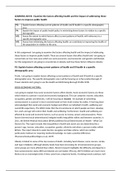
PROBLEM 1
Learning objective:
1. When can a state be held responsible, under international law, for an internationally wrongful act?
a. Act/omission
b. Attribution to a state
c. Breach of an international obligation
Literature:
- Jan Klabbers, ‘International Law’, Chapter 7 + Chapter 5 (p. 113-114)
- E-lessons: 8 + 9
- James Crawford, ‘State Responsibility’
- Genocide-case
- Nicaragua-case
- Teheran Hostages-case
- Tadic-case (1999)
1 WHEN CAN A STATE BE HELD RESPONSIBLE, UNDER INTERNATIONAL LAW, FOR
AN INTERNATIONALLY WRONGFUL ACT?
Introduction
‘Responsibility’ is the term used by international lawyers to denote the idea that some entity can be
blamed for undesirable behavior.
- The main form: the responsibility of states.
- In principle, all subjects of international law can be held responsible for their behavior, not just
states, but also international organizations, liberation movements and even NGOs.
o But: specific responsibility regimes have only been developed with respect to states,
international organizations, and individuals, and even then, much of the law is rather
sketchy and incipient.
o To some extent, the gap is being filled by speaking of accountability (instead of
responsibility) of companies and NGOs, in addition to corporate social responsibility.
As a terminological matter, responsibility is usually (but not always) distinguished from liability and
accountability.
- Liability (aansprakelijkheid) usually denotes the existence of a financial obligation → someone is
liable to pay compensation
o Hence a finding of responsibility may come with a finding of liability (X is responsible for
wrongdoing, and thus liable to pay compensation)
- Accountability (verantwoordelijkheid) is the broadest of the terms, and in its more sophisticated
versions may signify the existence of a relationship whereby someone is held to explain and
justify their behavior to someone else.
A breach by a state of such a substantive legal obligation triggers the law of state responsibility. The
rules on state responsibility, which are an example of a set of secondary rules, are concerned with:
- Whether there has been a breach of an international obligation
- Attribution
- Defenses, and
- The legal consequences of a breach
1
PROBLEM 1
Learning objective:
1. When can a state be held responsible, under international law, for an internationally wrongful act?
a. Act/omission
b. Attribution to a state
c. Breach of an international obligation
Literature:
- Jan Klabbers, ‘International Law’, Chapter 7 + Chapter 5 (p. 113-114)
- E-lessons: 8 + 9
- James Crawford, ‘State Responsibility’
- Genocide-case
- Nicaragua-case
- Teheran Hostages-case
- Tadic-case (1999)
1 WHEN CAN A STATE BE HELD RESPONSIBLE, UNDER INTERNATIONAL LAW, FOR
AN INTERNATIONALLY WRONGFUL ACT?
Introduction
‘Responsibility’ is the term used by international lawyers to denote the idea that some entity can be
blamed for undesirable behavior.
- The main form: the responsibility of states.
- In principle, all subjects of international law can be held responsible for their behavior, not just
states, but also international organizations, liberation movements and even NGOs.
o But: specific responsibility regimes have only been developed with respect to states,
international organizations, and individuals, and even then, much of the law is rather
sketchy and incipient.
o To some extent, the gap is being filled by speaking of accountability (instead of
responsibility) of companies and NGOs, in addition to corporate social responsibility.
As a terminological matter, responsibility is usually (but not always) distinguished from liability and
accountability.
- Liability (aansprakelijkheid) usually denotes the existence of a financial obligation → someone is
liable to pay compensation
o Hence a finding of responsibility may come with a finding of liability (X is responsible for
wrongdoing, and thus liable to pay compensation)
- Accountability (verantwoordelijkheid) is the broadest of the terms, and in its more sophisticated
versions may signify the existence of a relationship whereby someone is held to explain and
justify their behavior to someone else.
A breach by a state of such a substantive legal obligation triggers the law of state responsibility. The
rules on state responsibility, which are an example of a set of secondary rules, are concerned with:
- Whether there has been a breach of an international obligation
- Attribution
- Defenses, and
- The legal consequences of a breach
1