Advantages and Disadvantages
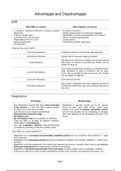
ADR
What ADR can achieve What Litigation can achieve
• A change in behaviour/methods to prevent unwanted • Prohibitory injunction;
behaviours; • Specific performance of a contractual obligation;
• Putting a mistake right; • Rectification of a document/rescission of a contract;
• A promise not to do something; • Return of property (land/goods);
• Repair/replacement of an item; • Compensation;
• Apology/explanation; • Declaration of parties’ legal rights.
• Compensation.
What are the costs of ADR?
Community Mediation Usually free (subject to travel/other disbursements)
Ombudsman Schemes Usually free to the person lodging complaint
Standard hourly rate (some mediators will accept reduced
Family Mediation fees based on financial circumstances). Parties may be
eligible for legal aid.
Total charge is determined according to complexity/value.
Fees calculated on basis of instruction fee per party,
Commercial Mediation
hourly rate, and additional fees (venue hire, etc.). Parties
may be eligible for legal aid.
Consumer Arbitration Some services are free.
May charge a registration fee and/or deposit (upwards of
Commercial Arbitration £2,000) plus daily/hourly fees, and additional fees (venue
hire, etc.).
Negotiation
Advantages Disadvantages
• Non-adjudicative process that gives client ownership • Negotiation is normally carried out by the lawyers
of the outcome — it is for the client to decide whether acting for each party, often without clients being
to settle and on what terms to settle; present. This gives the lawyers substantial control,
• Can take place at any stage of proceedings; but the fluid process can be challenging to manage,
• Removes risk of maverick judge; and much depends on the preparation and skill of the
• No litigation risk; lawyer.
• No uncertainty of trial such as failures of witnesses;
• Costs are likely to increase as litigation continues,
which leads to a shrinking pie;
• Can yield imaginative solutions (style/format/issues)
compared to potentially conservative judicial orders.
Why might you choose negotiation?
• Negotiation can be arranged and (potentially) completed quickly (even by comparison with mediation) — apply
this to the facts;
• Negotiation is an inexpensive process (at least as compared to litigation and probably mediation) — apply this to
the facts;
• Negotiation would be appropriate if the relationship between the parties is amicable; there would be no need for
third party involvement (which removes the incentive for mediation);
• Negotiation is structured around heads of loss and issues, so each problem can be considered in isolation;
• There are no rules as to conduct (except professional conduct rules, including not exceeding instructions, etc.).
Page 1
,Mediation
Advantages Disadvantages
• May be quicker than litigation (if successful) given the • There is no guarantee of an outcome;
time waiting for court listings; • Mediation costs money — if mediation is
• May be cheaper (if successful) because there are fewer unsuccessful then it is a loss;
parties to represent at court, etc.; • Risk-conscious parties may settle at mediation
• No litigation risk; when they should not necessarily have done so,
• Confidentiality, which can reduce the likelihood of leading to a lower award;
multiple claims/lessen the chance of loss of reputation; • Clients do not experience their ‘day in court’;
• Opportunities for clients to reach a creative solution/to • There is no public/formal consequences for parties
achieve outcomes that cannot be ordered by the court; who are in the wrong;
• Easier to maintain future relationships between the • Issues may not be clearly defined;
parties; • Parties may not have an accurate assessment of their
• Will not create an adverse precedent; own case;
• Settlement is facilitated in conducive environment — • There is not full disclosure requirements;
addition of new dynamic can work where negotiation • Parties are able to walk away;
failed; • Parties may believe it shows a weakness in case.
• Settlement is not necessarily determined by the
strength of legal cases;
• Informality — the environment is less stressful than
court and more beneficial for vulnerable persons;
• Voluntary, which can be advantageous;
• Less emotionally-charged/stressful process;
• Encourages parties to express themselves;
• Community mediation can widen access;
• Potentially less time constraints as parties could
walk away;
• You are able to select your mediator;
• Good for international disputes or where a party is
out of the jurisdiction;
• Can bring about early resolution in certain cases and
can, on occasions, identify common ground which
conventional negotiation does not reach.
• Can be held anywhere;
• Can be undertaken at any time in a case.
Why might you choose mediation?
• Mediation involves a neutral third party who facilitates discussions between the parties — apply this to the
facts;
• If there is a degree of hostility between the parties, it would be potentially advantageous for them to communicate
through a neutral third party;
• Mediation is a private and confidential process — apply this to the facts;
• Mediation often provides an opportunity for parties to maintain a future relationship — apply this to the facts;
• Mediation can be a quick process — apply this to the facts;
• At mediation, parties have ownership over the solution which is to be reached — apply this to the facts;
• Mediation is a cost-effective/cheaper process than litigation— apply this to the facts;
• At mediation, parties can choose a mediator, which can be of assistance, i.e., a mediator experienced in resolving
commercial disputes means that the parties could be assisted by someone sensitive to their needs — apply this to
the facts.
• The presence of the mediator adds a new dynamic to the pre-existing bilateral relationship, balancing different
negotiating styles/personalities, helping parties present their own case more effectively to the other side, and
adding an element of detachment into the negotiation process and avoids the need for direct confrontation:
• Proposals offered through a mediator can be perceived as being more attractive than an offer made by the party
directly.
• Parties are likely to be paying for the mediation, which generates an impetus to settle.
Page 2
, Arbitration
Advantages Disadvantages
• Flexibility with respect of the appointment of • Potentially additional costs if unsuccessful;
arbitrators and greater control over timings, etc.; • If there are multiple parties who each seek their own
• Arbitration is voluntary which gives the parties arbitrators then it can be costly;
flexibility on how to undertake the process (including • If one party is obstructive then there can be a delay;
language, venue, basis of decision, etc.); • There are a number of mandatory provisions in AA;
• The process is adjudicative; • You cannot appeal/challenge a decision unless you
• The process is private and/or confidential, which meet higher threshold than in litigation;
means that outcomes are not disclosed; • Arbitrators can be unqualified/inexperienced;
• Arbitration can be quicker than litigation/other forms • Arbitration is not available for public law cases;
of ADR; • Lack of precedents upon which arbitration can be
• Arbitration can be used for international disputes and enacted;
there is the opportunity to select beneficial jurisdiction; • There are few consequences for non-compliance;
• Less adversarial and hence more likely to maintain • There are no disclosure requirements;
working relations; • No powers for interim orders/summary procedures;
• Parties can be represented by anyone, legal • Arbitral tribunals usually lack power to add/
qualifications are not necessary; substitute a party to the proceeding without the
• Arbitrators can have specialist knowledge; consent of all the existing parties;
• Enforcement, particularly of international disputes, is • Arbitrators have no power to deal with third parties;
easier because of the New York Convention. • Without parties’ agreement, arbitral tribunal cannot
consolidate its arbitration with another to bring
before one tribunal related claims for determination.
Page 3
ADR
What ADR can achieve What Litigation can achieve
• A change in behaviour/methods to prevent unwanted • Prohibitory injunction;
behaviours; • Specific performance of a contractual obligation;
• Putting a mistake right; • Rectification of a document/rescission of a contract;
• A promise not to do something; • Return of property (land/goods);
• Repair/replacement of an item; • Compensation;
• Apology/explanation; • Declaration of parties’ legal rights.
• Compensation.
What are the costs of ADR?
Community Mediation Usually free (subject to travel/other disbursements)
Ombudsman Schemes Usually free to the person lodging complaint
Standard hourly rate (some mediators will accept reduced
Family Mediation fees based on financial circumstances). Parties may be
eligible for legal aid.
Total charge is determined according to complexity/value.
Fees calculated on basis of instruction fee per party,
Commercial Mediation
hourly rate, and additional fees (venue hire, etc.). Parties
may be eligible for legal aid.
Consumer Arbitration Some services are free.
May charge a registration fee and/or deposit (upwards of
Commercial Arbitration £2,000) plus daily/hourly fees, and additional fees (venue
hire, etc.).
Negotiation
Advantages Disadvantages
• Non-adjudicative process that gives client ownership • Negotiation is normally carried out by the lawyers
of the outcome — it is for the client to decide whether acting for each party, often without clients being
to settle and on what terms to settle; present. This gives the lawyers substantial control,
• Can take place at any stage of proceedings; but the fluid process can be challenging to manage,
• Removes risk of maverick judge; and much depends on the preparation and skill of the
• No litigation risk; lawyer.
• No uncertainty of trial such as failures of witnesses;
• Costs are likely to increase as litigation continues,
which leads to a shrinking pie;
• Can yield imaginative solutions (style/format/issues)
compared to potentially conservative judicial orders.
Why might you choose negotiation?
• Negotiation can be arranged and (potentially) completed quickly (even by comparison with mediation) — apply
this to the facts;
• Negotiation is an inexpensive process (at least as compared to litigation and probably mediation) — apply this to
the facts;
• Negotiation would be appropriate if the relationship between the parties is amicable; there would be no need for
third party involvement (which removes the incentive for mediation);
• Negotiation is structured around heads of loss and issues, so each problem can be considered in isolation;
• There are no rules as to conduct (except professional conduct rules, including not exceeding instructions, etc.).
Page 1
,Mediation
Advantages Disadvantages
• May be quicker than litigation (if successful) given the • There is no guarantee of an outcome;
time waiting for court listings; • Mediation costs money — if mediation is
• May be cheaper (if successful) because there are fewer unsuccessful then it is a loss;
parties to represent at court, etc.; • Risk-conscious parties may settle at mediation
• No litigation risk; when they should not necessarily have done so,
• Confidentiality, which can reduce the likelihood of leading to a lower award;
multiple claims/lessen the chance of loss of reputation; • Clients do not experience their ‘day in court’;
• Opportunities for clients to reach a creative solution/to • There is no public/formal consequences for parties
achieve outcomes that cannot be ordered by the court; who are in the wrong;
• Easier to maintain future relationships between the • Issues may not be clearly defined;
parties; • Parties may not have an accurate assessment of their
• Will not create an adverse precedent; own case;
• Settlement is facilitated in conducive environment — • There is not full disclosure requirements;
addition of new dynamic can work where negotiation • Parties are able to walk away;
failed; • Parties may believe it shows a weakness in case.
• Settlement is not necessarily determined by the
strength of legal cases;
• Informality — the environment is less stressful than
court and more beneficial for vulnerable persons;
• Voluntary, which can be advantageous;
• Less emotionally-charged/stressful process;
• Encourages parties to express themselves;
• Community mediation can widen access;
• Potentially less time constraints as parties could
walk away;
• You are able to select your mediator;
• Good for international disputes or where a party is
out of the jurisdiction;
• Can bring about early resolution in certain cases and
can, on occasions, identify common ground which
conventional negotiation does not reach.
• Can be held anywhere;
• Can be undertaken at any time in a case.
Why might you choose mediation?
• Mediation involves a neutral third party who facilitates discussions between the parties — apply this to the
facts;
• If there is a degree of hostility between the parties, it would be potentially advantageous for them to communicate
through a neutral third party;
• Mediation is a private and confidential process — apply this to the facts;
• Mediation often provides an opportunity for parties to maintain a future relationship — apply this to the facts;
• Mediation can be a quick process — apply this to the facts;
• At mediation, parties have ownership over the solution which is to be reached — apply this to the facts;
• Mediation is a cost-effective/cheaper process than litigation— apply this to the facts;
• At mediation, parties can choose a mediator, which can be of assistance, i.e., a mediator experienced in resolving
commercial disputes means that the parties could be assisted by someone sensitive to their needs — apply this to
the facts.
• The presence of the mediator adds a new dynamic to the pre-existing bilateral relationship, balancing different
negotiating styles/personalities, helping parties present their own case more effectively to the other side, and
adding an element of detachment into the negotiation process and avoids the need for direct confrontation:
• Proposals offered through a mediator can be perceived as being more attractive than an offer made by the party
directly.
• Parties are likely to be paying for the mediation, which generates an impetus to settle.
Page 2
, Arbitration
Advantages Disadvantages
• Flexibility with respect of the appointment of • Potentially additional costs if unsuccessful;
arbitrators and greater control over timings, etc.; • If there are multiple parties who each seek their own
• Arbitration is voluntary which gives the parties arbitrators then it can be costly;
flexibility on how to undertake the process (including • If one party is obstructive then there can be a delay;
language, venue, basis of decision, etc.); • There are a number of mandatory provisions in AA;
• The process is adjudicative; • You cannot appeal/challenge a decision unless you
• The process is private and/or confidential, which meet higher threshold than in litigation;
means that outcomes are not disclosed; • Arbitrators can be unqualified/inexperienced;
• Arbitration can be quicker than litigation/other forms • Arbitration is not available for public law cases;
of ADR; • Lack of precedents upon which arbitration can be
• Arbitration can be used for international disputes and enacted;
there is the opportunity to select beneficial jurisdiction; • There are few consequences for non-compliance;
• Less adversarial and hence more likely to maintain • There are no disclosure requirements;
working relations; • No powers for interim orders/summary procedures;
• Parties can be represented by anyone, legal • Arbitral tribunals usually lack power to add/
qualifications are not necessary; substitute a party to the proceeding without the
• Arbitrators can have specialist knowledge; consent of all the existing parties;
• Enforcement, particularly of international disputes, is • Arbitrators have no power to deal with third parties;
easier because of the New York Convention. • Without parties’ agreement, arbitral tribunal cannot
consolidate its arbitration with another to bring
before one tribunal related claims for determination.
Page 3