chemistry
Created @December 6, 2022 1:01 PM
Reviewed
Units/equations to remember
milli (10^-3) micro (10^-6) nano (10^-9) pico (10^-12)
C1V1 = C2V2
1 mole = 6x10^23 molecules
1 molar = 1M/L
% w/v = g/100ml
% v/v = ml/100ml
molar mass = mass of one mole of a substance gmol^-1 = relative atomic mass
relative molecular mass (Mr) = mass of a molecule of a substance compared
to 1/12th mass of 12C nuclide (no units)
molecular mass = mass of a molecule expressed in atomic mass units amu or
daltons Da
one dalton = 1/12th mass 12C atom
molecular weight = loose Mr, Mol mass
atoms, compounds and bonding
Recall the simple model of atomic structure in terms of protons, neutrons and
electrons.
rutherford bohr: protons (atomic, x10^-27kg) and neutrons (mass,
x10^-27kg) in nucleus ( small, +), electrons (x10^-31kg)in circular orbits
(quantised energy levels/shells, movement between absorbs/emits EM)
dalton > thomson > rutherford > bohr > quantum mechanical
Describe the shapes, arrangements and relative energies of s, p and d atomic
orbitals.
chemistry 1
, quantum mechanical = electrons confined within volumes of space
(orbitals) and these are grouped into shells
aufbau = orbitals filled from lowest energy/closest first, n+l
hunds = all empty similar (degenerate) orbitals filled with 1 first before
doubling
pauli exclusion = no more than 2 e in one orbital (opposite spin)
quantum state
1. principle (n) = shell, average distance from nucleus, 1(K),2(L),3(M),4(N)…
2. orbital (l) = orbital shape, 90% probability of electron, s(0, sphere, 1x), p(1,
dumbell, 3x), d(2, clover, 5x, only from n3), f(3)…n-1
3. magnetic (m) = orbital orientation, between +/- l
4. spin = direction in magnetic field, +/- 0.5
Predict the electron configuration of isolated atoms of the major elements
commonly found in biological molecules (H, C, N, O, P, S) and relate this to their
valence and reactivity.
H = 1s1
C = 1s2 2s2 2p2
N = 1s2 2s2 2p3
O = 1s2 2s2 2p4
P = 1s2 2s2 2p6 3s2 3p3
S = 1s2 2s2 2p6 3s2 3p4
valency = number of univalent (H/Cl) atoms that can combine to fill
valence (outer) shell = number of bonds + charge eg. CH4 C is 4 > H is 1,
O2, N3
full valence shell (highest occupied) = unreactive, only 1/2 valence
electrons = reactive
Understand the nature of ionic, covalent and dative covalent bonds, and lone
pairs of electrons, and depict these using Lewis dot symbols.
chemistry 2
, ionic = electron transferred from one to other
covalent = e pair shared between both
dative = e pair shared with both e from one
Outline how molecular orbitals are formed from atomic orbitals and distinguish
between bonding, anti-bonding and non-bonding orbitals.
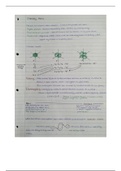
atomic orbitals eg. s,p merge = molecular orbitals sigma, pi
both + = constructive interference = bonding probability density s, low
energy, occupied first, more stable, overlap (electrons between nuclei),
allows covalent bond if more here than in anti
+ and - = destructive = antibonding s*, high energy, less stable, node
(bigger dip, electrons outside bonding overlap region), against covalent
bond eg. He
non bonding = lone pair
Describe the shapes of sigma and pi bonding orbitals and their contribution to
single, double and triple covalent bonds.
head on overlap = sigma = peanut shape, strong, hybridised
p + p lateral overlap = pi, top and bottom, must be with sigma,
unhybridised orbitals, weaker
single bond = sigma
double bond = sigma + pi (no rotation)
triple bond = sigma + 2pi
Explain the terms: aromatic compound, electron delocalization, conjugated
bond, resonance hybrid.
aromatic = conjugated ring with stronger stabilisation than from
conjugation alone, huckels - planar ring with 4n+2 pi (double) electrons,
non - aliphatic, absorbance in eg. tryptophan allows UV-vis/fluorescence
spectroscopy
delocalisation = electron not fixed in place in pi bond > stability
chemistry 3
, conjugated bond = alternating single and double bonds > generalised
delocalisation across pi orbitals > stable, lower energy
resonance = stable, lower energy hybrid of different possible lewis
structures (positions of double bond)
hybridisation = different orbitals combine to give ones with equal energy
eg. sp, sp2, more s character/% = more stable
degree unsat = number rings + number pi
Define the term “electronegativity”, describe electronegativity trends in the
periodic table, and use electronegativity values to predict whether ionic or
covalent bonding will occur between two atoms.
tendency of an atom to attract electrons, inc towards top right (radius dec
and ionisation energy inc), O>N>C
if difference <0.7 = covalent, if >1.7 = ionic
molecular shape, forces, non covalent interaction
Explain the structure and shape of some simple molecules (CO2, CH4 and
NH4+, NH3, H2O) in terms of VSEPR theory and atomic orbital bonding.
structure determined by bond length, angle and rotation
rotation restricted when there is a pi bond
valence shell pairs repel, position with furthest distance between, LP>BP,
ignore pi
linear = 180 = CO2, HCN = sp
trigonal planar = 120 = C2H4 (also radical c) = sp2
angular (LP) = <180 = O3 = sp2
tetrahedral = 109.5 = CH4, NH4+ = sp3
trigonal pyrimidal (LP) = 106.6 = NH3 = sp3
angular (2LP) = 104.5 = H2O = sp3
trigonal bipyrimidal = 120/90 = PF5 = sp3d
octahedral = 90 = SF6 = sp3d2
chemistry 4
Created @December 6, 2022 1:01 PM
Reviewed
Units/equations to remember
milli (10^-3) micro (10^-6) nano (10^-9) pico (10^-12)
C1V1 = C2V2
1 mole = 6x10^23 molecules
1 molar = 1M/L
% w/v = g/100ml
% v/v = ml/100ml
molar mass = mass of one mole of a substance gmol^-1 = relative atomic mass
relative molecular mass (Mr) = mass of a molecule of a substance compared
to 1/12th mass of 12C nuclide (no units)
molecular mass = mass of a molecule expressed in atomic mass units amu or
daltons Da
one dalton = 1/12th mass 12C atom
molecular weight = loose Mr, Mol mass
atoms, compounds and bonding
Recall the simple model of atomic structure in terms of protons, neutrons and
electrons.
rutherford bohr: protons (atomic, x10^-27kg) and neutrons (mass,
x10^-27kg) in nucleus ( small, +), electrons (x10^-31kg)in circular orbits
(quantised energy levels/shells, movement between absorbs/emits EM)
dalton > thomson > rutherford > bohr > quantum mechanical
Describe the shapes, arrangements and relative energies of s, p and d atomic
orbitals.
chemistry 1
, quantum mechanical = electrons confined within volumes of space
(orbitals) and these are grouped into shells
aufbau = orbitals filled from lowest energy/closest first, n+l
hunds = all empty similar (degenerate) orbitals filled with 1 first before
doubling
pauli exclusion = no more than 2 e in one orbital (opposite spin)
quantum state
1. principle (n) = shell, average distance from nucleus, 1(K),2(L),3(M),4(N)…
2. orbital (l) = orbital shape, 90% probability of electron, s(0, sphere, 1x), p(1,
dumbell, 3x), d(2, clover, 5x, only from n3), f(3)…n-1
3. magnetic (m) = orbital orientation, between +/- l
4. spin = direction in magnetic field, +/- 0.5
Predict the electron configuration of isolated atoms of the major elements
commonly found in biological molecules (H, C, N, O, P, S) and relate this to their
valence and reactivity.
H = 1s1
C = 1s2 2s2 2p2
N = 1s2 2s2 2p3
O = 1s2 2s2 2p4
P = 1s2 2s2 2p6 3s2 3p3
S = 1s2 2s2 2p6 3s2 3p4
valency = number of univalent (H/Cl) atoms that can combine to fill
valence (outer) shell = number of bonds + charge eg. CH4 C is 4 > H is 1,
O2, N3
full valence shell (highest occupied) = unreactive, only 1/2 valence
electrons = reactive
Understand the nature of ionic, covalent and dative covalent bonds, and lone
pairs of electrons, and depict these using Lewis dot symbols.
chemistry 2
, ionic = electron transferred from one to other
covalent = e pair shared between both
dative = e pair shared with both e from one
Outline how molecular orbitals are formed from atomic orbitals and distinguish
between bonding, anti-bonding and non-bonding orbitals.
atomic orbitals eg. s,p merge = molecular orbitals sigma, pi
both + = constructive interference = bonding probability density s, low
energy, occupied first, more stable, overlap (electrons between nuclei),
allows covalent bond if more here than in anti
+ and - = destructive = antibonding s*, high energy, less stable, node
(bigger dip, electrons outside bonding overlap region), against covalent
bond eg. He
non bonding = lone pair
Describe the shapes of sigma and pi bonding orbitals and their contribution to
single, double and triple covalent bonds.
head on overlap = sigma = peanut shape, strong, hybridised
p + p lateral overlap = pi, top and bottom, must be with sigma,
unhybridised orbitals, weaker
single bond = sigma
double bond = sigma + pi (no rotation)
triple bond = sigma + 2pi
Explain the terms: aromatic compound, electron delocalization, conjugated
bond, resonance hybrid.
aromatic = conjugated ring with stronger stabilisation than from
conjugation alone, huckels - planar ring with 4n+2 pi (double) electrons,
non - aliphatic, absorbance in eg. tryptophan allows UV-vis/fluorescence
spectroscopy
delocalisation = electron not fixed in place in pi bond > stability
chemistry 3
, conjugated bond = alternating single and double bonds > generalised
delocalisation across pi orbitals > stable, lower energy
resonance = stable, lower energy hybrid of different possible lewis
structures (positions of double bond)
hybridisation = different orbitals combine to give ones with equal energy
eg. sp, sp2, more s character/% = more stable
degree unsat = number rings + number pi
Define the term “electronegativity”, describe electronegativity trends in the
periodic table, and use electronegativity values to predict whether ionic or
covalent bonding will occur between two atoms.
tendency of an atom to attract electrons, inc towards top right (radius dec
and ionisation energy inc), O>N>C
if difference <0.7 = covalent, if >1.7 = ionic
molecular shape, forces, non covalent interaction
Explain the structure and shape of some simple molecules (CO2, CH4 and
NH4+, NH3, H2O) in terms of VSEPR theory and atomic orbital bonding.
structure determined by bond length, angle and rotation
rotation restricted when there is a pi bond
valence shell pairs repel, position with furthest distance between, LP>BP,
ignore pi
linear = 180 = CO2, HCN = sp
trigonal planar = 120 = C2H4 (also radical c) = sp2
angular (LP) = <180 = O3 = sp2
tetrahedral = 109.5 = CH4, NH4+ = sp3
trigonal pyrimidal (LP) = 106.6 = NH3 = sp3
angular (2LP) = 104.5 = H2O = sp3
trigonal bipyrimidal = 120/90 = PF5 = sp3d
octahedral = 90 = SF6 = sp3d2
chemistry 4